Swiss Tropical and Public Health Institute, Kreuzstrasse 2, 4123, Allschwil, Switzerland.
University of Basel, Petersplatz 1, 4001, Basel, Switzerland.
Malar J. 2024 Aug 23;23(1):252. doi: 10.1186/s12936-024-05053-3.
Indoor residual spraying (IRS) is one of the most effective malaria control tools. However, its application has become limited to specific contexts due to the increased costs of IRS products and implementation programmes. Selective spraying-selective spray targeted to particular areas/surfaces of dwellings-has been proposed to maintain the malaria control and resistance-management benefits of IRS while decreasing the costs of the intervention.
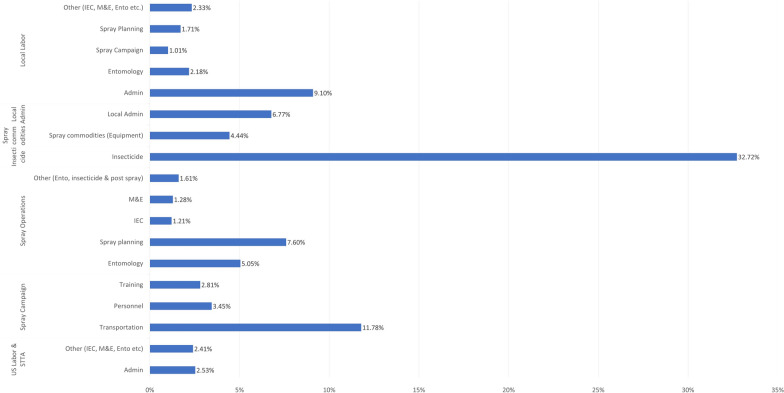
A literature search was conducted to find (1) studies that assessed the resting behaviour of Anopheles mosquitoes and (2) studies that evaluated the impact of selective spraying on entomological and malaria outcomes. Additional articles were identified through hand searches of all references cited in articles identified through the initial search. A cost model was developed from PMI VectorLink IRS country programmes, and comparative cost analysis reports to describe the overall cost benefits of selective IRS.
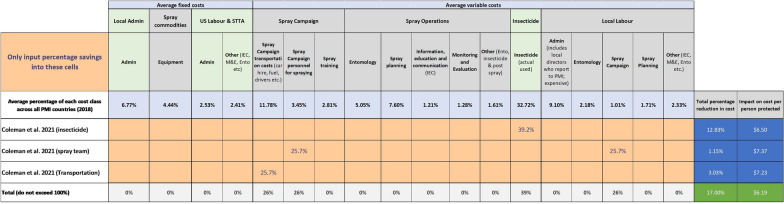
In some studies, there appeared to be a clear resting preference for certain Anopheles species in terms of the height at which they rested. However, for other species, and particularly the major African malaria vectors, a clear resting pattern was not detected. Furthermore, resting behaviour was not measured in a standardized way. For the selective spray studies that were assessed, there was a wide range of spray configurations, which complicates the comparison of methods. Many of these spray techniques were effective and resulted in reported 25-68% cost savings and reduced use of insecticide. The reported cost savings in the literature do not always consider all of the IRS implementation costs. Using the IRS cost model, these savings ranged from 17 to 29% for programs that targeted Anopheles spp. and 18-41% for programmes that targeted Aedes aegypti.
Resting behaviour is generally measured in a simplistic way; noting the resting spot of mosquitoes in the morning. This is likely an oversimplification, and there is a need for better monitoring of resting mosquitoes. This may improve the target surface for selective spray techniques, which could reduce the cost of IRS while maintaining its effectiveness. Reporting of cost savings should be calculated considering the entire implementation costs, and a cost model was provided for future calculations.
室内滞留喷洒(IRS)是最有效的疟疾控制工具之一。然而,由于 IRS 产品和实施计划的成本增加,其应用已仅限于特定环境。选择性喷洒——针对住宅特定区域/表面的选择性喷洒——已被提议在降低干预成本的同时保持 IRS 的疟疾控制和抗药性管理效益。
进行了文献检索,以查找(1)评估按蚊休息行为的研究,以及(2)评估选择性喷洒对昆虫学和疟疾结果影响的研究。通过对通过初始搜索确定的文章的所有引用的手动搜索,确定了其他文章。从 PMI VectorLink IRS 国家规划和比较成本分析报告中开发了一个成本模型,以描述选择性 IRS 的总体成本效益。
在一些研究中,某些按蚊物种似乎在休息时明显偏爱一定的高度。然而,对于其他物种,特别是主要的非洲疟疾媒介,并没有检测到明显的休息模式。此外,休息行为没有以标准化的方式进行测量。对于评估的选择性喷雾研究,喷雾配置范围很广,这使得方法比较变得复杂。许多这些喷雾技术是有效的,并且导致报告的 25-68%的成本节约和减少杀虫剂的使用。文献中报告的成本节约并不总是考虑到所有 IRS 实施成本。使用 IRS 成本模型,针对按蚊 spp. 的方案的节约成本从 17%到 29%不等,针对埃及伊蚊的方案的节约成本从 18%到 41%不等。
休息行为通常以简单的方式进行测量;注意到早上蚊子的休息点。这可能过于简单化,需要更好地监测休息中的蚊子。这可能会改善选择性喷雾技术的目标表面,从而降低 IRS 的成本,同时保持其有效性。成本节约的报告应考虑到整个实施成本进行计算,并提供了一个成本模型以供将来计算。