Istanbul University, Faculty of Pharmacy, Department of Pharmaceutical Technology, Turkey; Trakya University, Faculty of Pharmacy, Department of Pharmaceutical Technology, Turkey.
Istanbul University, Faculty of Pharmacy, Department of Pharmaceutical Technology, Turkey.
J Pharm Sci. 2022 Oct;111(10):2652-2661. doi: 10.1016/j.xphs.2022.06.004. Epub 2022 Jun 9.
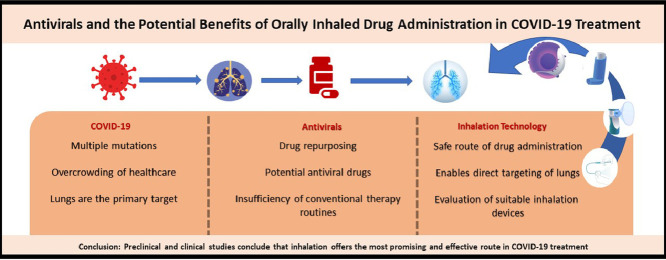
Coronavirus Disease 2019 (COVID-19) pandemic has been on the agenda of humanity for more than 2 years. In the meantime, the pandemic has caused economic shutdowns, halt of daily lives and global mobility, overcrowding of the healthcare systems, panic, and worse, more than 6 million deaths. Today, there is still no specific therapy for COVID-19. Research focuses on repurposing of antiviral drugs that are licensed or currently in the research phase, with a known systemic safety profile. However, local safety profile should also be evaluated depending on the new indication, administration route and dosage form. Additionally, various vaccines have been developed. But the causative virus, Severe Acute Respiratory Syndrome Coronavirus-2 (SARS-CoV-2), has undergone multiple variations, too. The premise that vaccines may suffice to eradicate new and all variants is unreliable, as they are based on earlier versions of the virus. Therefore, a specific medication therapy for COVID-19 is crucial and needed in order to prevent severe complications of the disease. Even though there is no specific drug that inhibits the replication of the disease-causing virus, among the current treatment options, systemic antivirals are the most medically appropriate. As SARS-CoV-2 directly targets the lungs and initiates lung damage, treating COVID-19 with inhalants can offer many advantages over the enteral/parenteral administration. Inhaled drug delivery provides higher drug concentration, specifically in the pulmonary system. This enables the reduction of systemic side effects and produces a rapid clinical response. In this article, the most frequently (systemically) used antiviral compounds are reviewed including Remdesivir, Favipiravir, Molnupiravir, Lopinavir-Ritonavir, Umifenovir, Chloroquine, Hydroxychloroquine and Heparin. A comprehensive literature search was conducted to provide insight into the potential inhaled use of these antiviral drugs and the current studies on inhalation therapy for COVID-19 was presented. A brief evaluation was also made on the use of inhaler devices in the treatment of COVID-19. Inhaled antivirals paired with suitable inhaler devices should be considered for COVID-19 treatment options.
新型冠状病毒病(COVID-19)大流行已经成为人类议程上的一个议题超过 2 年了。在此期间,大流行导致了经济停摆、日常生活和全球流动性停止、医疗系统拥挤、恐慌,更糟糕的是,超过 600 万人死亡。目前,仍然没有针对 COVID-19 的特定疗法。研究集中在重新利用已获得许可或目前处于研究阶段的抗病毒药物,这些药物具有已知的系统安全性。然而,还应根据新的适应症、给药途径和剂型评估局部安全性。此外,已经开发了各种疫苗。但是,致病病毒严重急性呼吸系统综合征冠状病毒 2 型(SARS-CoV-2)也经历了多次变异。疫苗可能足以消除新的和所有变体的前提是不可靠的,因为它们是基于病毒的早期版本。因此,为了预防疾病的严重并发症,针对 COVID-19 的特定药物治疗至关重要。尽管没有抑制致病病毒复制的特定药物,但在当前的治疗选择中,全身性抗病毒药物是最合理的。由于 SARS-CoV-2 直接靶向肺部并引发肺部损伤,因此用吸入剂治疗 COVID-19相对于肠内/肠胃外给药具有许多优势。吸入药物输送可提供更高的药物浓度,特别是在肺部系统中。这可以减少全身副作用并产生快速的临床反应。在本文中,回顾了最常(全身)使用的抗病毒化合物,包括瑞德西韦、法匹拉韦、莫努匹韦、洛匹那韦/利托那韦、乌米福韦、氯喹、羟氯喹和肝素。进行了全面的文献检索,以深入了解这些抗病毒药物的潜在吸入用途以及 COVID-19 的吸入治疗的当前研究。还简要评估了吸入器设备在 COVID-19 治疗中的使用。吸入性抗病毒药物与合适的吸入器设备联合使用,应考虑作为 COVID-19 的治疗选择。