Laboratory of Epidemiology and Population Sciences, NIA/NIH/IRP, 251 Bayview Blvd., Suite 100, Room #: 04B118, Baltimore, MD, 21224, USA.
Department of Demography, University of California, Berkeley, Berkeley, CA, USA.
BMC Med. 2022 Jun 13;20(1):218. doi: 10.1186/s12916-022-02425-x.
Neurofilament light chain (NfL) is released into the blood during neuronal damage. NfL is linked to mortality in neurological disorders, remaining unexplored in population studies. We investigated whether initial (v) and annualized change (δ) in plasma NfL can predict all-cause mortality in middle-aged dementia-free urban adults.
Longitudinal data were from 694 participants in the Healthy Aging in Neighborhoods of Diversity Across the Life Span study (HANDLS, mean age: 47.8 years, 42% male, 55.8% African American). Plasma NfL was measured prospectively at three visits. Analyses included Cox proportional hazards models for all-cause mortality risk and 4-way decomposition testing for interaction and mediation.
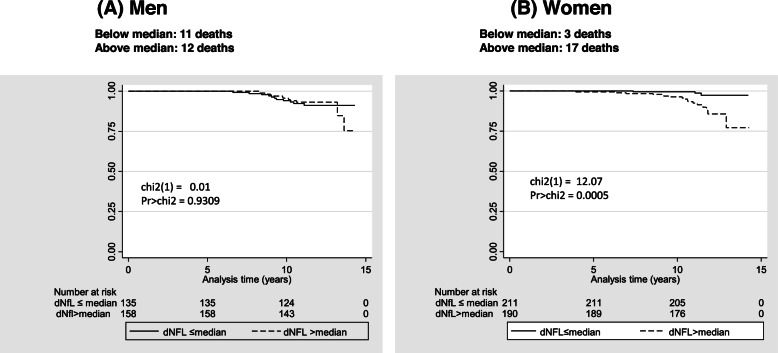
Unlike men, women exhibited a direct association between δNfL (above vs. below median) and all-cause mortality risk in both the minimally (HR = 3.91, 95% CI 1.10-13.9, p = 0.036) and fully adjusted models (HR = 4.92, 95% CI 1.26-19.2, p = 0.022), and for δNfL (per unit increase) in the full model (HR = 1.65, 95% CI 1.04-2.61, p = 0.034). In both models, and among women, 1 standard deviation of NfL was associated with an increased all-cause mortality risk (reduced model: HR = 2.01, 95% CI 1.24-3.25, p = 0.005; full model: HR = 1.75, 95% CI 1.02-2.98, p = 0.041). Only few interactions were detected for cardio-metabolic risk factors. Notably, NfL was shown to be a better prognostic indicator at normal hsCRP values among women, while HbA1c and δNfL interacted synergistically to determine mortality risk, overall.
These findings indicate that plasma NfL levels at baseline and over time can predict all-cause mortality in women and interacts with hsCRP and HbA1c to predict that risk.
神经丝轻链(NfL)在神经元损伤时释放到血液中。NfL与神经疾病的死亡率有关,但在人群研究中尚未得到探索。我们研究了在无痴呆的中年城市成年人中,初始(v)和年度变化(δ)血浆 NfL 是否可以预测全因死亡率。
来自多样性跨越生命跨度的邻里健康老龄化研究(HANDLS)的 694 名参与者的纵向数据(平均年龄:47.8 岁,42%为男性,55.8%为非裔美国人)。前瞻性地在三次就诊时测量血浆 NfL。分析包括全因死亡率风险的 Cox 比例风险模型和 4 路分解测试以检验交互作用和中介作用。
与男性不同,女性在最小调整(HR=3.91,95%CI 1.10-13.9,p=0.036)和完全调整模型(HR=4.92,95%CI 1.26-19.2,p=0.022)中,以及在完全模型中(HR=1.65,95%CI 1.04-2.61,p=0.034),均显示出 δNfL(高于 vs. 低于中位数)与全因死亡率风险之间存在直接关联。在这两种模型中,以及在女性中,NfL 的一个标准差与全因死亡率风险增加相关(简化模型:HR=2.01,95%CI 1.24-3.25,p=0.005;完全模型:HR=1.75,95%CI 1.02-2.98,p=0.041)。仅检测到少数与心血管代谢危险因素的相互作用。值得注意的是,在女性中,NfL 在正常 hsCRP 值时显示出更好的预后指标,而 HbA1c 和 δNfL 协同作用来确定总体死亡率风险。
这些发现表明,基线时和随时间变化的血浆 NfL 水平可以预测女性的全因死亡率,并与 hsCRP 和 HbA1c 相互作用来预测该风险。