Menzies Health Institute of Queensland, Griffith University, Southport, QLD, Australia.
School of Health Sciences and Social Work, Griffith University, Gold Coast Campus, Southport, QLD, Australia.
Nutr Diet. 2022 Sep;79(4):469-480. doi: 10.1111/1747-0080.12742. Epub 2022 Jun 12.
Effective quality improvement strategies are essential to enhancing outcomes of dietetic care. Interventions informed by complex adaptive systems theory have demonstrated effectiveness in other healthcare settings. This study aimed to explore primary care dietetics practice using complex adaptive systems theory and to identify factors that individuals across the healthcare system can examine and address to improve the quality of dietetic care.
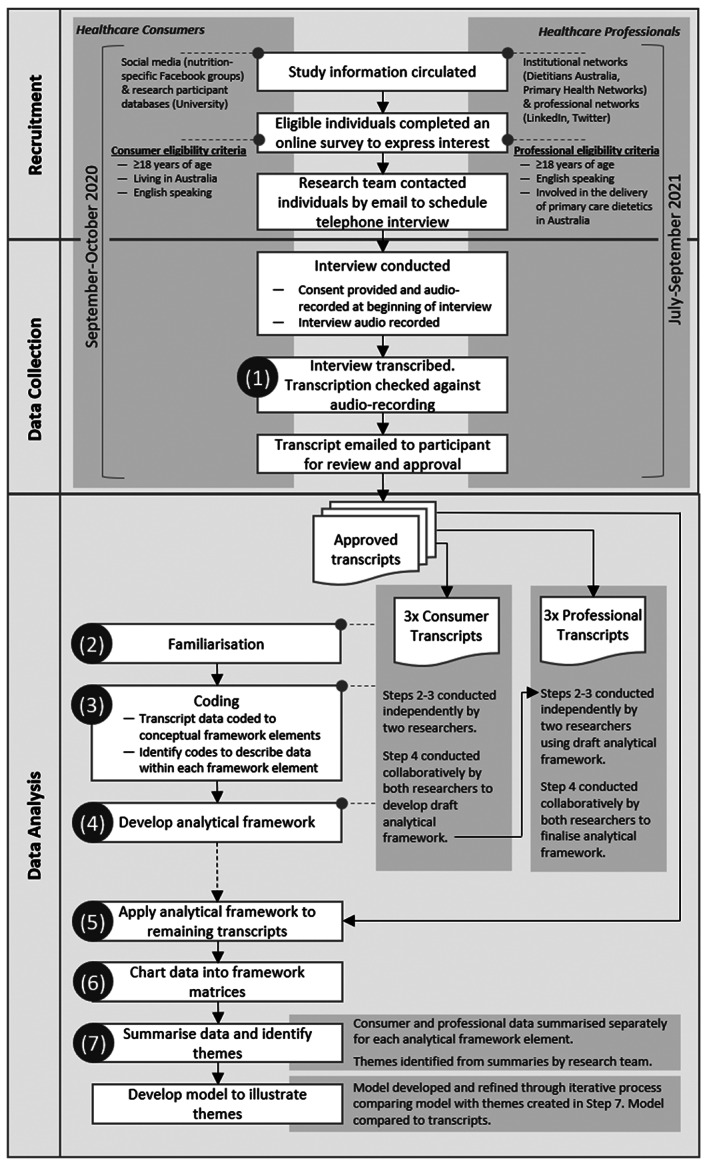
Qualitative analysis of semi-structured interviews of healthcare consumers and professionals involved in the provision of dietetic care. Data collection and analysis was guided by a complexity-informed conceptual framework. The Framework Method was used to code transcripts and identify themes describing primary care dietetics.
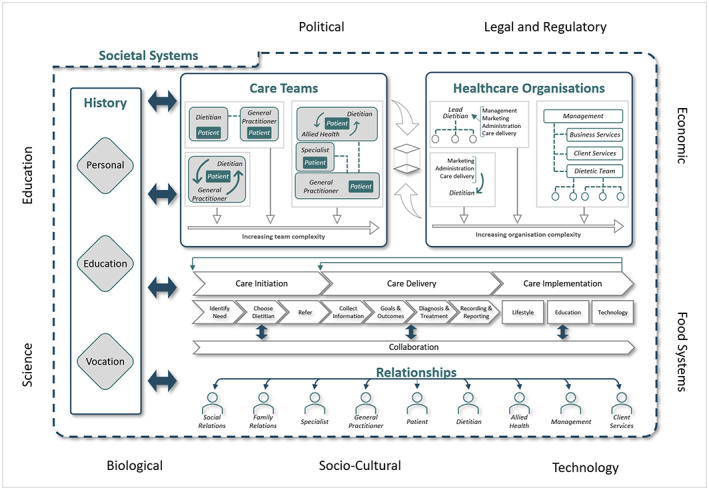
Twenty-three consumers and 26 primary care professionals participated. Participants described dietetic care as being delivered by individuals organised into formal and informal systems that were influenced by the wider environment, including legal, economic, and socio-cultural systems. Dietitians described interactions with consumers as a learning opportunity and sought education, mentoring, or supervision to address knowledge and skill gaps. Relationships underpinned transfer of information between individuals.
Complex adaptive systems theory proved to be a useful conceptual framework for primary care dietetics. Factors identified at the macro (e.g., funding), meso (e.g., professional networks), and micro (e.g., consumer education) levels should be examined and addressed to improve the quality of dietetic care.
有效的质量改进策略对于提高饮食护理的效果至关重要。基于复杂适应系统理论的干预措施在其他医疗保健环境中已被证明是有效的。本研究旨在使用复杂适应系统理论探索初级保健营养学实践,并确定医疗保健系统中的个体可以检查和解决哪些因素,以提高饮食护理的质量。
对参与提供饮食护理的医疗保健消费者和专业人员进行半结构化访谈的定性分析。数据收集和分析以复杂性知情的概念框架为指导。采用框架方法对转录本进行编码,并确定描述初级保健营养学的主题。
23 名消费者和 26 名初级保健专业人员参与了研究。参与者将饮食护理描述为由个人组成的正式和非正式系统提供的服务,这些系统受到包括法律、经济和社会文化系统在内的更广泛环境的影响。营养师将与消费者的互动描述为一个学习机会,并寻求教育、指导或监督来解决知识和技能差距。关系是个体之间信息传递的基础。
复杂适应系统理论被证明是初级保健营养学的有用概念框架。应检查和解决宏观(例如,资金)、中观(例如,专业网络)和微观(例如,消费者教育)层面的因素,以提高饮食护理的质量。