Manzoli Tatiane Miranda, Zaniboni Joissi Ferrari, Besegato João Felipe, Guiotti Flávia Angélica, Dantas Andréa Abi Rached, Kuga Milton Carlos
Department of Restorative Dentistry, School of Dentistry, Araraquara, São Paulo State University - UNESP, Araraquara, SP, Brazil.
Restor Dent Endod. 2022 Apr 6;47(2):e21. doi: 10.5395/rde.2022.47.e21. eCollection 2022 May.
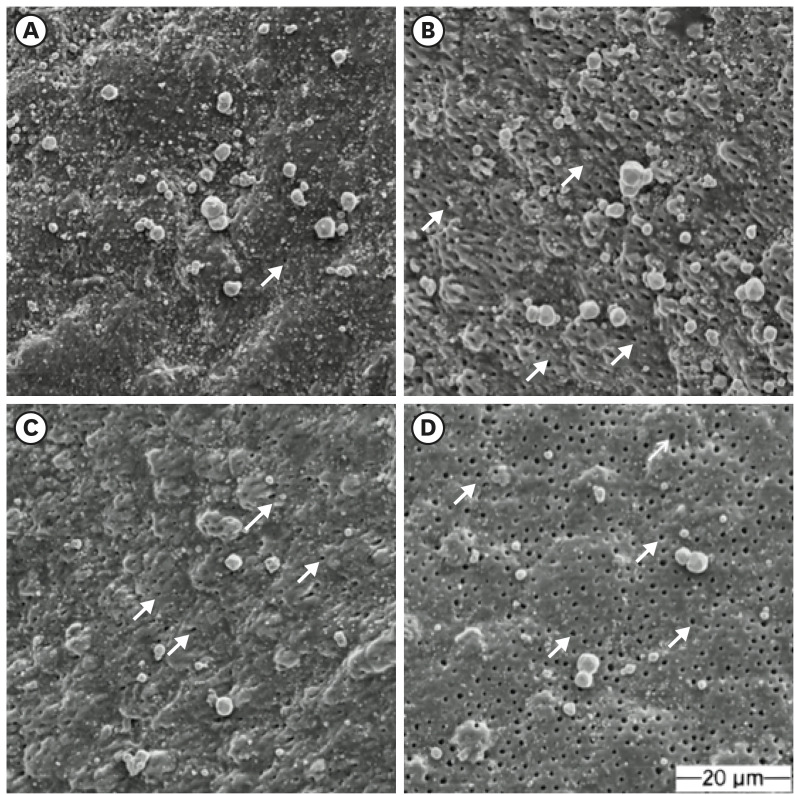
This study aimed to investigate the bonding effects of cleaning protocols on dentin impregnated with endodontic sealer residues using ethanol (E) or xylol (X). The effects of dentin acid etching immediately (I) or 7 days (P) after cleaning were also evaluated. For bonding to dentin, universal adhesive (Scotchbond Universal; 3M ESPE) was used. The persistence of sealer residues, hybrid layer formation and microshear bond strength were the performed analysis.
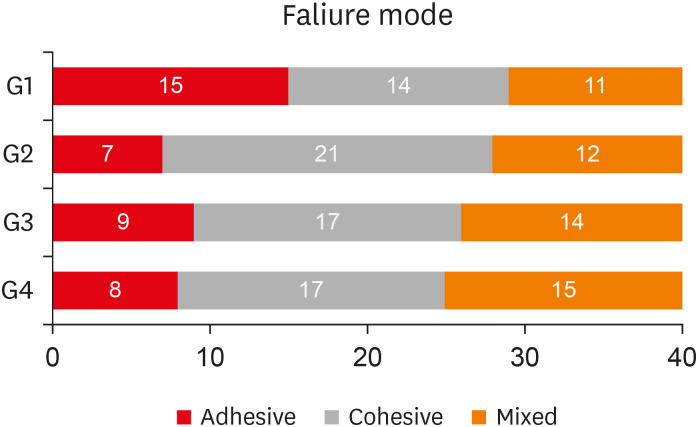
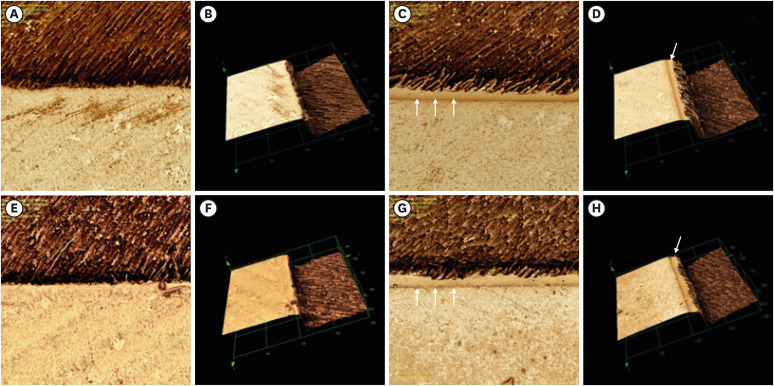
One hundred and twenty bovine dentin specimens were allocated into 4 groups ( = 10): G1 (E+I); G2 (X+I); G3 (E+P); and G4 (X+P). The persistence of sealer residues was evaluated by SEM. Confocal laser scanning microscopy images were taken to measure the formed hybrid layer using the Image J program. For microshear bond strength, 4 resin composite cylinders were placed over the dentin after the cleaning protocols. ANOVA followed by Tukey test and Kruskal-Wallis followed by Dunn test were used for parametric and non-parametric data, respectively (α = 5%).
G2 and G4 groups showed a lower persistence of residues ( < 0.05) and thicker hybrid layer than the other groups ( < 0.05). No bond strength differences among all groups were observed ( > 0.05).
Dentin cleaning using xylol, regardless of the time-point of acid etching, provided lower persistence of residues over the surface and thicker hybrid layer. However, the bond strength of the universal adhesive system in etch-and-rinse strategy was not influenced by the cleaning protocols or time-point of acid etching.
本研究旨在调查使用乙醇(E)或二甲苯(X)的清洁方案对浸渍有根管封闭剂残留物的牙本质的粘结效果。还评估了清洁后立即(I)或7天(P)进行牙本质酸蚀的效果。对于与牙本质的粘结,使用通用粘结剂(Scotchbond Universal;3M ESPE)。进行了封闭剂残留物的持久性、混合层形成和微剪切粘结强度分析。
将120个牛牙本质标本分为4组(每组n = 30):G1(E + I);G2(X + I);G3(E + P);和G4(X + P)。通过扫描电子显微镜评估封闭剂残留物的持久性。使用Image J程序拍摄共聚焦激光扫描显微镜图像以测量形成的混合层。对于微剪切粘结强度,在清洁方案后将4个树脂复合材料圆柱体放置在牙本质上。分别对参数数据和非参数数据使用方差分析后进行Tukey检验以及Kruskal-Wallis检验后进行Dunn检验(α = 5%)。
G2组和G4组显示出比其他组更低的残留物持久性(P < 0.05)和更厚的混合层(P < 0.05)。在所有组之间未观察到粘结强度差异(P > 0.05)。
无论酸蚀时间点如何,使用二甲苯进行牙本质清洁可使表面残留物的持久性更低且混合层更厚。然而,通用粘结剂系统在酸蚀冲洗策略中的粘结强度不受清洁方案或酸蚀时间点的影响。