Witten/Herdecke University, Chair of Medical Theory, Integrative and Anthroposophic Medicine, Herdecke, Germany.
Johannes Gutenberg University, Mainz University Medical Center, Department of Child and Adolescent Psychiatry and Psychotherapy, Mainz, Germany.
GMS J Med Educ. 2022 Apr 14;39(2):Doc25. doi: 10.3205/zma001546. eCollection 2022.
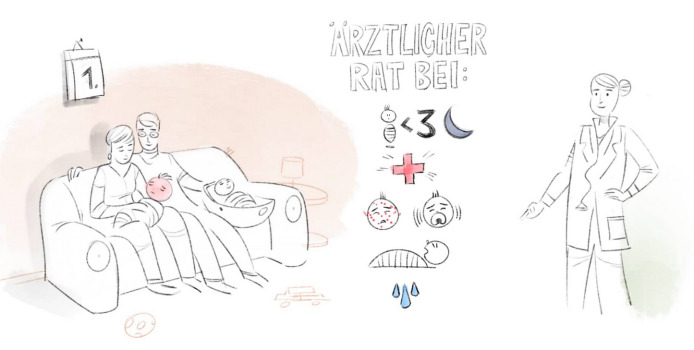
Although infantile fever is harmless in most cases, many parents feel insecure when having to deal with it because important information is often missing. For educational purposes, an information video on fever in children was developed, which is also intended to serve as an onboarding element of a health app. The aim of the present work was to record the attitude of parents and adults on the topic of fever before and after the presentation of the information video, as well as its evaluation.
Between May and November 2020, a total of 123 adults from three groups with different backgrounds (students, parents and educators) were interviewed using a questionnaire that was completed before and after the one-time presentation of an educational information video clip.
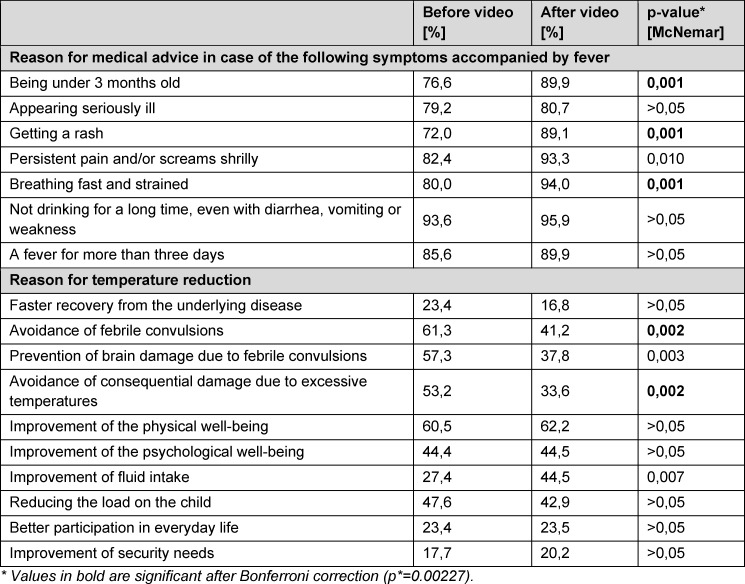
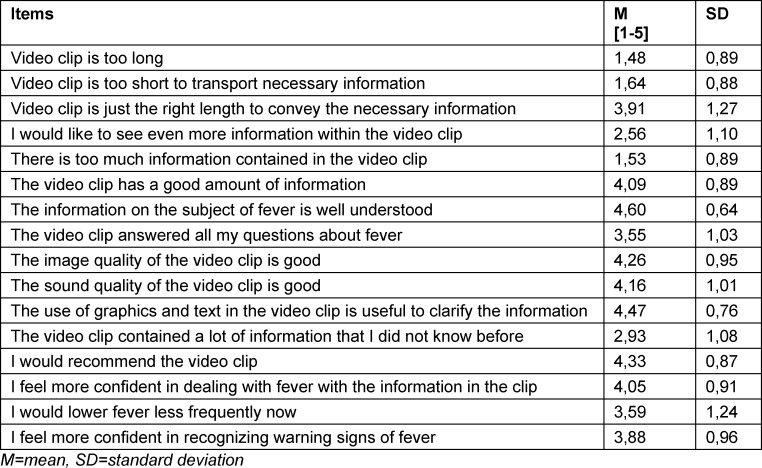
Several significant outcomes were recorded in attitude change toward managing fever, with no significant difference between groups. After viewing the informational video clip, 74% of participants would take body temperature rectally more often. In the after-questionnaire, 83% of participants agreed that they would now be more cautious about using fever-reducing medications. Before the video clip, 75% of the participants thought fever was "rather useful"; after, 93%. The level of temperature played a minor role as a reason for fever reduction. The information content and quality of the video were rated positively.
This study shows that a short information video is capable of bringing about a subjectively perceived intentional change in the attitude to dealing with fever, motivating a change in behavior, and reducing uncertainty in dealing with fever. Since the change in attitude was measured immediately after viewing the video clip, no statement can be made about the medium to long-term effect.
The information video clip can be classified as a short-term fever education tool for which at least short-term effective is demonstrated. Long-term and possible synergistic effects when integrated into a health app with further information still needs to be investigated.
尽管婴儿发热在多数情况下是无害的,但许多父母在处理发热问题时会感到不安,因为他们经常缺乏重要信息。为了教育目的,我们制作了一个关于儿童发热的信息视频,该视频也旨在作为健康应用程序的入门元素。本研究旨在记录家长和成人在观看信息视频前后对发热主题的态度,并对其进行评估。
2020 年 5 月至 11 月,我们对三组具有不同背景的共 123 名成年人(学生、家长和教育工作者)进行了访谈,使用的是在一次性展示教育信息视频片段前后完成的问卷。
在管理发热的态度变化方面,我们记录了几个显著的结果,各组之间没有显著差异。在观看信息视频片段后,74%的参与者会更频繁地直肠测温。在后续问卷中,83%的参与者表示,他们现在会更加小心使用退热药物。在观看视频片段之前,75%的参与者认为发热“相当有用”;之后,93%的参与者认为发热“相当有用”。发热的体温水平作为退热的原因作用较小。视频的信息内容和质量受到了积极评价。
本研究表明,一段简短的信息视频能够引起人们对处理发热问题的主观态度的有意改变,促使行为发生改变,并减少处理发热问题时的不确定性。由于态度的改变是在观看视频片段后立即测量的,因此无法对中长期效果做出任何陈述。
该信息视频片段可以归类为短期发热教育工具,至少在短期内是有效的。当它被整合到一个具有更多信息的健康应用程序中时,长期和可能的协同作用仍需要进一步研究。