Tanaka Akihito, Furuhashi Kazuhiro, Fujieda Kumiko, Maeda Kayaho, Saito Shoji, Mimura Tetsushi, Saka Yosuke, Naruse Tomohiko, Ishimoto Takuji, Kosugi Tomoki, Kinoshita Fumie, Kuwatsuka Yachiyo, Shimizu Shinobu, Nakai Yasuhiro, Maruyama Shoichi
Department of Nephrology, Nagoya University Hospital, Nagoya, Japan.
Department of Nephrology, Kasugai Municipal Hospital, Kasugai, Japan.
Front Med (Lausanne). 2022 May 27;9:883168. doi: 10.3389/fmed.2022.883168. eCollection 2022.
Immunoglobulin A (IgA) nephropathy is a disease that presents with urinary symptoms such as glomerular hematuria and urinary protein positivity, with predominant deposition of IgA in the mesangial region of the glomerulus. Corticosteroids are mainly used for treatment; however, infection is a serious adverse event, and evidence regarding therapeutic efficacy is insufficient, thus new treatments are strongly desired. Mesenchymal stem cells (MSCs) contribute to the amelioration of inflammation and recovery of organ function in inflammatory environments by converting the character of leukocytes from inflammatory to anti-inflammatory and inducing the proliferation and differentiation of organ component cells, respectively. These properties of MSCs have led to their clinical application in various inflammatory diseases, but this study is the first clinical trial of MSCs for refractory glomerulonephritis in the world. This study is registered and assigned the number, jRCT2043200002 and NCT04342325.
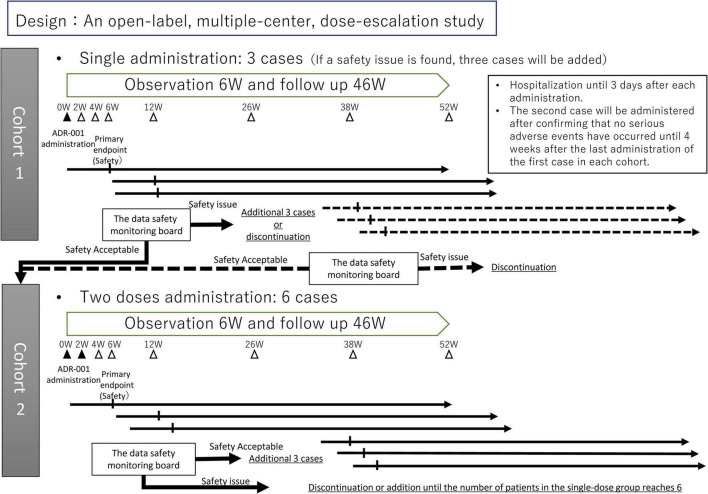
This will be a phase 1, open-label, multiple-center, dose-escalation study of adult patients with refractory IgA nephropathy resistant to or difficult to treat with existing therapies. ADR-001 will be administered intravenously to from three to six patients at a dose of 1 × 10 cells once in the first cohort and to six patients twice at 2-week intervals in the second cohort, and observation will continue until 52 weeks. The primary endpoint will be the evaluation of adverse events up to 6 weeks after the start of ADR-001 administration. Secondary endpoints will be the respective percentages of patients with adverse events, clinical remission, partial remission, remission of urine protein, remission of hematuria, time to remission, changes in urine protein, hematuria, and estimated glomerular filtration rate.
Following the administration of ADR-001 to patients with IgA nephropathy, the respective percentages of patients with adverse events, asymptomatic pulmonary emboli, clinical remission, partial remission, urine protein remission, hematuria remission, their time to remission, changes in urine protein, hematuria, and glomerular filtration rate will be determined.
This study will evaluate the safety and tolerability of ADR-001 and confirm its therapeutic efficacy in adult patients with refractory IgA nephropathy.
免疫球蛋白A(IgA)肾病是一种以肾小球性血尿和尿蛋白阳性等泌尿系统症状为表现的疾病,IgA主要沉积于肾小球系膜区。皮质类固醇是主要的治疗药物;然而,感染是一种严重的不良事件,且治疗效果的证据不足,因此迫切需要新的治疗方法。间充质干细胞(MSCs)通过将白细胞的特性从促炎转变为抗炎,并分别诱导器官组成细胞的增殖和分化,有助于在炎症环境中改善炎症和恢复器官功能。MSCs的这些特性已使其在各种炎症性疾病中得到临床应用,但本研究是世界上首次针对难治性肾小球肾炎进行的间充质干细胞临床试验。本研究已注册并被赋予编号jRCT2043200002和NCT04342325。
这将是一项针对现有治疗耐药或难治的成年难治性IgA肾病患者的1期、开放标签、多中心、剂量递增研究。ADR-001将以1×10个细胞的剂量静脉注射给第一组的3至6名患者一次,第二组的6名患者每隔2周注射两次,观察将持续至52周。主要终点将是评估ADR-001给药开始后6周内的不良事件。次要终点将是不良事件、临床缓解、部分缓解、尿蛋白缓解、血尿缓解、缓解时间、尿蛋白、血尿和估计肾小球滤过率变化的患者各自百分比。
在对IgA肾病患者给予ADR-001后,将确定不良事件、无症状肺栓塞、临床缓解、部分缓解、尿蛋白缓解、血尿缓解的患者各自百分比、缓解时间、尿蛋白、血尿和肾小球滤过率的变化。
本研究将评估ADR-001的安全性和耐受性,并确认其对成年难治性IgA肾病患者的治疗效果。