Imam Shahnawaz, Paparodis Rodis D, Rafiqi Shafiya Imtiaz, Ali Sophia, Niaz Azra, Kanzy Abed, Tovar Yara E, Madkhali Mohammed A, Elsherif Ahmed, Khogeer Feras, Zahid Zeeshan A, Sarwar Haider, Karim Tamanna, Salim Nancy, Jaume Juan C
Division of Endocrinology, Diabetes and Metabolism, Department of Medicine, College of Medicine and Life Sciences, University of Toledo, Toledo, OH, United States.
Center for Diabetes and Endocrine Research (CeDER), University of Toledo, Toledo, OH, United States.
Front Oncol. 2022 May 27;12:891002. doi: 10.3389/fonc.2022.891002. eCollection 2022.
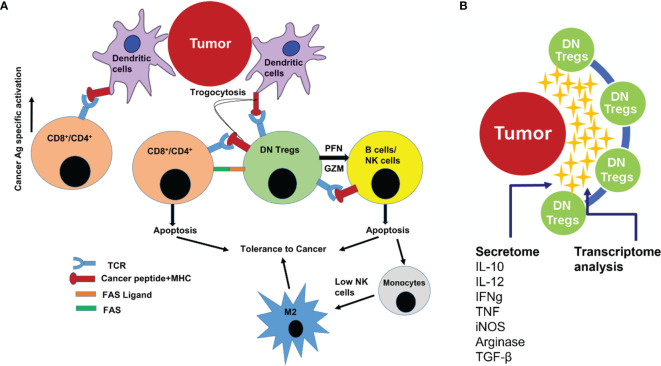
Thyroid nodules are an extremely common entity, and surgery is considered the ultimate diagnostic strategy in those with unclear malignant potential. Unfortunately, strategies aiming to predict the risk of malignancy have inadequate specificity. Our group recently found that the microenvironment of thyroid cancer is characterized by an enhanced immune invasion and activated immune response mediated by double-negative T lymphocytes (DN T) (CD3CD4CD8), which are believed to enable or promote tumorigenesis. In the present work, we try to use the DN T cells' proportion in thyroid fine-needle aspiration (FNA) material as a predictor of the risk of malignancy.
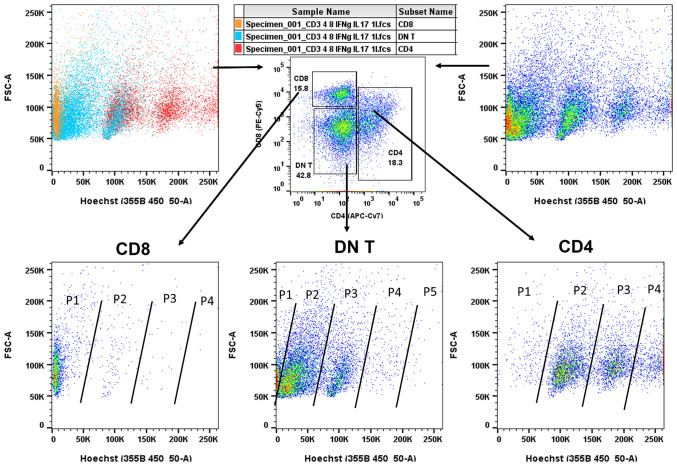
We recruited 127 patients and obtained ultrasound-guided FNA samples from subjects with cytology-positive or suspicious for malignancy and from those with benign nodular goiter associated with compressive symptoms (such as dysphagia, shortness of breath, or hoarseness), Hashimoto thyroiditis, and Graves' disease. Out of 127, we investigated 46 FNA samples of patients who underwent total thyroidectomy and for which postoperative histological diagnosis by the academic pathologists was available. We specifically measured the number of cells expressing CD3CD4CD8 (DN T) as a function of total CD3 cells in FNA samples using flow cytometry. We correlated their FNA DN T-cell proportions with the pathological findings.
The DN T cells were significantly more abundant in lymphocytic infiltrates of thyroid cancer cases compared to benign nodule controls (p < 0.0001). When the DN T-cell population exceeded a threshold of 9.14%, of total CD3 cells, the negative likelihood ratio of being cancer-free was 0.034 (96.6% sensitivity, 95% CI, 0.915-1.000, p < 0.0001). DN T cells at <9.14% were not found in any subject with benign disease (specificity 100%). The high specificity of the test is promising, since it abolishes a false-positive diagnosis and in turn unnecessary surgical procedures.
The present study proposes DN T cells' proportion as a preoperative diagnostic signature for thyroid cancer that with integration of RNA transcriptomics can provide a simplified technology based on the PCR assay for the ease of operation.
甲状腺结节极为常见,对于恶性潜能不明的患者,手术被视为最终的诊断策略。不幸的是,旨在预测恶性风险的策略特异性不足。我们团队最近发现,甲状腺癌的微环境特征是免疫侵袭增强以及由双阴性T淋巴细胞(DN T)(CD3CD4CD8)介导的免疫反应激活,据信这些细胞能够促成或促进肿瘤发生。在本研究中,我们尝试将甲状腺细针穿刺(FNA)材料中DN T细胞的比例用作恶性风险的预测指标。
我们招募了127名患者,从细胞学检查呈阳性或怀疑为恶性的患者以及患有伴有压迫症状(如吞咽困难、呼吸急促或声音嘶哑)的良性结节性甲状腺肿、桥本甲状腺炎和格雷夫斯病的患者中获取超声引导下的FNA样本。在这127名患者中,我们研究了46例接受全甲状腺切除术且有学术病理学家术后组织学诊断结果的患者的FNA样本。我们使用流式细胞术具体测量了FNA样本中表达CD3CD4CD8(DN T)的细胞数量与总CD3细胞数量的关系。我们将他们FNA中DN T细胞的比例与病理结果进行了关联分析。
与良性结节对照组相比,甲状腺癌病例的淋巴细胞浸润中DN T细胞明显更多(p < 0.0001)。当DN T细胞群体超过总CD3细胞的9.14%这一阈值时,无癌的阴性似然比为0.034(敏感性96.6%,95%可信区间,0.915 - 1.000,p < 0.0001)。在任何良性疾病患者中均未发现DN T细胞比例低于9.14%的情况(特异性100%)。该检测的高特异性很有前景,因为它消除了假阳性诊断,进而避免了不必要的手术。
本研究提出将DN T细胞比例作为甲状腺癌的术前诊断标志物,结合RNA转录组学,可基于PCR检测提供一种操作简便的简化技术。