Department of Anesthesia, The First Affiliated Hospital of Wenzhou Medical University, Wenzhou, Zhejiang 325000, China.
Wenzhou Key Laboratory of Perioperative Medicine, Wenzhou, Zhejiang 325000, China.
Dis Markers. 2022 May 23;2022:8787782. doi: 10.1155/2022/8787782. eCollection 2022.
Myopathies related to Ryanodine receptor 1 (RYR1) mutation are the most common nondystrophy muscle disorder in humans. Early detection and diagnosis of RYR1 mutation-associated myopathies may lead to more timely treatment of patients, which contributes to the management and preparation for malignant hyperthermia. However, diagnosis of RYR1 mutation-associated myopathies is delayed and challenging. The absence of diagnostic morphological features in muscle biopsy does not rule out the possibility of pathogenic variations in RYR1. Accordingly, it is helpful to seek biomarkers to diagnose RYR1 mutation-associated myopathies.
Skeletal muscle tissue microarray datasets of RYR1 mutation-associated myopathies or healthy persons were built in accordance with the gene expression synthesis (GEO) database. Differentially expressed genes (DEGs) were identified on the basis of R software. Genes specific to tissue/organ were identified through BioGPS. An enrichment analysis of DEGs was conducted in accordance with the Kyoto Encyclopedia of Genes and Genomes (KEGG) and Gene Ontology (GO). We also built protein-protein interaction (PPI) networks to explore the function and enrichment pathway of DEGs and the identification of hub genes. Lastly, the ROC curve was drawn for hub genes achieving specific expressions within skeletal muscle. Moreover, the area under the curve (AUC) was obtained to calculate the predictive value of key genes. The transcription factors of hub genes achieving specific expressions within skeletal muscle were predicted with the use of the iRegulon plugin.
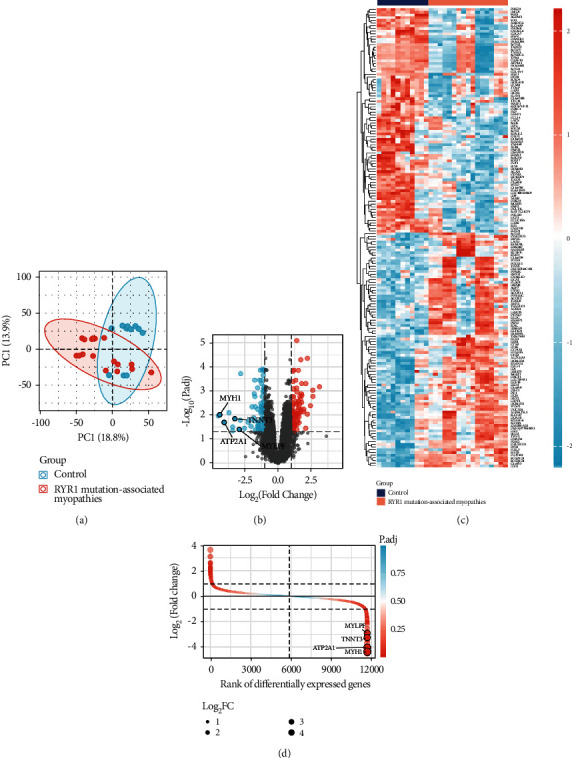
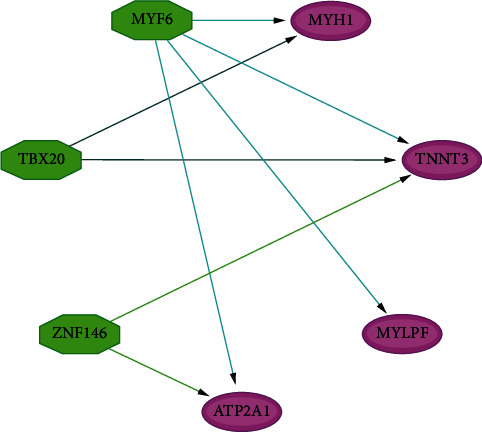
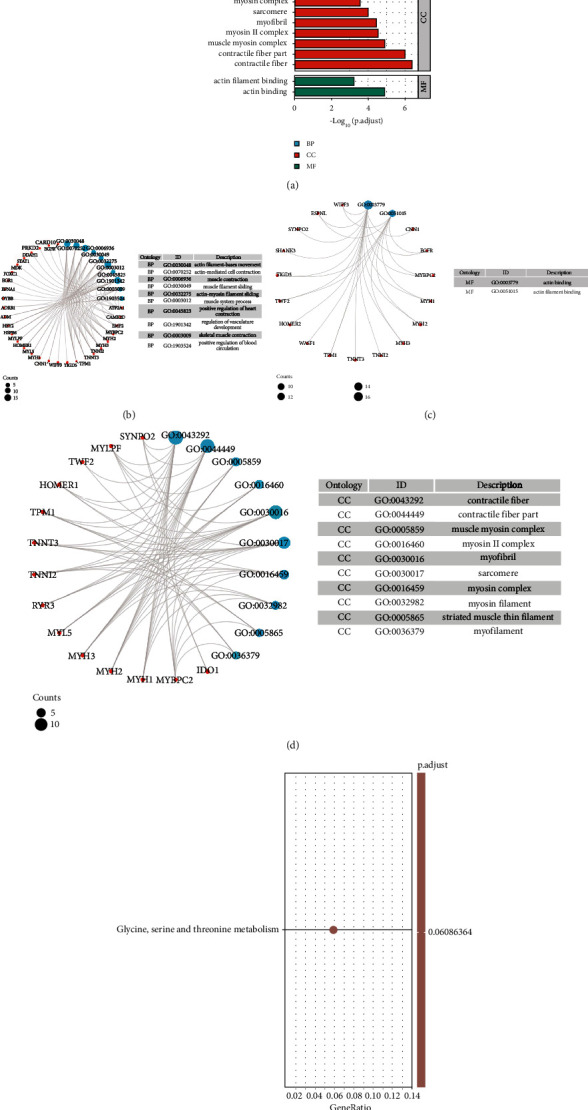
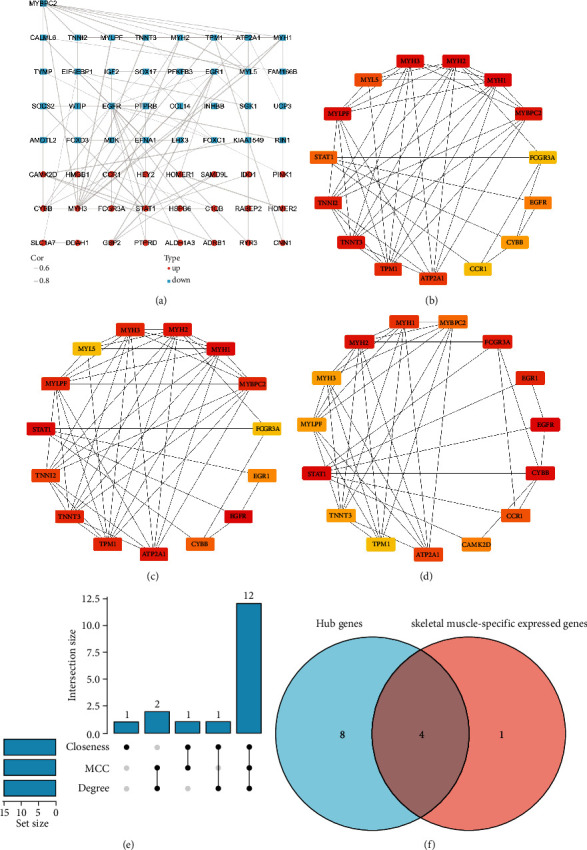
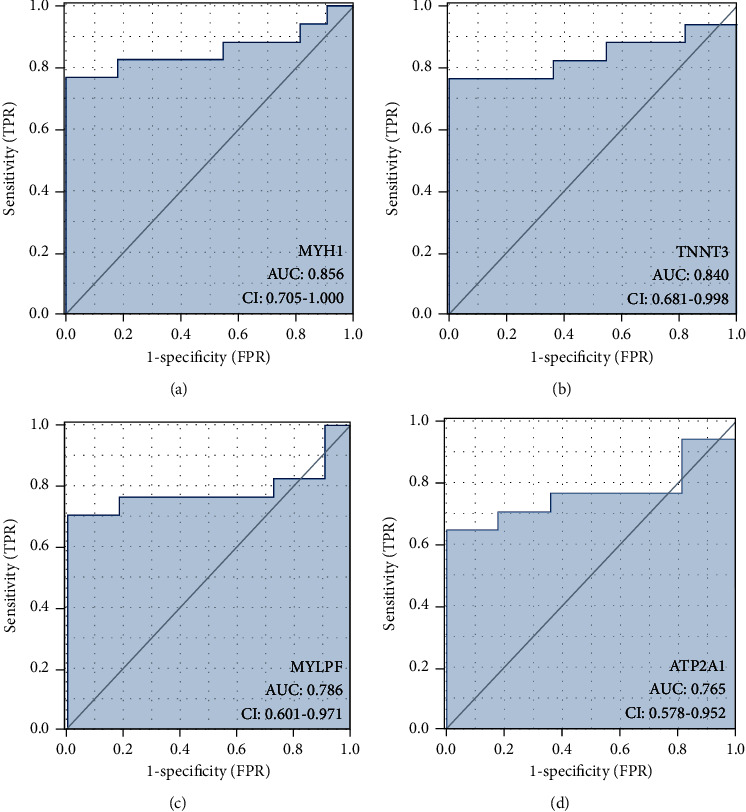
We identified 170 DEGs among 11 muscle biopsy samples of healthy subjects and 17 muscle biopsy samples of RYR1 mutation-associated myopathy patients in the dataset. Among the above DEGs, 30 genes achieving specific expressions within tissues/organs were found. GO and KEGG enrichment analysis of DEGs mainly focused on muscle contraction, actin-mediated cell contraction, actin filament-based movement, and muscular sliding. 12 hub genes were identified with the use of Cytoscape. Four hub genes were specifically expressed in skeletal muscle tissue, including MYH1 (AUC: 0.856), TNNT3 (AUC: 0.840), MYLPF (AUC: 0.786), and ATP2A1 (AUC: 0.765). The iRegulon predicted results suggested that the transcription factor MYF6 was found with the highest reliability.
Four skeletal muscle tissue-specific genes were identified, including MYH1, TNNT3, MYLPF, and ATP2A1, as the potential biomarkers for diagnosing and treating RYR1 mutation-associated myopathies, which provided insights into the transcriptome-level development mechanism. The transcription factor MYF6 may be a vital upstream regulator of the above biomarkers.
与兰尼碱受体 1(RYR1)突变相关的肌病是人类最常见的非营养不良性肌肉疾病。早期发现和诊断 RYR1 突变相关的肌病可能会导致患者得到更及时的治疗,这有助于对恶性高热进行管理和准备。然而,RYR1 突变相关肌病的诊断被延迟且具有挑战性。肌肉活检中缺乏诊断形态学特征并不能排除 RYR1 中致病性变异的可能性。因此,寻找生物标志物来诊断 RYR1 突变相关的肌病是有帮助的。
根据基因表达综合(GEO)数据库构建 RYR1 突变相关肌病或健康人的骨骼肌组织微阵列数据集。基于 R 软件识别差异表达基因(DEGs)。通过 BioGPS 识别组织/器官特异性基因。根据京都基因与基因组百科全书(KEGG)和基因本体论(GO)对 DEGs 进行富集分析。我们还构建了蛋白质-蛋白质相互作用(PPI)网络,以探讨 DEGs 的功能和富集途径以及关键基因的识别。最后,为骨骼肌中具有特定表达的关键基因绘制 ROC 曲线。此外,通过计算曲线下面积(AUC)来计算关键基因的预测值。使用 iRegulon 插件预测在骨骼肌中具有特定表达的关键基因的转录因子。
我们在数据集的 11 个健康受试者的肌肉活检样本和 17 个 RYR1 突变相关肌病患者的肌肉活检样本中鉴定出 170 个 DEG。在上述 DEGs 中,发现了 30 个在组织/器官中具有特异性表达的基因。GO 和 KEGG 富集分析的 DEGs 主要集中在肌收缩、肌动蛋白介导的细胞收缩、肌动蛋白丝的运动和肌肉滑行。使用 Cytoscape 鉴定出 12 个枢纽基因。在骨骼肌组织中特异性表达的 4 个枢纽基因包括 MYH1(AUC:0.856)、TNNT3(AUC:0.840)、MYLPF(AUC:0.786)和 ATP2A1(AUC:0.765)。iRegulon 预测结果表明,转录因子 MYF6 的可靠性最高。
鉴定出包括 MYH1、TNNT3、MYLPF 和 ATP2A1 在内的 4 个骨骼肌组织特异性基因,作为诊断和治疗 RYR1 突变相关肌病的潜在生物标志物,为研究转录组水平的发病机制提供了新视角。转录因子 MYF6 可能是上述生物标志物的重要上游调控因子。