
接种 COVID-19 疫苗后自身免疫性皮肤病恶化。
Autoimmune Skin Disease Exacerbations Following COVID-19 Vaccination.
机构信息
Dermatology, Corporal Michael J. Crescenz Department of Veterans Affairs Medical Center, Philadelphia, PA, United States.
Dermatology, Perelman School of Medicine, University of Pennsylvania, Philadelphia, PA, United States.
出版信息
Front Immunol. 2022 May 27;13:899526. doi: 10.3389/fimmu.2022.899526. eCollection 2022.
BACKGROUND
Vaccination against COVID-19 reduces the risk of severe COVID-19 disease and death. However, few studies have examined the safety of the COVID-19 vaccine in patients with autoimmune skin disease.
OBJECTIVES
We sought to determine the incidence of disease exacerbation in this population following COVID-19 vaccination as well as the associated factors.
METHODS
We performed a chart review of all patients seen in the autoimmune skin disease clinic of the principal investigator during the study period. All patients included for analysis were systematically and prospectively asked about COVID-19 vaccination status, manufacturers, vaccine dates, autoimmune symptoms after the vaccine, and timing of symptom onset using a standardized template as part of their visit. Demographics and autoimmune disease diagnosis were also collected. Analysis used Chi-square and Fisher's exact tests.
RESULTS
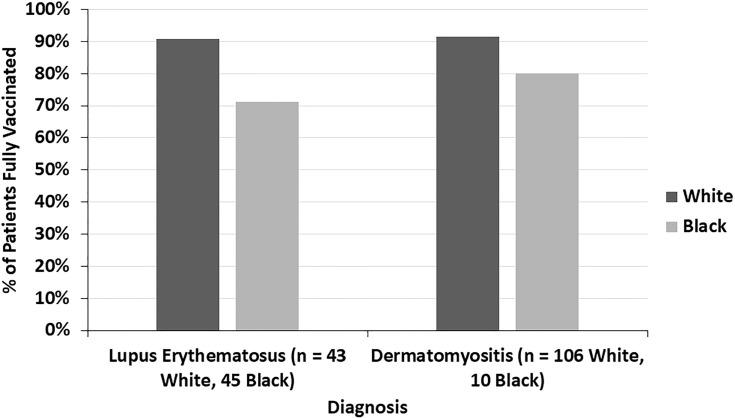
402 subjects were included for analysis. 85.6% of patients were fully vaccinated, with 12.9% unvaccinated and 1.5% partially vaccinated. 14.8% of fully vaccinated patients reported worsening autoimmune signs and symptoms after the vaccine. Fully vaccinated dermatomyositis patients were more likely to report worsening autoimmune signs and symptoms after the vaccine (22.7%) than fully vaccinated lupus erythematosus patients (8.6%) (p=0.009). Patients fully vaccinated with the Moderna vaccine trended towards an increased likelihood of reporting worsening autoimmune signs and symptoms after the vaccine (19.1%) than those with the Pfizer-BioNTech vaccine (12.0%) (p=0.076). Of the patients who had autoimmune symptoms after vaccination, 20% had symptoms after the 1st dose, 82% after the 2nd dose, and 4% after the 3rd dose with median onset (95% confidence interval) of 7 (2,14), 14 (14,21), and 18 (7,28) days later, respectively.
CONCLUSIONS
More fully vaccinated dermatomyositis patients had exacerbation of autoimmune signs and symptoms after the vaccine than fully vaccinated lupus erythematosus patients. However, given the risks of COVID-19, clinicians should still promote vaccination in most patients with autoimmune skin disease.
背景
接种 COVID-19 疫苗可降低患严重 COVID-19 疾病和死亡的风险。然而,很少有研究检查 COVID-19 疫苗在自身免疫性皮肤病患者中的安全性。
目的
我们旨在确定该人群接种 COVID-19 疫苗后疾病恶化的发生率以及相关因素。
方法
我们对研究期间在首席研究员的自身免疫性皮肤病诊所就诊的所有患者进行了图表回顾。所有纳入分析的患者都被系统地和前瞻性地询问了 COVID-19 疫苗接种状况、制造商、疫苗接种日期、接种疫苗后的自身免疫症状以及使用标准化模板作为其就诊的一部分的症状出现时间。还收集了人口统计学和自身免疫性疾病诊断信息。分析采用卡方检验和 Fisher 精确检验。
结果
共纳入 402 例患者进行分析。85.6%的患者已完全接种疫苗,12.9%未接种疫苗,1.5%部分接种疫苗。14.8%的完全接种疫苗的患者报告接种疫苗后自身免疫迹象和症状恶化。与完全接种狼疮红斑的患者(8.6%)相比,完全接种皮肌炎的患者更有可能报告接种疫苗后自身免疫迹象和症状恶化(22.7%)(p=0.009)。与接受辉瑞-生物技术公司(Pfizer-BioNTech)疫苗接种的患者(12.0%)相比,接受莫德纳(Moderna)疫苗接种的患者更有可能报告接种疫苗后自身免疫迹象和症状恶化(19.1%)(p=0.076)。在接种疫苗后出现自身免疫症状的患者中,20%在第 1 剂后出现症状,82%在第 2 剂后出现症状,4%在第 3 剂后出现症状,中位数(95%置信区间)分别为 7(2,14)、14(14,21)和 18(7,28)天。
结论
与完全接种狼疮红斑的患者相比,更多完全接种皮肌炎的患者在接种疫苗后自身免疫迹象和症状恶化。然而,鉴于 COVID-19 的风险,临床医生仍应在大多数自身免疫性皮肤病患者中推广疫苗接种。


 Zotero 插件