School of Medicine, Tehran University of Medical Sciences, Tehran, Iran.
Non-Communicable Diseases Research Center, Endocrinology and Metabolism Population Sciences Institute, Tehran University of Medical Sciences, Tehran, Iran.
Eur J Med Res. 2024 Jan 17;29(1):55. doi: 10.1186/s40001-024-01639-4.
Patients with autoimmune and immune-mediated diseases (AI-IMD) are at greater risk of COVID-19 infection; therefore, they should be prioritized in vaccination programs. However, there are concerns regarding the safety of COVID-19 vaccines in terms of disease relapse, flare, or exacerbation. In this study, we aimed to provide a more precise and reliable vision using systematic review and meta-analysis.
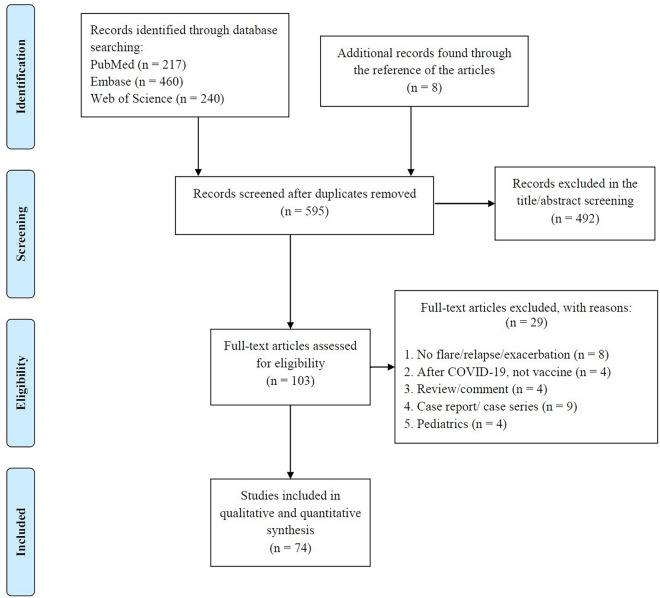
PubMed-MEDLINE, Embase, and Web of Science were searched for original articles reporting the relapse/flare in adult patients with AI-IMD between June 1, 2020 and September 25, 2022. Subgroup analysis and sensitivity analysis were conducted to investigate the sources of heterogeneity. Statistical analysis was performed using R software.
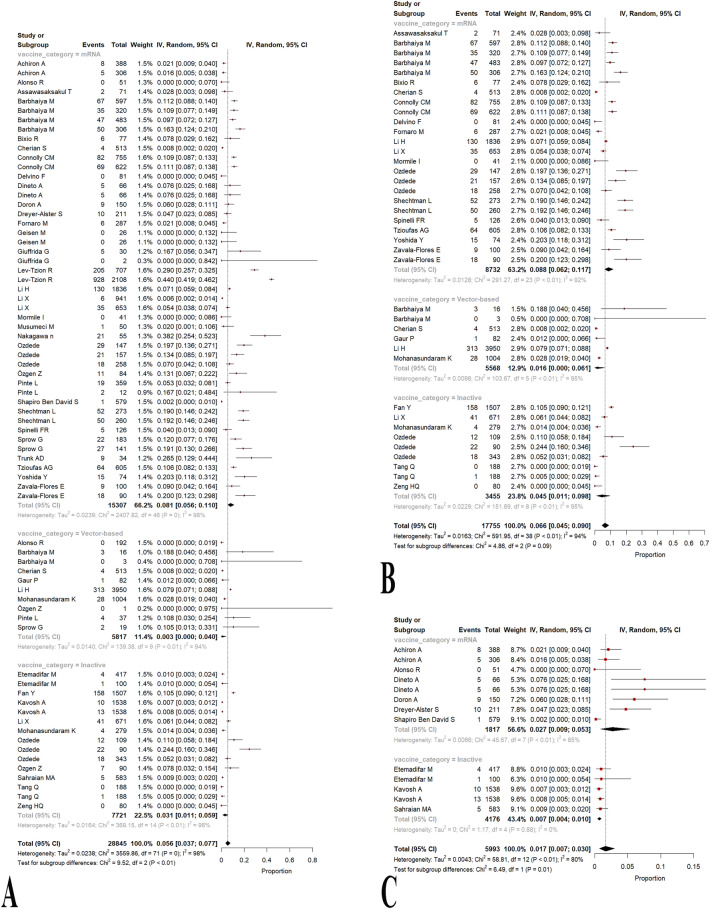
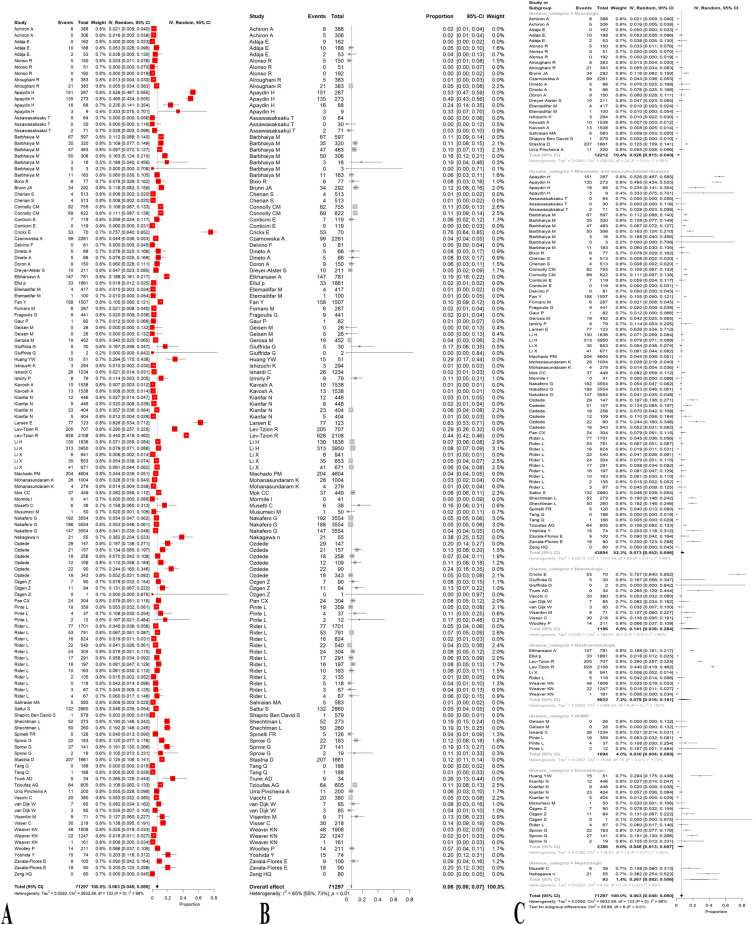
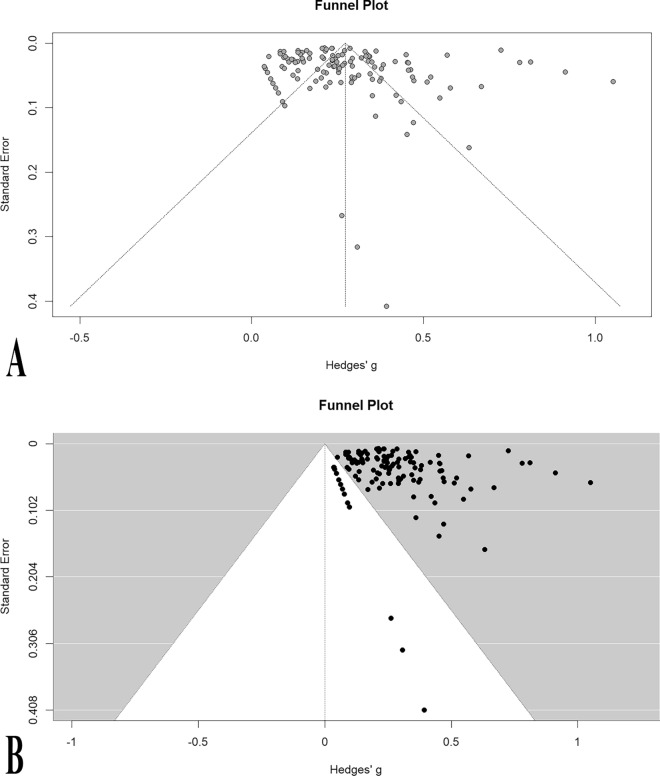
A total of 134 observations of various AI-IMDs across 74 studies assessed the rate of relapse, flare, or exacerbation in AI-IMD patients. Accordingly, the crude overall prevalence of relapse, flare, or exacerbation was 6.28% (95% CI [4.78%; 7.95%], I = 97.6%), changing from 6.28% (I = 97.6%) to 6.24% (I = 65.1%) after removing the outliers. AI-IMD patients administering mRNA, vector-based, and inactive vaccines showed 8.13% ([5.6%; 11.03%], I = 98.1%), 0.32% ([0.0%; 4.03%], I = 93.5%), and 3.07% ([1.09%; 5.9%], I = 96.2%) relapse, flare, or exacerbation, respectively (p-value = 0.0086). In terms of disease category, nephrologic (26.66%) and hematologic (14.12%) disorders had the highest and dermatologic (4.81%) and neurologic (2.62%) disorders exhibited to have the lowest crude prevalence of relapse, flare, or exacerbation (p-value < 0.0001).
The risk of flare/relapse/exacerbation in AI-IMD patients is found to be minimal, especially with vector-based vaccines. Vaccination against COVID-19 is recommended in this population.
自身免疫和免疫介导性疾病(AI-IMD)患者感染 COVID-19 的风险更高;因此,他们应该优先考虑接种疫苗。然而,人们担心 COVID-19 疫苗会导致疾病复发、恶化或加重。在这项研究中,我们旨在通过系统评价和荟萃分析提供更准确和可靠的结果。
检索 2020 年 6 月 1 日至 2022 年 9 月 25 日期间发表的关于成年 AI-IMD 患者复发/恶化的原始文章,检索数据库包括 PubMed-MEDLINE、Embase 和 Web of Science。进行亚组分析和敏感性分析以探究异质性的来源。统计分析使用 R 软件进行。
共有 74 项研究的 134 个 AI-IMD 观察结果评估了 AI-IMD 患者的复发、恶化或加重率。因此,AI-IMD 患者的总体复发、恶化或加重的未调整发生率为 6.28%(95%CI[4.78%;7.95%],I=97.6%),剔除离群值后发生率为 6.24%(I=65.1%)。接种 mRNA、载体和灭活疫苗的 AI-IMD 患者的复发、恶化或加重发生率分别为 8.13%(5.6%;11.03%,I=98.1%)、0.32%(0.0%;4.03%,I=93.5%)和 3.07%(1.09%;5.9%,I=96.2%)(p 值=0.0086)。按疾病类别划分,肾脏疾病(26.66%)和血液疾病(14.12%)的复发、恶化或加重发生率最高,皮肤疾病(4.81%)和神经系统疾病(2.62%)的发生率最低(p 值<0.0001)。
AI-IMD 患者发生恶化/复发/加重的风险极小,尤其是接种载体疫苗的患者。建议该人群接种 COVID-19 疫苗。