Williams Isabelle, Pandey Sumeet, Haller Wolfram, Huynh Hien Quoc, Chan Alicia, Düeker Gesche, Bettels Ruth, Peyrin-Biroulet Laurent, Dike Chinenye R, DeGeeter Catherine, Smith David, Al Eisa Nada, Platt Nick, Marquardt Thorsten, Schwerd Tobias, Platt Frances M, Uhlig Holm H
Translational Gastroenterology Unit, University of Oxford, Oxford, UK.
Birmingham Children's Hospital, UK, Birmingham, UK.
Wellcome Open Res. 2022 Jan 11;7:11. doi: 10.12688/wellcomeopenres.16986.1. eCollection 2022.
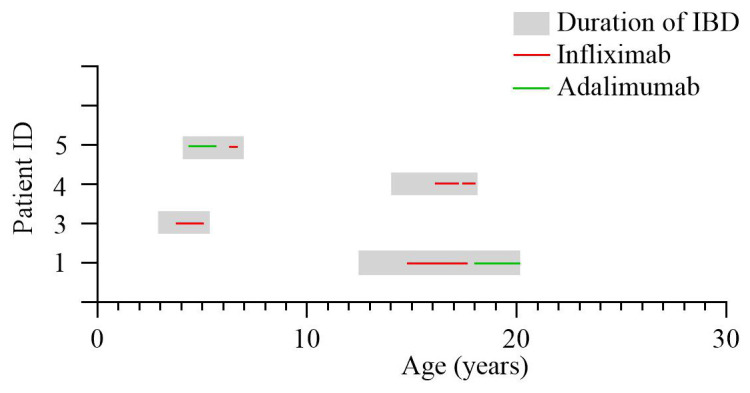
Blockade of tumour necrosis factor (anti-TNF) is effective in patients with Crohn's Disease but has been associated with infection risk and neurological complications such as demyelination. Niemann-Pick disease Type C1 (NPC1) is a lysosomal storage disorder presenting in childhood with neurological deterioration, liver damage and respiratory infections. Some NPC1 patients develop severe Crohn's disease. Our objective was to investigate the safety and effectiveness of anti-TNF in NPC1 patients with Crohn's disease. Retrospective data on phenotype and therapy response were collected in 2019-2020 for the time period 2014 to 2020 from patients in the UK, France, Germany and Canada with genetically confirmed NPC1 defects and intestinal inflammation. We investigated TNF secretion in peripheral blood mononuclear cells treated with NPC1 inhibitor in response to bacterial stimuli NPC1 inhibitor treated peripheral blood mononuclear cells (PBMCs) show significantly increased TNF production after lipopolysaccharide or bacterial challenge providing a rationale for anti-TNF therapy. We identified 4 NPC1 patients with Crohn's disease (CD)-like intestinal inflammation treated using anti-TNF therapy (mean age of onset 8.1 years, mean treatment length 27.75 months, overall treatment period 9.25 patient years). Anti-TNF therapy was associated with reduced gastrointestinal symptoms with no apparent adverse neurological events. Therapy improved intestinal inflammation in 4 patients. Anti-TNF therapy appears safe in patients with NPC1 and is an effective treatment strategy for the management of intestinal inflammation in these patients.
肿瘤坏死因子阻断剂(抗TNF)对克罗恩病患者有效,但与感染风险及脱髓鞘等神经并发症相关。尼曼-匹克C1型病(NPC1)是一种溶酶体贮积症,于儿童期发病,伴有神经功能恶化、肝损伤及呼吸道感染。部分NPC1患者会发展为重度克罗恩病。我们的目的是研究抗TNF对患有克罗恩病的NPC1患者的安全性和有效性。2019年至2020年期间,我们收集了英国、法国、德国和加拿大经基因确诊患有NPC1缺陷且伴有肠道炎症的患者在2014年至2020年期间的表型和治疗反应的回顾性数据。我们研究了用NPC1抑制剂处理的外周血单核细胞在受到细菌刺激时的TNF分泌情况。经NPC1抑制剂处理的外周血单核细胞(PBMCs)在脂多糖或细菌攻击后显示TNF产生显著增加,这为抗TNF治疗提供了理论依据。我们确定了4例使用抗TNF疗法治疗的患有类似克罗恩病(CD)肠道炎症的NPC1患者(平均发病年龄8.1岁,平均治疗时长27.75个月,总治疗期9.25患者年)。抗TNF疗法与胃肠道症状减轻相关,且无明显不良神经事件。该疗法改善了4例患者的肠道炎症。抗TNF疗法对NPC1患者似乎是安全的,并且是治疗这些患者肠道炎症的有效策略。