Department of Dentistry, Radboud University Medical Center, Nijmegen, The Netherlands.
Radboudumc 3D Lab, Radboud University Medical Center, Nijmegen, The Netherlands.
PeerJ. 2022 Jun 7;10:e13281. doi: 10.7717/peerj.13281. eCollection 2022.
To develop a semi-automatic technique to evaluate normative facial growth in healthy children between the age of 1.5 and 5.0 years using three-dimensional stereophotogrammetric images.
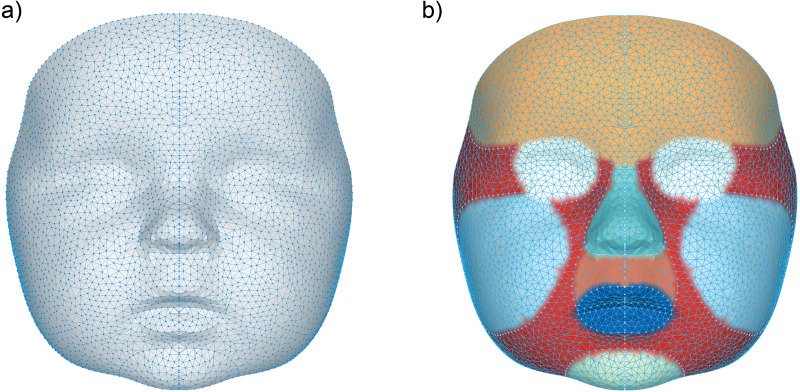
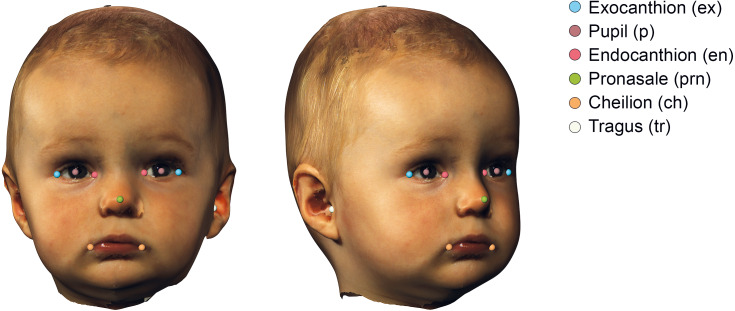
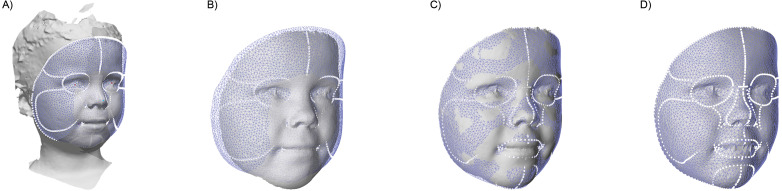
Three-dimensional facial images of healthy children at 1.5, 2.0, 2.5, 3.0, 4.0 and 5.0 years of age were collected and positioned based on a reference frame. A general face template was used to extract the face and its separate regions from the full stereophotogrammetric image. Furthermore, this template was used to create a uniform distributed mesh, which could be directly compared to other meshes. Average faces were created for each age group and mean growth was determined between consecutive groups for the full face and its separate regions. Finally, the results were tested for intra- and inter-operator performance.
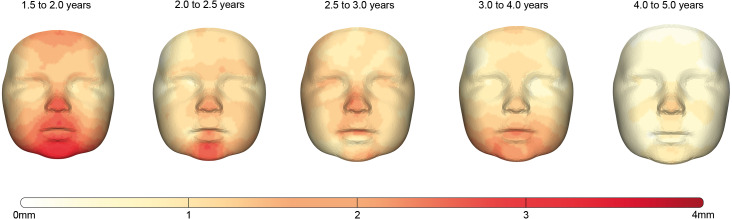
The highest growth velocity was present in the first period between 1.5 and 2.0 years of age with an average of 1.50 mm (±0.54 mm) per six months. After 2.0 years, facial growth velocity declined to only a third at the age of 5.0 years. Intra- and inter-operator variability was small and not significant.
The results show that this technique can be used for objective clinical evaluation of facial growth. Example normative facial averages and the corresponding facial growth between the age 1.5 and 5.0 years are shown.
This technique can be used to collect and process facial data for objective clinical evaluation of facial growth in the individual patient. Furthermore, these data can be used as normative data in future comparative studies.
使用三维体视摄影图像,开发一种半自动技术来评估 1.5 至 5.0 岁健康儿童的正常面部生长。
收集并定位了 1.5、2.0、2.5、3.0、4.0 和 5.0 岁健康儿童的三维面部图像。使用通用面部模板从完整体视摄影图像中提取面部及其单独区域。此外,该模板用于创建均匀分布的网格,可直接与其他网格进行比较。为每个年龄组创建平均脸,并确定连续组之间整个面部及其单独区域的平均生长。最后,测试了结果的内、外操作员性能。
1.5 至 2.0 岁之间的第一个阶段生长速度最快,平均每六个月为 1.50 毫米(±0.54 毫米)。2.0 岁后,面部生长速度下降到 5.0 岁时仅为三分之一。内、外操作员的变异性很小且无统计学意义。
结果表明,该技术可用于对面部生长进行客观的临床评估。展示了示例正常面部平均值和 1.5 至 5.0 岁之间的相应面部生长。
该技术可用于收集和处理面部数据,以对个体患者的面部生长进行客观的临床评估。此外,这些数据可用作未来比较研究的标准数据。