Kluge Jennifer, Bruggink Robin, Pandis Nikolaos, Unkovskiy Alexey, Jost-Brinkmann Paul-Georg, Kuijpers-Jagtman Anne Marie, Bartzela Theodosia
Department of Orthodontics and Dentofacial Orthopedics, Center for Oral Health Sciences CC3, Charité-Universitätsmedizin Berlin, Corporate Member of Freie Universität Berlin and Humboldt-Universität zu Berlin, Aßmannshauser Straße 4-6, 14197 Berlin, Germany.
Radboudumc 3D Lab, Radboud Institute for Health Sciences, Radboud University Medical Center, 6500 HB Nijmegen, The Netherlands.
J Clin Med. 2023 Oct 10;12(20):6432. doi: 10.3390/jcm12206432.
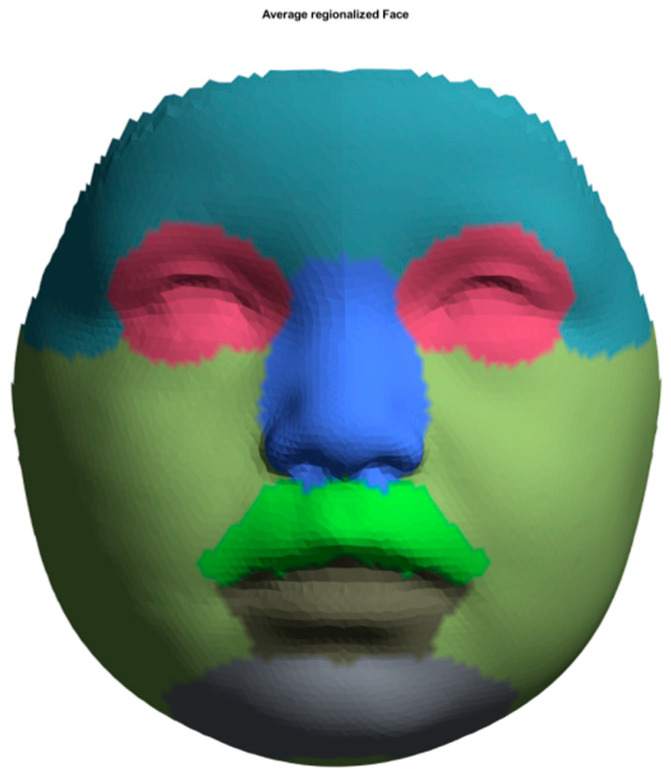
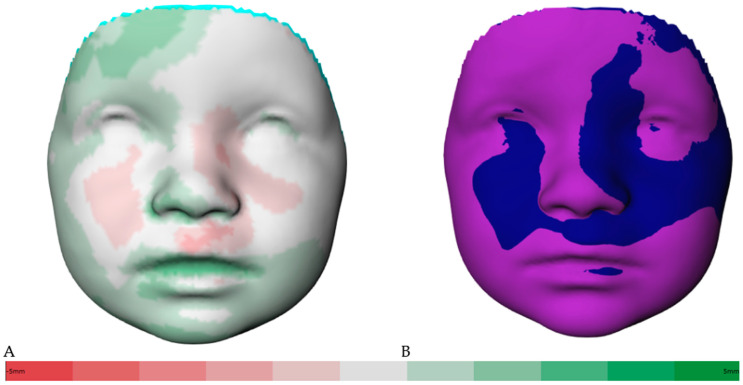
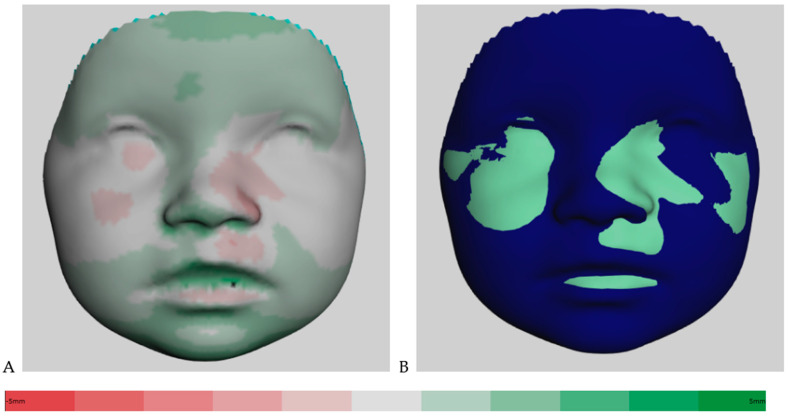
This longitudinal study aimed to evaluate facial growth and soft tissue changes in infants with complete unilateral cleft lip, alveolus, and palate (CUCLAP) at ages 3, 9, and 12 months. Using 3D images of 22 CUCLAP infants, average faces and distance maps for the entire face and specific regions were created. Color-coded maps highlighted more significant soft tissue changes from 3 to 9 months than from 9 to 12 months. The first interval showed substantial growth in the entire face, particularly in the forehead, eyes, lower lip, chin, and cheeks ( < 0.001), while the second interval exhibited no significant growth. This study provides insights into facial soft tissue growth in CUCLAP infants during critical developmental stages, emphasizing substantial improvements between 3 and 9 months, mainly in the chin, lower lip, and forehead. However, uneven growth occurred in the upper lip, philtrum, and nostrils throughout both intervals, with an overall decline in growth from 9 to 12 months. These findings underscore the dynamic nature of soft tissue growth in CUCLAP patients, highlighting the need to consider these patterns in treatment planning. Future research should explore the underlying factors and develop customized treatment interventions for enhanced facial aesthetics and function in this population.
这项纵向研究旨在评估完全性单侧唇腭裂(CUCLAP)婴儿在3个月、9个月和12个月时的面部生长及软组织变化。利用22名CUCLAP婴儿的三维图像,创建了全脸及特定区域的平均面部图像和距离图。彩色编码图显示,3至9个月期间的软组织变化比9至12个月期间更为显著。第一个时间段全脸有显著生长,尤其是额头、眼睛、下唇、下巴和脸颊(<0.001),而第二个时间段无显著生长。本研究深入了解了CUCLAP婴儿在关键发育阶段的面部软组织生长情况,强调了3至9个月期间的显著改善,主要集中在下巴、下唇和额头。然而,在两个时间段内,上唇、人中及鼻孔均出现生长不均衡的情况,且从9至12个月生长总体呈下降趋势。这些发现强调了CUCLAP患者软组织生长的动态特性,突出了在治疗计划中考虑这些模式的必要性。未来的研究应探索潜在因素,并开发定制化治疗干预措施,以改善该人群的面部美观和功能。