Division of Colon and Rectal Surgery, Department of Surgery, Gil Medical Center, Gachon University College of Medicine, Incheon, Republic of Korea.
Division of Medical Oncology, Department of Internal Medicine, Gil Medical Center, Gachon University College of Medicine, Incheon, Republic of Korea.
Integr Cancer Ther. 2022 Jan-Dec;21:15347354221105498. doi: 10.1177/15347354221105498.
Colorectal cancer is the third most common malignant disease and the second leading cause of death worldwide. Previous studies showed improved bioavailability and cytotoxicity of ginsenoside-modified nanostructured lipid carrier containing curcumin (G-NLC) in human colon cancer cell lines. This study aimed to evaluate the safety and tolerability with long-term survival rates in patients with colorectal cancer with unresectable metastases after treatment with first-line bevacizumab/FOLFIRI (folinic acid, bolus/continuous fluorouracil, and irinotecan) in combination with a dietary supplement of G-NLC.
This study was a prospective, observational, single-group analysis. The enrolled patients had colorectal cancer with unresectable metastases and were administered bevacizumab and FOLFIRI in combination with daily oral G-NLC as first-line treatment. Overall survival, progression-free survival, tumor response, and adverse events were evaluated.
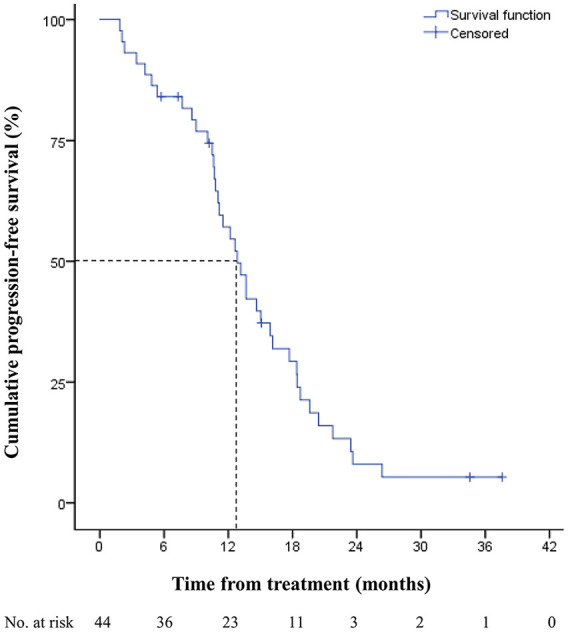
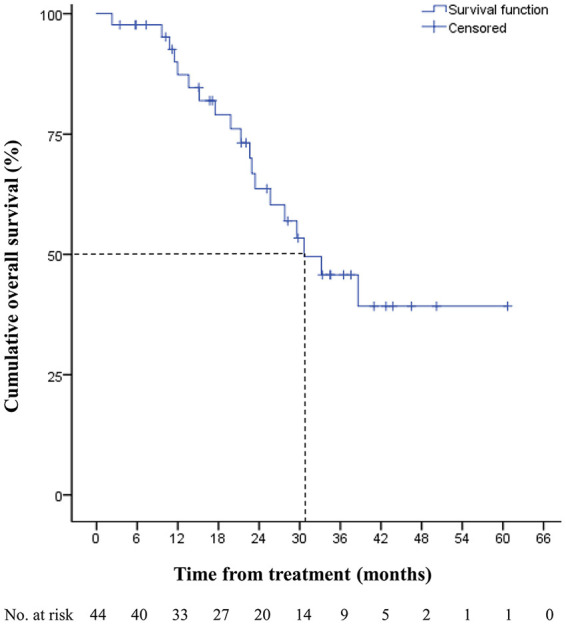
A total of 44 patients were enrolled between 2015 and 2019. The median age was 65 (range 45-81) years and the sex ratio was 31:13 (male:female). The primary tumor locations were the colon (31 patients) and rectum (13 patients). The metastatic sites included, liver only (n = 20), lung only (n = 6), both liver and lung (n = 12), and others (n = 6). The median duration of curcumin supply was 7.9 (range 0.9-16.6) months. The most common grade 3 or higher adverse events were neutropenia (n = 15, 34.1%), followed by nausea (n = 4, 9.1%) and vomiting (n = 4, 9.1%). Within the median follow-up period of 22.8 months, the median overall survival was 30.7 months, and the median progression-free survival was 12.8 months. None of the patients achieved complete response (CR); however, 9 patients showed partial response (PR), and 3 patients underwent conversion surgery.
Bevacizumab/FOLFIRI with G-NLC as first-line chemotherapy in patients with colorectal cancer with unresectable metastases presented comparable long-term survival outcomes with acceptable toxicity outcomes. Additional randomized controlled studies are needed to establish definitive conclusions regarding this new regimen for metastatic colorectal cancer.
结直肠癌是全球第三大常见恶性疾病,也是第二大死亡原因。先前的研究表明,姜黄素修饰的纳米结构脂质载体(G-NLC)载人参皂苷在人结肠癌细胞系中具有更好的生物利用度和细胞毒性。本研究旨在评估在接受一线贝伐珠单抗/FOLFIRI(亚叶酸钙、推注/持续氟尿嘧啶和伊立替康)联合含 G-NLC 的膳食补充剂治疗后,转移性不可切除的结直肠癌患者的安全性、耐受性和长期生存率。
这是一项前瞻性、观察性、单组分析研究。纳入的患者患有转移性不可切除的结直肠癌,接受贝伐珠单抗和 FOLFIRI 联合每日口服 G-NLC 作为一线治疗。评估总生存期、无进展生存期、肿瘤反应和不良事件。
2015 年至 2019 年期间共纳入 44 例患者。中位年龄为 65 岁(范围 45-81 岁),性别比例为 31:13(男:女)。原发肿瘤部位为结肠(31 例)和直肠(13 例)。转移部位包括仅肝转移(20 例)、仅肺转移(6 例)、肝和肺均转移(12 例)和其他部位(6 例)。姜黄素供应的中位持续时间为 7.9 个月(范围 0.9-16.6 个月)。最常见的 3 级或更高级别的不良事件为中性粒细胞减少(n=15,34.1%),其次为恶心(n=4,9.1%)和呕吐(n=4,9.1%)。在中位随访 22.8 个月期间,中位总生存期为 30.7 个月,中位无进展生存期为 12.8 个月。无患者达到完全缓解(CR);然而,有 9 例患者显示部分缓解(PR),3 例患者接受了转化手术。
转移性不可切除的结直肠癌患者一线化疗采用贝伐珠单抗/FOLFIRI 联合 G-NLC 治疗,具有可接受的毒性作用,且长期生存结果相当。需要进一步的随机对照研究来确定转移性结直肠癌新方案的明确结论。