Department of Agronomy, University of Agriculture Faisalabad, Faisalabad, Pakistan.
College of Agriculture, Bahadur Sub-Campus, Bahauddin Zakariya University, Layyah, Pakistan.
PLoS One. 2022 Jun 13;17(6):e0268907. doi: 10.1371/journal.pone.0268907. eCollection 2022.
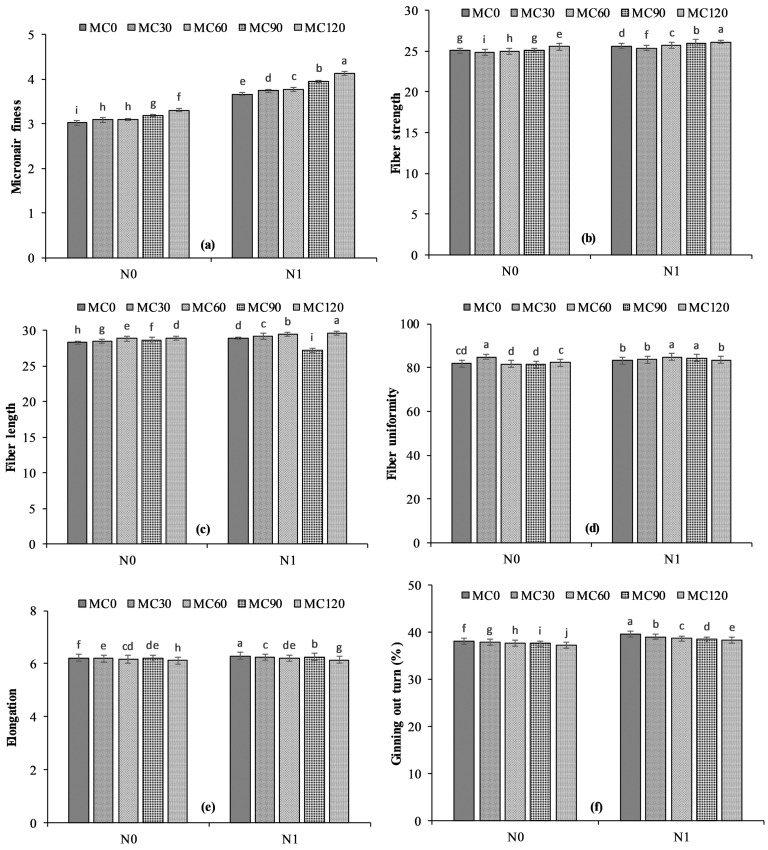
Cotton (Gossypium hirsutum L.) is one of the most important cash crops primarily grown for fiber. It is a perennial crop with indeterminate growth pattern. Nitrogen (N) is extremely important for vegetative growth as balanced N-nutrition improves photosynthesis, resulting in better vegetative growth. Excessive N-supply results in more vegetative growth, which increases the incidence of insect pest and diseases' infestation, pollute surface and ground water, delays maturity and produces low crop yield with poor quality. The use of plant growth regulators (PGRs) is an emerging option to control excessive vegetative growth. The PGRs help in improving plant architecture, boll retention, boll opening, yield and quality by altering growth and physiological processes such as photosynthesis, assimilate partitioning and nutrients dynamic inside the plant body. Mepiquat chloride (1,1-dimethylpiperidinum chloride) is globally used PGR for canopy development and control of excessive vegetative growth in cotton. This study investigated the effect of mepiquat chloride (MC) and N application on yield and yield components of transgenic cotton variety 'BT-FSH-326'. Two N rates (0, 198 kg ha-1) and five MC rates (0, 30,60, 90 and 120 g ha-1) were included in the study. Results revealed that MC and N application improved boll weight, number of bolls per plant, and seed cotton and lint yields. The highest seed cotton and lint yields (3595 kg ha-1 and 1701 kg ha-1, respectively) were observed under foliar application of 198 kg ha-1 N and 120 g ha-1 MC. Fiber length, fiber strength, micronaire and uniformity were significantly improved with foliar application of MC and N. In conclusion, foliar application of MC and N could be helpful in improving yield and fiber quality of cotton.
棉花(Gossypium hirsutum L.)是一种主要用于纤维的最重要的经济作物之一。它是一种多年生作物,具有不定长的生长模式。氮(N)对营养生长极其重要,因为平衡的 N 营养可以提高光合作用,从而促进更好的营养生长。过量的 N 供应会导致更多的营养生长,从而增加虫害和疾病的发生,污染地表水和地下水,延迟成熟,并导致作物产量低、质量差。使用植物生长调节剂(PGRs)是控制过度营养生长的新兴选择。PGRs 通过改变光合作用、同化产物分配和植物体内养分动态等生长和生理过程,帮助改善植物结构、保铃、吐絮、产量和品质。矮壮素(1,1-二甲基哌啶氯化物)是一种全球范围内用于控制棉花冠层发育和过度营养生长的 PGR。本研究调查了矮壮素(MC)和 N 应用对转基因棉花品种'BT-FSH-326'产量和产量构成的影响。该研究包括两个 N 率(0、198 kg ha-1)和五个 MC 率(0、30、60、90 和 120 g ha-1)。结果表明,MC 和 N 的应用提高了铃重、单株铃数、籽棉和皮棉产量。在叶面喷施 198 kg ha-1 N 和 120 g ha-1 MC 的条件下,籽棉和皮棉产量最高(分别为 3595 kg ha-1 和 1701 kg ha-1)。MC 和 N 的叶面喷施显著提高了纤维长度、纤维强度、马克隆值和均匀度。总之,MC 和 N 的叶面喷施有助于提高棉花的产量和纤维品质。