Ben May Department for Cancer Research, University of Chicago, Chicago, IL 60637.
Department of Biochemistry, Molecular Biology, and Biophysics, University of Minnesota, Minneapolis, MN 55455.
Proc Natl Acad Sci U S A. 2022 Jun 21;119(25):e2121867119. doi: 10.1073/pnas.2121867119. Epub 2022 Jun 13.
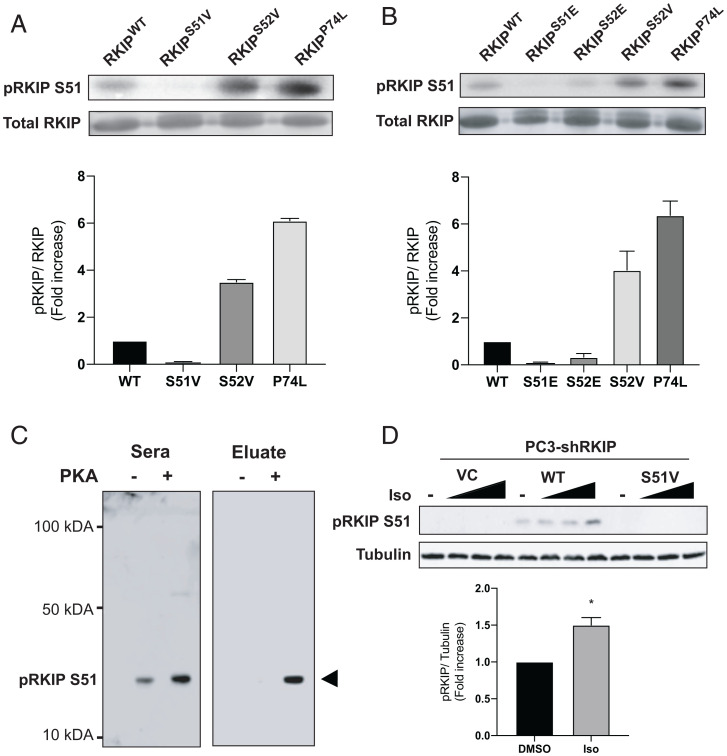
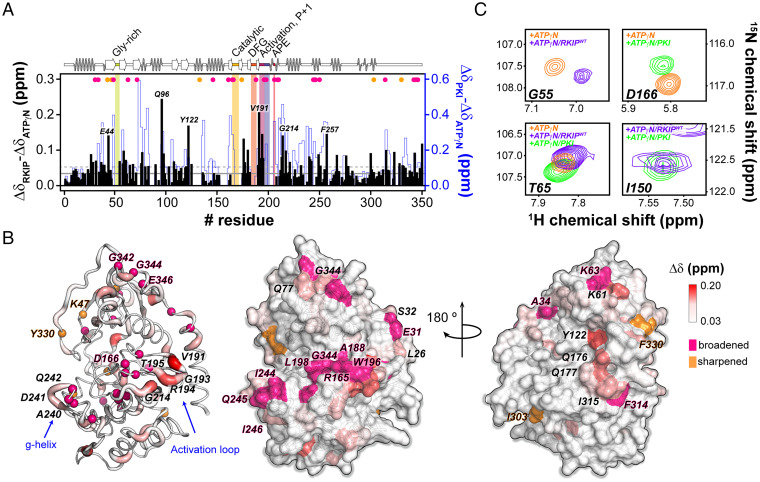
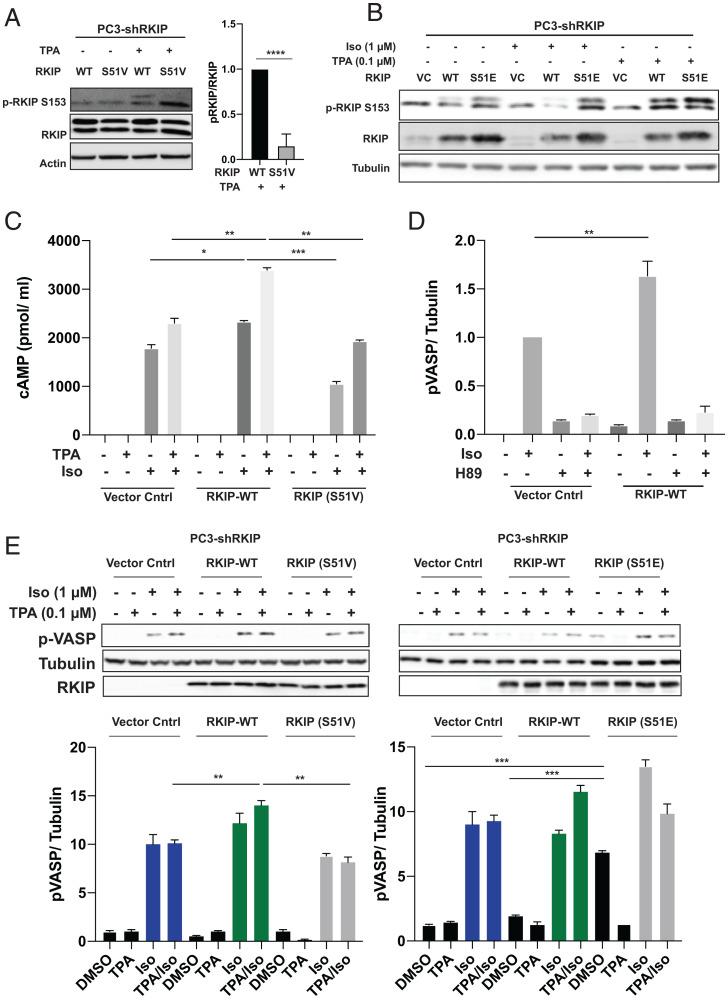
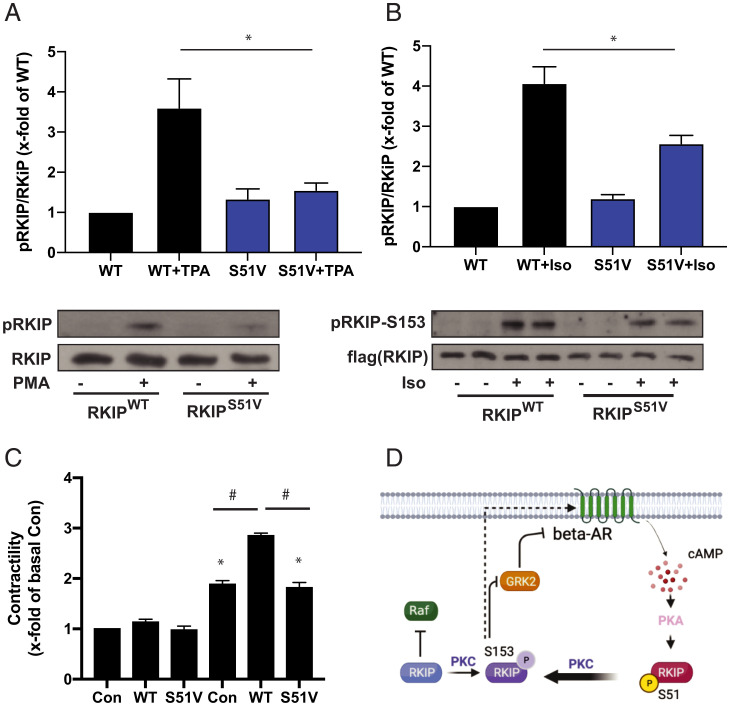
Raf Kinase Inhibitory Protein (RKIP) maintains cellular robustness and prevents the progression of diseases such as cancer and heart disease by regulating key kinase cascades including MAP kinase and protein kinase A (PKA). Phosphorylation of RKIP at S153 by Protein Kinase C (PKC) triggers a switch from inhibition of Raf to inhibition of the G protein coupled receptor kinase 2 (GRK2), enhancing signaling by the β-adrenergic receptor (β-AR) that activates PKA. Here we report that PKA-phosphorylated RKIP promotes β-AR-activated PKA signaling. Using biochemical, genetic, and biophysical approaches, we show that PKA phosphorylates RKIP at S51, increasing S153 phosphorylation by PKC and thereby triggering feedback activation of PKA. The S51V mutation blocks the ability of RKIP to activate PKA in prostate cancer cells and to induce contraction in primary cardiac myocytes in response to the β-AR activator isoproterenol, illustrating the functional importance of this positive feedback circuit. As previously shown for other kinases, phosphorylation of RKIP at S51 by PKA is enhanced upon RKIP destabilization by the P74L mutation. These results suggest that PKA phosphorylation at S51 may lead to allosteric changes associated with a higher-energy RKIP state that potentiates phosphorylation of RKIP at other key sites. This allosteric regulatory mechanism may have therapeutic potential for regulating PKA signaling in disease states.
Raf 激酶抑制蛋白(RKIP)通过调节包括 MAP 激酶和蛋白激酶 A(PKA)在内的关键激酶级联反应,维持细胞的稳健性,并预防癌症和心脏病等疾病的进展。蛋白激酶 C(PKC)在 S153 位对 RKIP 的磷酸化触发了从 Raf 抑制到 G 蛋白偶联受体激酶 2(GRK2)抑制的转变,增强了β-肾上腺素能受体(β-AR)的信号转导,从而激活了 PKA。在这里,我们报告 PKA 磷酸化的 RKIP 促进了β-AR 激活的 PKA 信号转导。我们使用生化、遗传和生物物理方法表明,PKA 在 S51 位磷酸化 RKIP,增加 PKC 对 S153 的磷酸化,从而触发 PKA 的反馈激活。S51V 突变阻止了 RKIP 在前列腺癌细胞中激活 PKA 的能力,并阻止了 P74L 突变导致的 RKIP 不稳定时 PKA 在原代心肌细胞中对β-AR 激活剂异丙肾上腺素的收缩反应,说明了这个正反馈回路的功能重要性。如先前对其他激酶所示,PKA 在 S51 位对 RKIP 的磷酸化在 P74L 突变导致的 RKIP 失稳时增强。这些结果表明,PKA 在 S51 位的磷酸化可能导致与高能 RKIP 状态相关的别构变化,从而增强 RKIP 在其他关键位点的磷酸化。这种别构调节机制可能具有在疾病状态下调节 PKA 信号转导的治疗潜力。