Department of Microbiology and Molecular Genetics, McGovern Medical School, University of Texas Health Science Center at Houston, Houston, Texas, USA.
Department of Microbiology and Molecular Genetics, McGovern Medical School, University of Texas Health Science Center at Houston, Houston, Texas, USA.
J Biol Chem. 2022 Jul;298(7):102125. doi: 10.1016/j.jbc.2022.102125. Epub 2022 Jun 10.
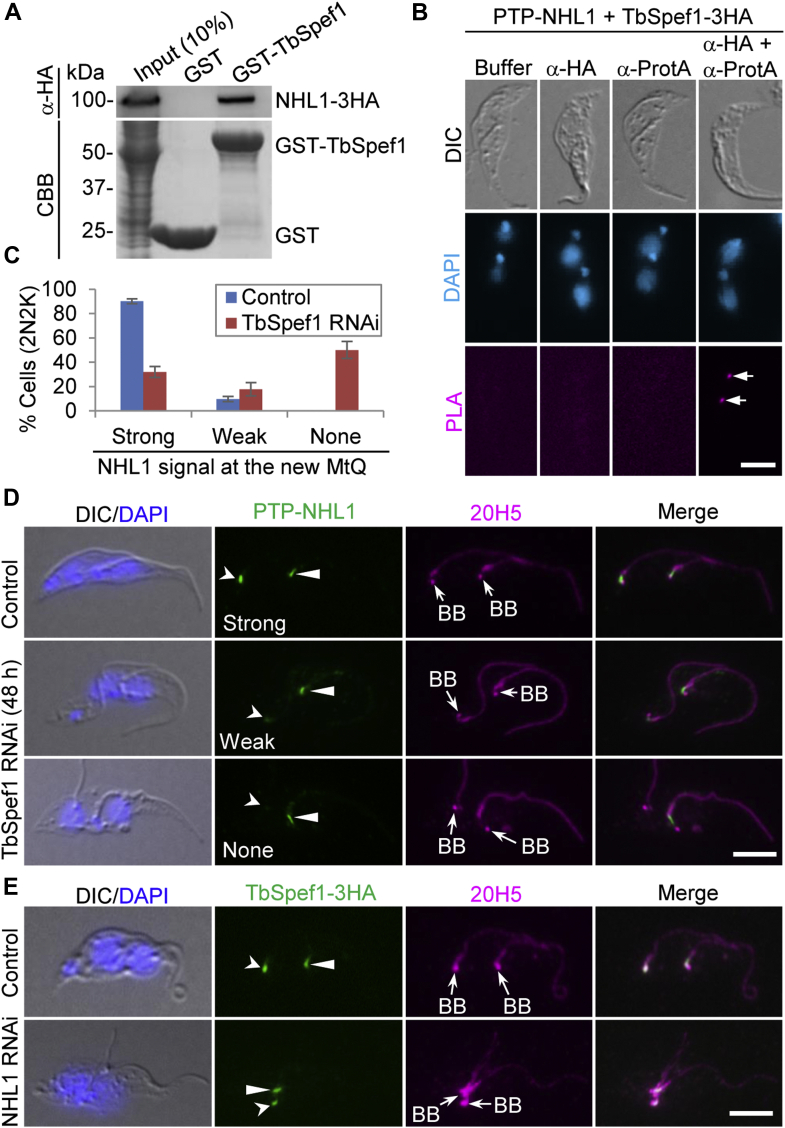
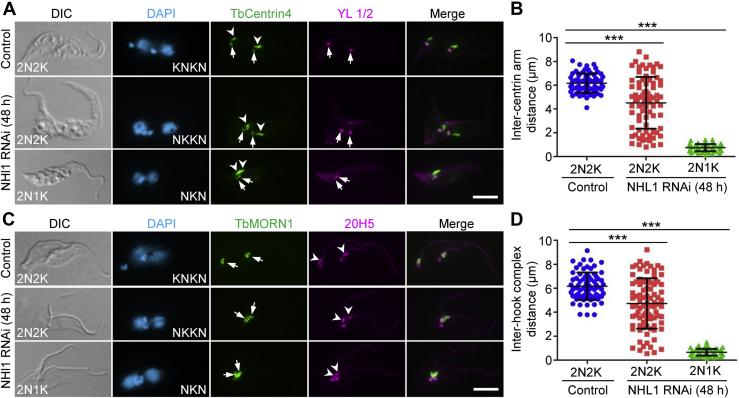
The human parasite Trypanosoma brucei contains a motile flagellum that determines the plane of cell division, controls cell morphology, and mediates cell-cell communication. During the cell cycle, inheritance of the newly formed flagellum requires its correct positioning toward the posterior of the cell, which depends on the faithful segregation of multiple flagellum-associated cytoskeletal structures including the basal body, the flagellar pocket collar, the flagellum attachment zone, and the hook complex. A specialized group of four microtubules termed the microtubule quartet (MtQ) originates from the basal body and runs through the flagellar pocket collar and the hook complex to extend, along the flagellum attachment zone, toward the anterior of the cell. However, the physiological function of the MtQ is poorly understood, and few MtQ-associated proteins have been identified and functionally characterized. We report here that an MtQ-localized protein named NHL1 interacts with the microtubule-binding protein TbSpef1 and depends on TbSpef1 for its localization to the MtQ. We show that RNAi-mediated knockdown of NHL1 impairs the segregation of flagellum-associated cytoskeletal structures, resulting in mispositioning of the new flagellum. Furthermore, knockdown of NHL1 also causes misplacement of the cell division plane in dividing trypanosome cells, halts cleavage furrow ingression, and inhibits completion of cytokinesis. These findings uncover a crucial role for the MtQ-associated protein NHL1 in regulating basal body segregation to promote flagellar inheritance in T. brucei.
人体寄生虫布氏锥虫含有一个可运动的鞭毛,它决定细胞分裂的平面,控制细胞形态,并介导细胞间的通讯。在细胞周期中,新形成的鞭毛的遗传需要其正确地朝向细胞的后部定位,这取决于多个鞭毛相关细胞骨架结构的忠实分离,包括基体、鞭毛口袋领、鞭毛附着区和钩复合体。一组被称为微管四联体(MtQ)的特殊的四个微管从基体起始,穿过鞭毛口袋领和钩复合体,沿着鞭毛附着区延伸到细胞的前部。然而,MtQ 的生理功能还知之甚少,并且很少有 MtQ 相关的蛋白质被鉴定和功能表征。我们在这里报告说,一种名为 NHL1 的 MtQ 定位蛋白与微管结合蛋白 TbSpef1 相互作用,并依赖于 TbSpef1 将其定位到 MtQ。我们表明,通过 RNAi 介导的 NHL1 敲低会损害与鞭毛相关的细胞骨架结构的分离,导致新鞭毛的位置不正。此外,NHL1 的敲低还会导致分裂锥虫细胞中的细胞分裂平面错位,停止分裂沟内陷,并抑制胞质分裂的完成。这些发现揭示了 MtQ 相关蛋白 NHL1 在调节基体分离以促进布氏锥虫中鞭毛遗传中的关键作用。