Dang Hung Quang, Zhou Qing, Rowlett Veronica W, Hu Huiqing, Lee Kyu Joon, Margolin William, Li Ziyin
Department of Microbiology and Molecular Genetics, McGovern Medical School, University of Texas Health Science Center at Houston, Houston, Texas, USA.
Department of Microbiology and Molecular Genetics, McGovern Medical School, University of Texas Health Science Center at Houston, Houston, Texas, USA
mBio. 2017 Jan 3;8(1):e02120-16. doi: 10.1128/mBio.02120-16.
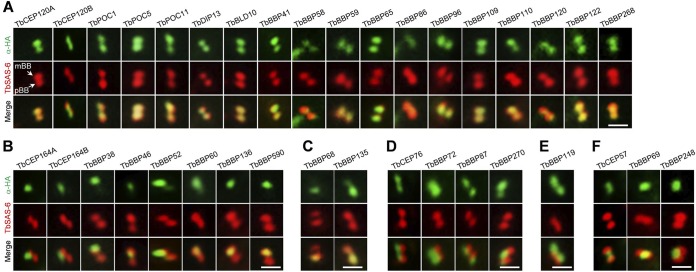
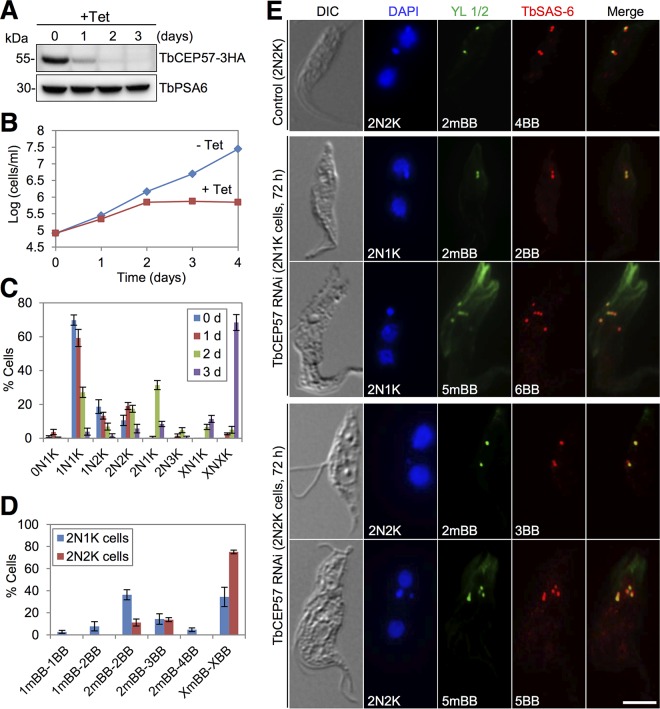
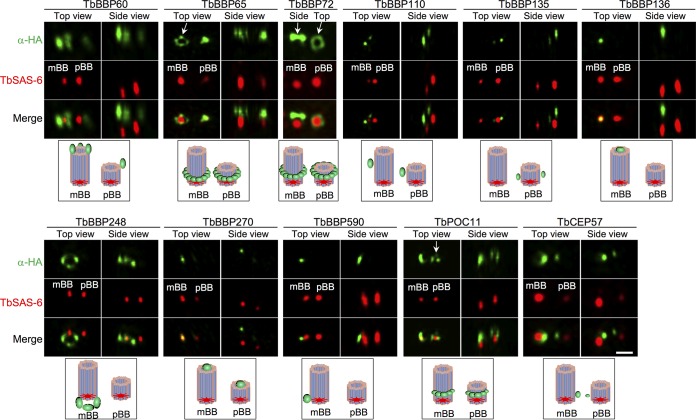
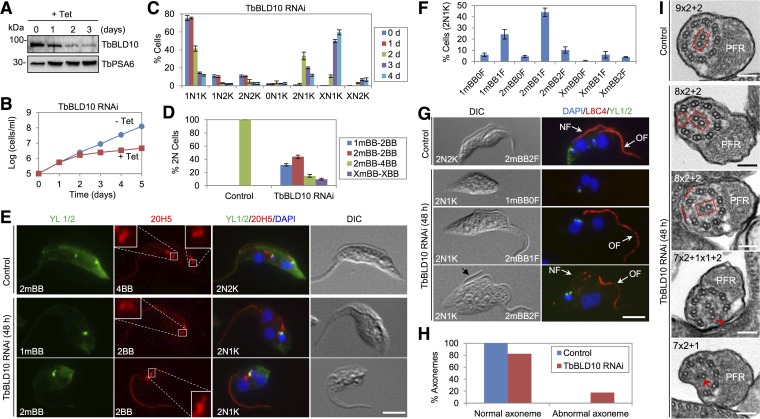
The basal body shares similar architecture with centrioles in animals and is involved in nucleating flagellar axonemal microtubules in flagellated eukaryotes. The early-branching Trypanosoma brucei possesses a motile flagellum nucleated from the basal body that consists of a mature basal body and an adjacent pro-basal body. Little is known about the basal body proteome and its roles in basal body biogenesis and flagellar axoneme assembly in T. brucei Here, we report the identification of 14 conserved centriole/basal body protein homologs and 25 trypanosome-specific basal body proteins. These proteins localize to distinct subdomains of the basal body, and several of them form a ring-like structure surrounding the basal body barrel. Functional characterization of representative basal body proteins revealed distinct roles in basal body duplication/separation and flagellar axoneme assembly. Overall, this work identified novel proteins required for basal body duplication and separation and uncovered new functions of conserved basal body proteins in basal body duplication and separation, highlighting an unusual mechanism of basal body biogenesis and inheritance in this early divergent eukaryote.
The basal body in the early-branching protozoan Trypanosoma brucei nucleates flagellum assembly and also regulates organelle segregation, cell morphogenesis, and cell division. However, the molecular composition and the assembly process of the basal body remain poorly understood. Here, we identify 14 conserved basal body proteins and 25 trypanosome-specific basal body proteins via bioinformatics, localization-based screening, and proximity-dependent biotin identification. We further localized these proteins to distinct subdomains of the basal body by using fluorescence microscopy and superresolution microscopy, discovered novel regulators of basal body duplication and separation, and uncovered new functions of conserved basal body proteins in basal body duplication and separation. This work lays the foundation for dissecting the mechanisms underlying basal body biogenesis and inheritance in T. brucei.
基体与动物中的中心粒具有相似的结构,并且在有鞭毛的真核生物中参与鞭毛轴丝微管的成核。早期分支的布氏锥虫拥有一条从基体产生的运动鞭毛,该基体由一个成熟的基体和一个相邻的前基体组成。关于布氏锥虫的基体蛋白质组及其在基体生物发生和鞭毛轴丝组装中的作用知之甚少。在此,我们报告鉴定出14种保守的中心粒/基体蛋白同源物和25种锥虫特异性基体蛋白。这些蛋白质定位于基体的不同亚结构域,其中几种形成围绕基体桶的环状结构。代表性基体蛋白的功能表征揭示了它们在基体复制/分离和鞭毛轴丝组装中的不同作用。总体而言,这项工作鉴定出了基体复制和分离所需的新蛋白质,并揭示了保守基体蛋白在基体复制和分离中的新功能,突出了这种早期分化真核生物中基体生物发生和遗传的一种不同寻常的机制。
早期分支的原生动物布氏锥虫中的基体启动鞭毛组装,还调节细胞器分离、细胞形态发生和细胞分裂。然而,基体的分子组成和组装过程仍知之甚少。在此,我们通过生物信息学、基于定位的筛选和邻近依赖性生物素鉴定,鉴定出14种保守的基体蛋白和25种锥虫特异性基体蛋白。我们进一步通过荧光显微镜和超分辨率显微镜将这些蛋白质定位于基体的不同亚结构域,发现了基体复制和分离的新调节因子,并揭示了保守基体蛋白在基体复制和分离中的新功能。这项工作为剖析布氏锥虫中基体生物发生和遗传的潜在机制奠定了基础。