Koga Shunsuke, Josephs Keith A, Aiba Ikuko, Yoshida Mari, Dickson Dennis W
Department of Neuroscience, Mayo Clinic, Jacksonville, Florida, USA
Department of Neurology, Mayo Clinic, Rochester, Minnesota, USA.
J Neurol Neurosurg Psychiatry. 2022 Jun 13;93(9):919-29. doi: 10.1136/jnnp-2021-328586.
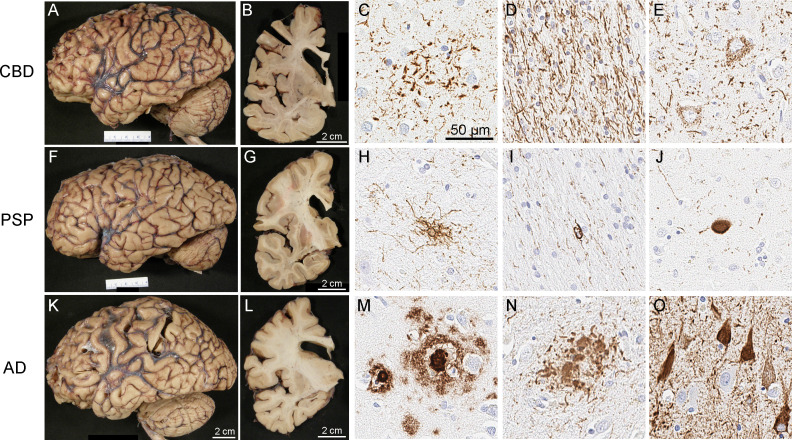
Corticobasal syndrome (CBS) is a clinical syndrome characterised by progressive asymmetric limb rigidity and apraxia with dystonia, myoclonus, cortical sensory loss and alien limb phenomenon. Corticobasal degeneration (CBD) is one of the most common underlying pathologies of CBS, but other disorders, such as progressive supranuclear palsy (PSP), Alzheimer's disease (AD) and frontotemporal lobar degeneration with TDP-43 inclusions, are also associated with this syndrome.In this review, we describe common and rare neuropathological findings in CBS, including tauopathies, synucleinopathies, TDP-43 proteinopathies, fused in sarcoma proteinopathy, prion disease (Creutzfeldt-Jakob disease) and cerebrovascular disease, based on a narrative review of the literature and clinicopathological studies from two brain banks. Genetic mutations associated with CBS, including and , are also reviewed. Clinicopathological studies on neurodegenerative disorders associated with CBS have shown that regardless of the underlying pathology, frontoparietal, as well as motor and premotor pathology is associated with CBS. Clinical features that can predict the underlying pathology of CBS remain unclear. Using AD-related biomarkers (ie, amyloid and tau positron emission tomography (PET) and fluid biomarkers), CBS caused by AD often can be differentiated from other causes of CBS. Tau PET may help distinguish AD from other tauopathies and non-tauopathies, but it remains challenging to differentiate non-AD tauopathies, especially PSP and CBD. Although the current clinical diagnostic criteria for CBS have suboptimal sensitivity and specificity, emerging biomarkers hold promise for future improvements in the diagnosis of underlying pathology in patients with CBS.
皮质基底节综合征(CBS)是一种临床综合征,其特征为进行性不对称肢体僵硬、失用症伴肌张力障碍、肌阵挛、皮质感觉丧失和异己肢体现象。皮质基底节变性(CBD)是CBS最常见的潜在病理之一,但其他疾病,如进行性核上性麻痹(PSP)、阿尔茨海默病(AD)以及伴有TDP-43包涵体的额颞叶变性,也与该综合征相关。在本综述中,我们基于对文献的叙述性综述以及来自两个脑库的临床病理研究,描述了CBS常见和罕见的神经病理学发现,包括tau蛋白病、α-突触核蛋白病、TDP-43蛋白病、肉瘤融合蛋白病、朊病毒病(克雅氏病)和脑血管病。还综述了与CBS相关的基因突变,包括[具体基因1]和[具体基因2]。关于与CBS相关的神经退行性疾病的临床病理研究表明,无论潜在病理如何,额顶叶以及运动和运动前区病理都与CBS相关。能够预测CBS潜在病理的临床特征仍不明确。使用与AD相关的生物标志物(即淀粉样蛋白和tau正电子发射断层扫描(PET)以及体液生物标志物),由AD引起的CBS通常可以与CBS的其他病因相鉴别。Tau PET可能有助于将AD与其他tau蛋白病和非tau蛋白病区分开来,但区分非AD tau蛋白病,尤其是PSP和CBD仍然具有挑战性。尽管目前CBS的临床诊断标准敏感性和特异性欠佳,但新兴的生物标志物有望在未来改善CBS患者潜在病理的诊断。