• 文献检索
  • 文档翻译
  • 深度研究
  • 学术资讯
  • Suppr Zotero 插件Zotero 插件
  • 邀请有礼
  • 套餐&价格
  • 历史记录
应用&插件
Suppr Zotero 插件Zotero 插件浏览器插件Mac 客户端Windows 客户端微信小程序
定价
高级版会员购买积分包购买API积分包
服务
文献检索文档翻译深度研究API 文档MCP 服务
关于我们
关于 Suppr公司介绍联系我们用户协议隐私条款
关注我们

Suppr 超能文献

核心技术专利:CN118964589B侵权必究
粤ICP备2023148730 号-1Suppr @ 2026

文献检索

告别复杂PubMed语法,用中文像聊天一样搜索,搜遍4000万医学文献。AI智能推荐,让科研检索更轻松。

立即免费搜索

文件翻译

保留排版,准确专业,支持PDF/Word/PPT等文件格式,支持 12+语言互译。

免费翻译文档

深度研究

AI帮你快速写综述,25分钟生成高质量综述,智能提取关键信息,辅助科研写作。

立即免费体验

使用改良呼吸频率氧合指数预测早期高流量鼻导管治疗结局。

Prediction of high-flow nasal cannula outcomes at the early phase using the modified respiratory rate oxygenation index.

机构信息

Department of Critical Care Medicine, Renji Hospital, School of Medicine, Shanghai Jiao Tong University, 160 Pujian Road, Shanghai, 200127, China.

Department of Biomedical Engineering, Fourth Military Medical University, Xi'an, China.

出版信息

BMC Pulm Med. 2022 Jun 13;22(1):227. doi: 10.1186/s12890-022-02017-8.

DOI:10.1186/s12890-022-02017-8
PMID:35698120
原文链接:https://pmc.ncbi.nlm.nih.gov/articles/PMC9189451/
Abstract

BACKGROUND

This study was designed to explore the early predictive value of the respiratory rate oxygenation (ROX) index modified by PaO (mROX) in high-flow nasal cannula (HFNC) therapy in patients with acute hypoxemia respiratory failure (AHRF).

METHOD

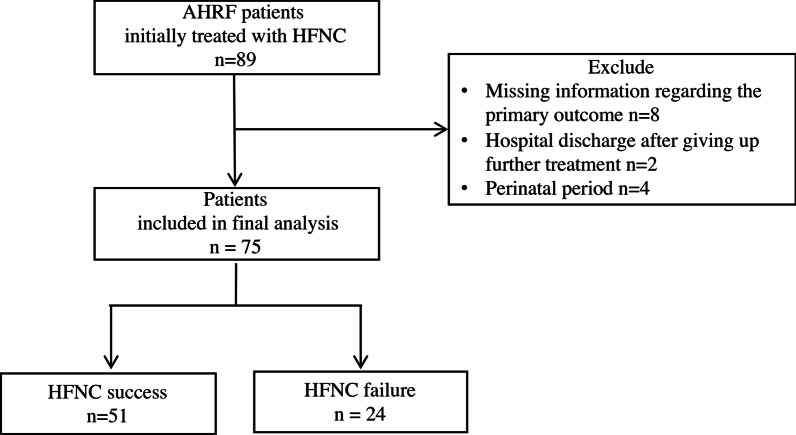
Seventy-five patients with AHRF treated with HFNC were retrospectively reviewed. Respiratory parameters at baseline and 2 h after HFNC initiation were analyzed. The predictive value of the ROX (ratio of pulse oximetry/FIO to respiratory rate) and mROX (ratio of arterial oxygen /FIO to respiratory rate) indices with two variations by adding heart rate to each index (ROX-HR and mROX-HR) was evaluated.

RESULTS

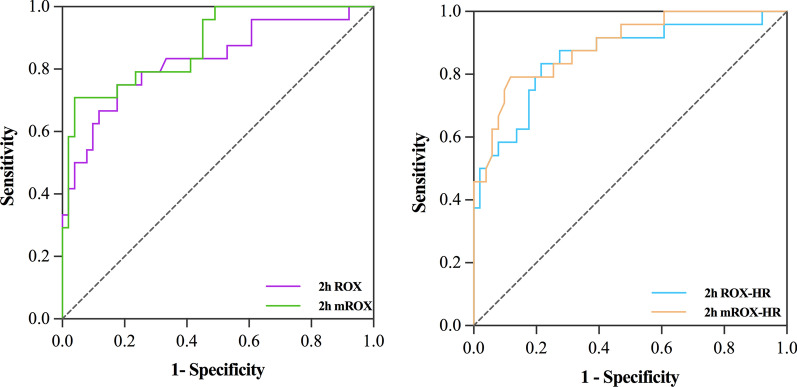
HFNC therapy failed in 24 patients, who had significantly higher intensive care unit (ICU) mortality and longer ICU stay. Both the ROX and mROX indices at 2 h after HFNC initiation can predict the risk of intubation after HFNC. Two hours after HFNC initiation, the mROX index had a higher area under the receiver operating characteristic curve (AUROC) for predicting HFNC success than the ROX index. Besides, baseline mROX index of greater than 7.1 showed a specificity of 100% for HFNC success.

CONCLUSION

The mROX index may be a suitable predictor of HFNC therapy outcomes at the early phase in patients with AHRF.

摘要

背景

本研究旨在探讨经动脉血氧分压(PaO )校正的呼吸率氧合(ROX)指数(mROX)在高流量鼻导管(HFNC)治疗急性低氧性呼吸衰竭(AHRF)患者中的早期预测价值。

方法

回顾性分析 75 例接受 HFNC 治疗的 AHRF 患者。分析 HFNC 起始后 2 小时的呼吸参数。评估 ROX(脉搏血氧饱和度/FIO 与呼吸率的比值)和 mROX(动脉氧/FIO 与呼吸率的比值)指数及其两种变体(每个指数均添加心率)的预测值(ROX-HR 和 mROX-HR)。

结果

HFNC 治疗失败 24 例,这组患者 ICU 死亡率和 ICU 住院时间明显更长。HFNC 起始后 2 小时的 ROX 和 mROX 指数均能预测 HFNC 后插管的风险。HFNC 起始后 2 小时,mROX 指数预测 HFNC 成功的 AUC 高于 ROX 指数。此外,mROX 指数的基线值大于 7.1 可特异性预测 HFNC 成功。

结论

mROX 指数可能是 AHRF 患者 HFNC 治疗早期结局的合适预测指标。
https://cdn.ncbi.nlm.nih.gov/pmc/blobs/62ef/9190143/c4f5a3c34f44/12890_2022_2017_Fig5_HTML.jpg
https://cdn.ncbi.nlm.nih.gov/pmc/blobs/62ef/9190143/d591b54c9b51/12890_2022_2017_Fig1_HTML.jpg
https://cdn.ncbi.nlm.nih.gov/pmc/blobs/62ef/9190143/8c7f351214d8/12890_2022_2017_Fig2_HTML.jpg
https://cdn.ncbi.nlm.nih.gov/pmc/blobs/62ef/9190143/3fad2a1f60b9/12890_2022_2017_Fig3_HTML.jpg
https://cdn.ncbi.nlm.nih.gov/pmc/blobs/62ef/9190143/3a4337c696f6/12890_2022_2017_Fig4_HTML.jpg
https://cdn.ncbi.nlm.nih.gov/pmc/blobs/62ef/9190143/c4f5a3c34f44/12890_2022_2017_Fig5_HTML.jpg
https://cdn.ncbi.nlm.nih.gov/pmc/blobs/62ef/9190143/d591b54c9b51/12890_2022_2017_Fig1_HTML.jpg
https://cdn.ncbi.nlm.nih.gov/pmc/blobs/62ef/9190143/8c7f351214d8/12890_2022_2017_Fig2_HTML.jpg
https://cdn.ncbi.nlm.nih.gov/pmc/blobs/62ef/9190143/3fad2a1f60b9/12890_2022_2017_Fig3_HTML.jpg
https://cdn.ncbi.nlm.nih.gov/pmc/blobs/62ef/9190143/3a4337c696f6/12890_2022_2017_Fig4_HTML.jpg
https://cdn.ncbi.nlm.nih.gov/pmc/blobs/62ef/9190143/c4f5a3c34f44/12890_2022_2017_Fig5_HTML.jpg

相似文献

1
Prediction of high-flow nasal cannula outcomes at the early phase using the modified respiratory rate oxygenation index.使用改良呼吸频率氧合指数预测早期高流量鼻导管治疗结局。
BMC Pulm Med. 2022 Jun 13;22(1):227. doi: 10.1186/s12890-022-02017-8.
2
[Value of modified ROX index in predicting the outcome of patients with acute respiratory distress syndrome due to SARS-CoV-2 infection treated with high-flow nasal cannula oxygen therapy].[改良ROX指数对预测新型冠状病毒2型感染所致急性呼吸窘迫综合征患者接受高流量鼻导管吸氧治疗预后的价值]
Zhonghua Wei Zhong Bing Ji Jiu Yi Xue. 2024 Jun;36(6):585-590. doi: 10.3760/cma.j.cn121430-20240228-00171.
3
Modified Respiratory Rate Oxygenation Index: An Early Warning Index for the Need of Intubation in COVID-19 Patients with High-Flow Nasal Cannula Therapy.改良呼吸频率氧合指数:高流量鼻导管治疗的 COVID-19 患者需要插管的早期预警指标。
J Emerg Med. 2023 Aug;65(2):e93-e100. doi: 10.1016/j.jemermed.2023.04.026. Epub 2023 May 26.
4
Comparison of ROX index (SpO/FIO ratio/respiratory rate) with a modified dynamic index incorporating PaO/FIO ratio and heart rate to predict high flow nasal cannula outcomes among patients with acute respiratory failure: a single centre retrospective study.比较 ROX 指数(SpO/FIO 比值/呼吸频率)与改良的动态指数(包括 PaO/FIO 比值和心率),以预测急性呼吸衰竭患者使用高流量鼻导管的结局:一项单中心回顾性研究。
BMC Pulm Med. 2022 Sep 16;22(1):350. doi: 10.1186/s12890-022-02121-9.
5
[Effect of high-flow nasal cannula oxygen on patients with chronic obstructive pulmonary disease and mild hypercapnia: a retrospective cohort study based on the Medical Information Mart for Intensive Care-IV database].高流量鼻导管吸氧对慢性阻塞性肺疾病合并轻度高碳酸血症患者的影响:一项基于重症监护医学信息集市-IV数据库的回顾性队列研究
Zhonghua Wei Zhong Bing Ji Jiu Yi Xue. 2021 Jun;33(6):686-691. doi: 10.3760/cma.j.cn121430-20210219-00258.
6
Respiratory rate‑oxygenation (ROX) index for predicting high-flow nasal cannula failure in patients with and without COVID-19.用于预测 COVID-19 患者和非 COVID-19 患者高流量鼻导管失败的呼吸频率-氧合(ROX)指数。
Am J Emerg Med. 2024 Jan;75:53-58. doi: 10.1016/j.ajem.2023.09.036. Epub 2023 Oct 14.
7
An Index Combining Respiratory Rate and Oxygenation to Predict Outcome of Nasal High-Flow Therapy.呼吸频率与氧合指数联合预测经鼻高流量治疗结局。
Am J Respir Crit Care Med. 2019 Jun 1;199(11):1368-1376. doi: 10.1164/rccm.201803-0589OC.
8
The use of respiratory rate-oxygenation index to predict failure of high-flow nasal cannula in patients with coronavirus disease 2019-associated acute respiratory distress syndrome: A retrospective study.应用呼吸频率-氧合指数预测 2019 冠状病毒病相关急性呼吸窘迫综合征患者使用高流量鼻导管治疗失败:一项回顾性研究。
PLoS One. 2023 Jun 21;18(6):e0287432. doi: 10.1371/journal.pone.0287432. eCollection 2023.
9
ROX index and SpO2/FiO2 ratio for predicting high-flow nasal cannula failure in hypoxemic COVID-19 patients: A multicenter retrospective study.ROX 指数和 SpO2/FiO2 比值预测低氧血症 COVID-19 患者高流量鼻导管治疗失败的多中心回顾性研究。
PLoS One. 2022 May 12;17(5):e0268431. doi: 10.1371/journal.pone.0268431. eCollection 2022.
10
Failure Prediction of High-Flow Nasal Cannula at the Conventional Oxygen Therapy Phase in the Emergency Department.急诊科常规氧疗阶段高流量鼻导管失败预测。
Respiration. 2024;103(8):488-495. doi: 10.1159/000540004. Epub 2024 Jun 22.

引用本文的文献

1
Real-time prediction of HFNC treatment failure in acute hypoxemic respiratory failure using machine learning.使用机器学习对急性低氧性呼吸衰竭患者高流量鼻导管治疗失败进行实时预测
Sci Rep. 2025 Aug 18;15(1):30245. doi: 10.1038/s41598-025-16061-x.
2
Predictive factors for failure of high flow nasal cannula among children with lower respiratory tract infection: A single center retrospective observational study.下呼吸道感染患儿高流量鼻导管吸氧失败的预测因素:一项单中心回顾性观察研究
PLoS One. 2025 Jul 14;20(7):e0328442. doi: 10.1371/journal.pone.0328442. eCollection 2025.
3
Comparisons of mortality predictions of mROX, CURB-65, and APACHE II in patients with severe pneumonia: A retrospective cohort study.

本文引用的文献

1
Effects of Carbon Dioxide and Temperature on the Oxygen-Hemoglobin Dissociation Curve of Human Blood: Implications for Avalanche Victims.二氧化碳和温度对人体血液氧-血红蛋白解离曲线的影响:对雪崩遇难者的启示
Front Med (Lausanne). 2022 Feb 7;8:808025. doi: 10.3389/fmed.2021.808025. eCollection 2021.
2
First Attempt at Using Electrical Impedance Tomography to Predict High Flow Nasal Cannula Therapy Outcomes at an Early Phase.首次尝试使用电阻抗断层成像技术早期预测高流量鼻导管治疗效果
Front Med (Lausanne). 2021 Oct 8;8:737810. doi: 10.3389/fmed.2021.737810. eCollection 2021.
3
Effects of high-flow oxygen therapy on patients with hypoxemia after extubation and predictors of reintubation: a retrospective study based on the MIMIC-IV database.
严重肺炎患者中mROX、CURB-65和APACHE II死亡率预测的比较:一项回顾性队列研究。
Medicine (Baltimore). 2025 Jun 13;104(24):e42931. doi: 10.1097/MD.0000000000042931.
4
Comparison of ROX index with modified indices incorporating heart rate, flow rate, and PaO/FiO ratio for early prediction of outcomes among patients initiated on post-extubation high-flow nasal cannula therapy.比较ROX指数与纳入心率、流速和动脉血氧分压/吸入氧浓度比的改良指数,用于拔管后高流量鼻导管治疗患者结局的早期预测。
Eur J Med Res. 2025 Mar 14;30(1):166. doi: 10.1186/s40001-025-02402-z.
5
Machine learning models compared with current clinical indices to predict the outcome of high flow nasal cannula therapy in acute hypoxemic respiratory failure.将机器学习模型与当前临床指标进行比较,以预测急性低氧性呼吸衰竭患者高流量鼻导管治疗的结果。
Crit Care. 2025 Mar 7;29(1):101. doi: 10.1186/s13054-025-05336-4.
6
Comparison of Modified ROX Index Score and ROX Index Score for Early Prediction of High Flow Nasal Oxygen Therapy Outcome in Patients with Acute Respiratory Failure: A Prospective Observational Cohort Study.改良ROX指数评分与ROX指数评分对急性呼吸衰竭患者高流量鼻导管给氧治疗结局早期预测的比较:一项前瞻性观察队列研究
Indian J Crit Care Med. 2024 Sep;28(9):842-846. doi: 10.5005/jp-journals-10071-24792. Epub 2024 Aug 31.
7
Risk factors analysis and prediction model construction for severe pneumonia in older adult patients.老年重症肺炎患者的危险因素分析及预测模型构建。
Front Public Health. 2024 Jun 3;12:1399470. doi: 10.3389/fpubh.2024.1399470. eCollection 2024.
8
ROX index as a predictor of failure of high-flow nasal cannula in infants with bronchiolitis.ROX 指数可预测毛细支气管炎婴儿高流量鼻导管吸氧失败。
Sci Rep. 2024 Jan 3;14(1):389. doi: 10.1038/s41598-024-51214-4.
9
Early Prediction of High-Flow Oxygen Therapy Failure in COVID-19 Acute Hypoxemic Respiratory Failure: A Retrospective Study of Scores and Thresholds.新型冠状病毒肺炎急性低氧性呼吸衰竭中高流量氧疗失败的早期预测:一项关于评分与阈值的回顾性研究
Cureus. 2022 Nov 30;14(11):e32087. doi: 10.7759/cureus.32087. eCollection 2022 Nov.
高流量氧疗对拔管后低氧血症患者的影响及再次插管的预测因素:基于 MIMIC-IV 数据库的回顾性研究。
BMC Pulm Med. 2021 May 13;21(1):160. doi: 10.1186/s12890-021-01526-2.
4
Association of noninvasive respiratory support with mortality and intubation rates in acute respiratory failure: a systematic review and network meta-analysis.急性呼吸衰竭中无创呼吸支持与死亡率和插管率的关联:一项系统评价和网状Meta分析
J Intensive Care. 2021 Apr 12;9(1):32. doi: 10.1186/s40560-021-00539-7.
5
Comparison of hypoxemia, intubation procedure, and complications for non-invasive ventilation against high-flow nasal cannula oxygen therapy for patients with acute hypoxemic respiratory failure: a non-randomized retrospective analysis for effectiveness and safety (NIVaHIC-aHRF).比较急性低氧性呼吸衰竭患者使用无创通气与高流量鼻导管氧疗的低氧血症、插管程序和并发症:一项评估有效性和安全性的非随机回顾性分析(NIVaHIC-aHRF)。
BMC Emerg Med. 2021 Jan 14;21(1):6. doi: 10.1186/s12873-021-00402-w.
6
The role for high flow nasal cannula as a respiratory support strategy in adults: a clinical practice guideline.高流量鼻导管在成人呼吸支持策略中的作用:临床实践指南。
Intensive Care Med. 2020 Dec;46(12):2226-2237. doi: 10.1007/s00134-020-06312-y. Epub 2020 Nov 17.
7
Use of nasal high flow oxygen during acute respiratory failure.急性呼吸衰竭时使用鼻高流量氧疗。
Intensive Care Med. 2020 Dec;46(12):2238-2247. doi: 10.1007/s00134-020-06228-7. Epub 2020 Sep 8.
8
High-flow nasal cannula oxygen therapy to treat patients with hypoxemic acute respiratory failure consequent to SARS-CoV-2 infection.高流量鼻导管氧疗治疗 COVID-19 感染所致低氧血症急性呼吸衰竭患者。
Thorax. 2020 Nov;75(11):998-1000. doi: 10.1136/thoraxjnl-2020-214993. Epub 2020 Jul 23.
9
Early prediction of high flow nasal cannula therapy outcomes using a modified ROX index incorporating heart rate.使用纳入心率的改良ROX指数对高流量鼻导管治疗结果进行早期预测。
J Intensive Care. 2020 Jun 22;8:41. doi: 10.1186/s40560-020-00458-z. eCollection 2020.
10
The arterial blood gas algorithm: Proposal of a systematic approach to analysis of acid-base disorders.动脉血气分析算法:酸碱紊乱分析的系统方法建议。
Rev Esp Anestesiol Reanim (Engl Ed). 2020 Jan;67(1):20-34. doi: 10.1016/j.redar.2019.04.001. Epub 2019 Dec 9.