Gangwar Vinod Kumar, Gurjar Om Prakash, Kumar Lalit, Agarwal Avinash, Mishra Vineet Kumar, Prasad Mishra Surendra, Pandey Saket
PhD Candidate, Department of Physics, M.J.P. Rohilkhand University, Bareilly Uttar Pradesh, India.
PhD, Government Cancer Hospital, Mahatma Gandhi Memorial Medical College, Indore-452001, India.
J Biomed Phys Eng. 2022 Jun 1;12(3):237-244. doi: 10.31661/jbpe.v0i0.2012-1246. eCollection 2022 Jun.
Modern radiotherapy techniques are using advanced algorithms; however, phantoms used for quality assurance have homogeneous density; accordingly, the development of heterogeneous phantom mimicking human body sites is imperative to examine variation between planned and delivered doses.
This study aimed to analyze the accuracy of planned dose by different algorithms using indigenously developed heterogeneous thoracic phantom (HT).
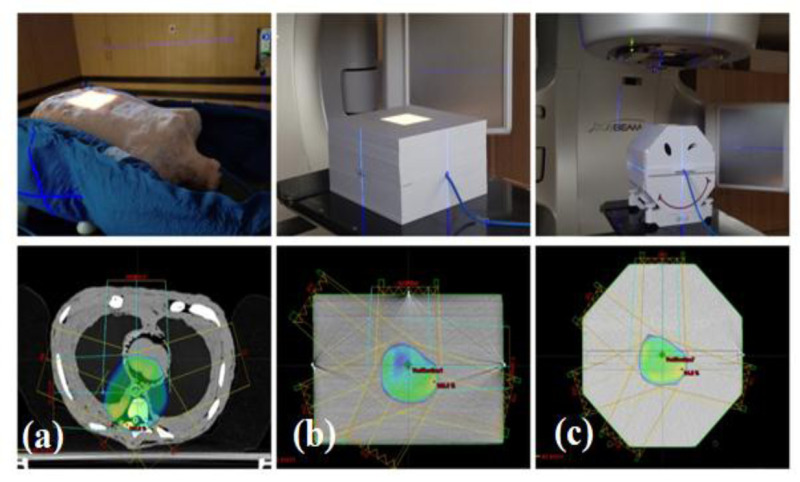
In this experimental study, computed tomography (CT) of HT was done, and the density of different parts was measured. The plan was generated on CT images of HCP with 6 and 15 Megavoltage (MV) photon beams using different treatment techniques, including three-dimensional conformal radiotherapy (3D-CRT), intensity-modulated radiation therapy (IMRT), and volumetric modulated arc therapy (VMAT). Plans were delivered by the linear accelerator, and the dose was measured using the ion chamber (IC) placed in HT; planned and measured doses were compared.
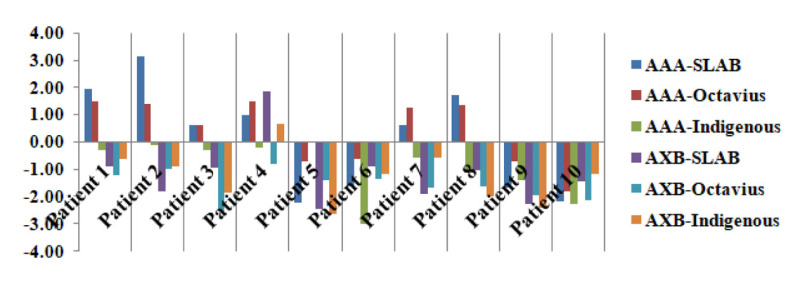
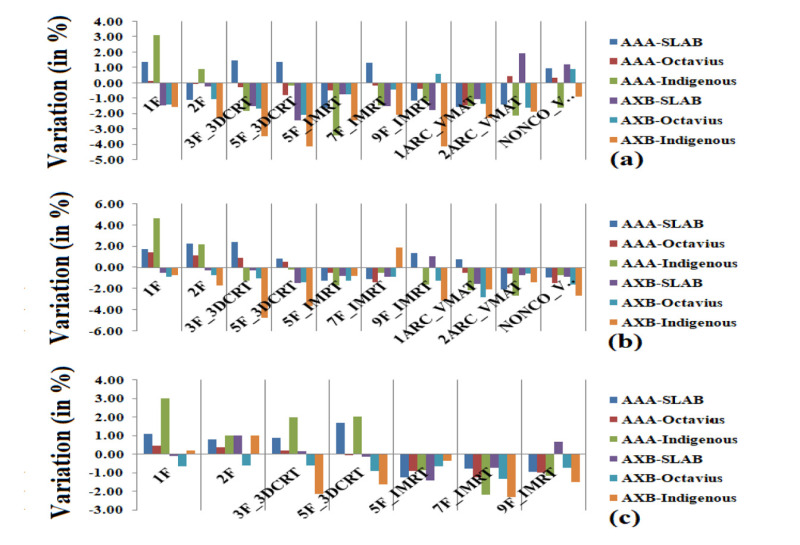
Density patterns for different parts of the fabricated phantom, including rib, spine, scapula, lung, chest wall, and heart were 1.849, 1.976, 1.983, 0.173, 0.855, and 0.833 g/cc, respectively. Variation between planned and IC estimated doses with the tolerance (±5%) for all photon energies using different techniques. Acuros-XB (AXB) showed a slightly higher variation between computed and IC estimated doses using HCP compared to the analytical anisotropic algorithm (AAA).
The indigenous heterogeneous phantom can accurately simulate the dosimetric scenario for different algorithms (AXB or AAA) and be also utilized for routine patient-specific QA.
现代放射治疗技术正在使用先进的算法;然而,用于质量保证的模体具有均匀的密度;因此,开发模仿人体部位的非均匀模体对于检查计划剂量和实际交付剂量之间的差异至关重要。
本研究旨在分析使用自主研发的非均匀胸部模体(HT)通过不同算法计算的计划剂量的准确性。
在本实验研究中,对HT进行了计算机断层扫描(CT),并测量了不同部位的密度。使用不同的治疗技术,包括三维适形放射治疗(3D-CRT)、调强放射治疗(IMRT)和容积调强弧形治疗(VMAT),在具有6和15兆伏(MV)光子束的HCP的CT图像上生成计划。计划由直线加速器执行,并使用放置在HT中的电离室(IC)测量剂量;比较计划剂量和测量剂量。
制造的模体不同部位的密度模式,包括肋骨、脊柱、肩胛骨、肺、胸壁和心脏,分别为1.849、1.976、1.983、0.173、0.855和0.833克/立方厘米。使用不同技术的所有光子能量下,计划剂量与IC估计剂量之间的差异在公差(±5%)范围内。与分析各向异性算法(AAA)相比,使用HCP时,Acuros-XB(AXB)在计算剂量与IC估计剂量之间显示出略高的差异。
自主研发的非均匀模体可以准确模拟不同算法(AXB或AAA)的剂量学情况,也可用于常规的患者特异性质量保证。