Department of Pathology, Saitama Medical University International Medical Center, Saitama, Japan.
Department of Uro-Oncology, Saitama Medical University International Medical Center, Saitama, Japan.
Cancer Med. 2022 Nov;11(22):4236-4245. doi: 10.1002/cam4.4779. Epub 2022 Jun 14.
Immune checkpoint inhibitors (ICIs) are effective in some cancer patients; however, they may show no efficacy in others. Predictive biomarkers are crucial for appropriately selecting the patients who receive ICI therapy. This study aimed to clarify the predictors of disease progression in urothelial carcinoma (UC) patients treated with an ICI, pembrolizumab.
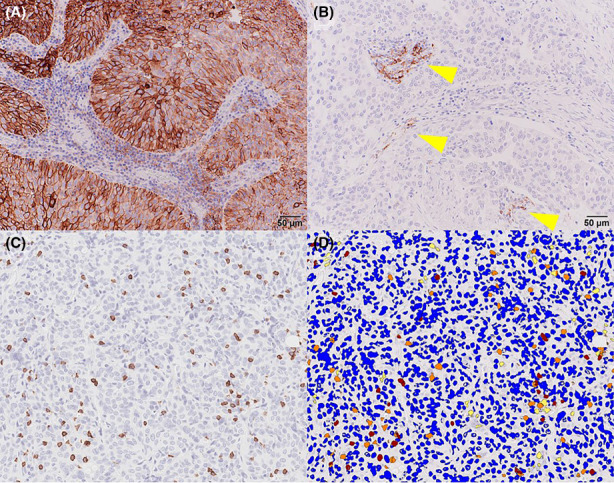
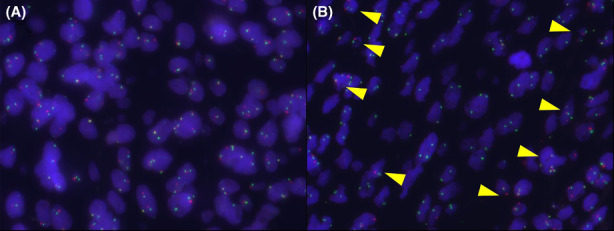
We analyzed the response patterns of 50 UC patients who were treated with pembrolizumab, as well as the association between survival and clinicopathological factors. Clinical factors included age, sex, body mass index, clinical courses, laboratory data, metastases, and adverse events. Pathological factors included special variant, squamous differentiation, programmed cell death ligand-1 (PD-L1) expression, CD8-positive lymphocytes density, and CDKN2A/p16 homozygous deletion.
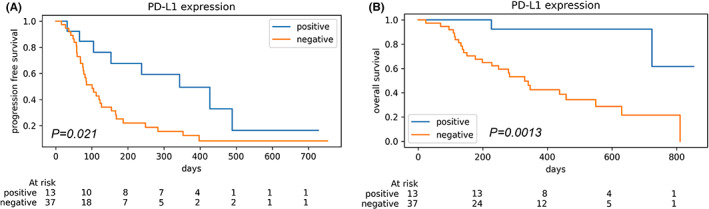
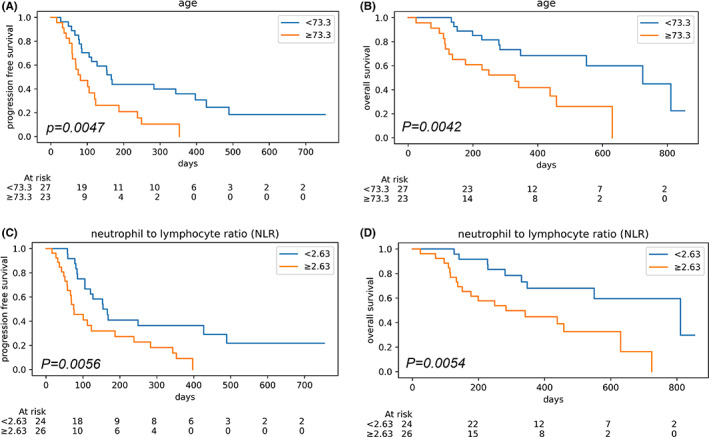
During pembrolizumab treatment, four (8%), 11 (22%), and eight (16%) patients achieved the best-case scenarios of complete response, partial response, and stable disease, respectively. Twenty-seven patients (54%) showed progressive disease. In this study, younger age, lower preoperative neutrophil-to-lymphocyte ratio (NLR), and positive PD-L1 expression were significantly correlated with longer progression-free survival and overall survival. Moreover, lower NLR and positive PD-L1 expression were independently associated with longer OS in multivariate analysis.
Based on our observations, lower NLR and positive PD-L1 expression may be independent favorable prognostic markers in UC patients treated with pembrolizumab. These results suggest that both host and tumor status can reflect the effectiveness of pembrolizumab among patients with UC.
免疫检查点抑制剂(ICIs)在一些癌症患者中有效;然而,在其他患者中可能没有疗效。预测生物标志物对于适当选择接受 ICI 治疗的患者至关重要。本研究旨在阐明接受 ICI 治疗的膀胱癌患者疾病进展的预测因素。
我们分析了 50 例接受 pembrolizumab 治疗的膀胱癌患者的反应模式,以及生存与临床病理因素之间的关系。临床因素包括年龄、性别、体重指数、临床病程、实验室数据、转移和不良事件。病理因素包括特殊变异、鳞状分化、程序性死亡配体 1(PD-L1)表达、CD8 阳性淋巴细胞密度和 CDKN2A/p16 纯合缺失。
在 pembrolizumab 治疗期间,4 名(8%)、11 名(22%)和 8 名(16%)患者分别达到完全缓解、部分缓解和稳定疾病的最佳情况。27 名患者(54%)出现疾病进展。在本研究中,年龄较小、术前中性粒细胞与淋巴细胞比值(NLR)较低和 PD-L1 表达阳性与无进展生存期和总生存期较长显著相关。此外,在多变量分析中,较低的 NLR 和 PD-L1 表达阳性与 OS 较长独立相关。
根据我们的观察,较低的 NLR 和 PD-L1 表达可能是接受 pembrolizumab 治疗的膀胱癌患者的独立有利预后标志物。这些结果表明,宿主和肿瘤状态都可以反映 pembrolizumab 在 UC 患者中的疗效。