Monash Cardiovascular Research Centre, Victorian Heart Institute Monash University Melbourne Victoria Australia.
Monash Heart Monash Health Melbourne Victoria Australia.
J Am Heart Assoc. 2022 Jun 21;11(12):e025862. doi: 10.1161/JAHA.121.025862. Epub 2022 Jun 14.
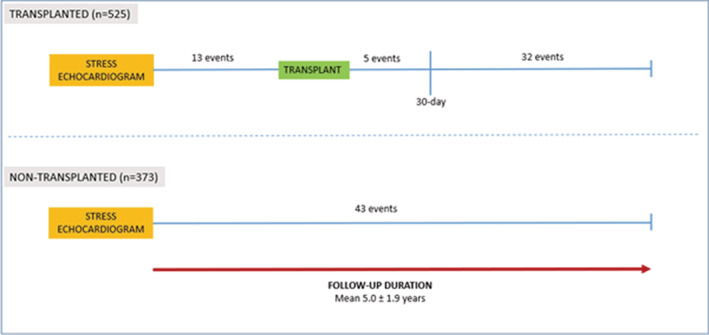
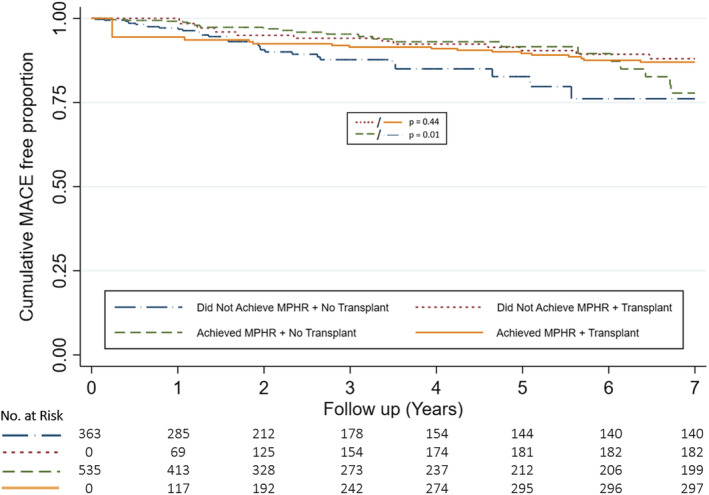
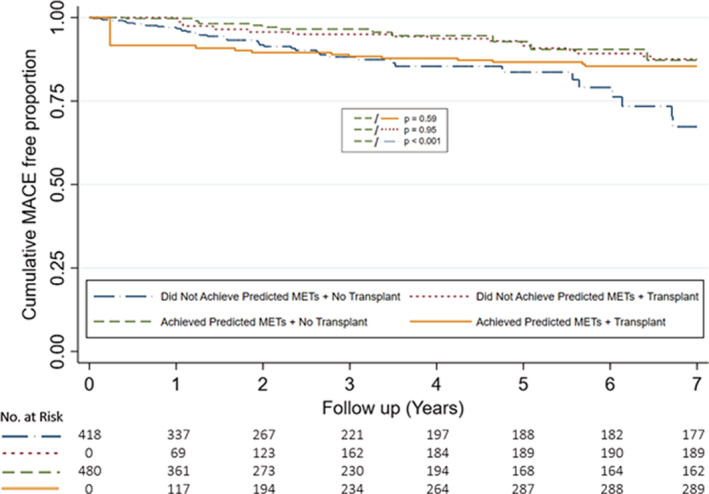
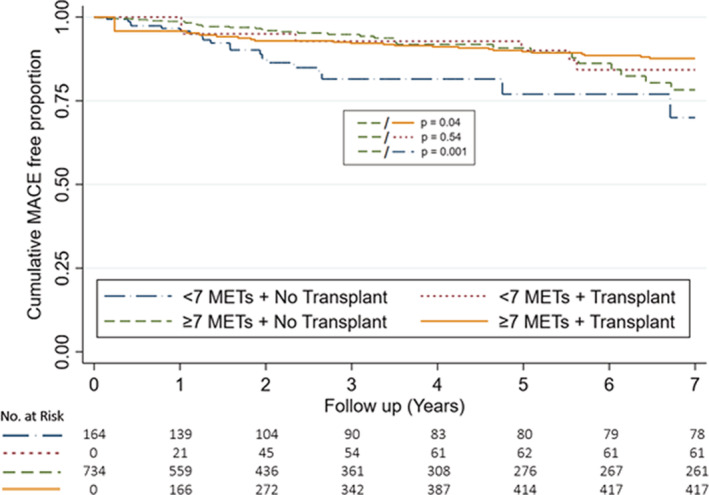
Background Exercise stress testing for cardiovascular assessment in kidney transplant candidates has been shown to be a feasible alternative to pharmacologic methods. Exercise stress testing allows the additional assessment of exercise capacity, which may have prognostic value for long-term cardiovascular outcomes in pre-transplant recipients. This study aimed to evaluate the prognostic value of exercise capacity on long-term cardiovascular outcomes in kidney transplant candidates. Methods and Results We retrospectively evaluated exercise capacity in 898 consecutive kidney transplant candidates between 2013 and 2020 who underwent symptom-limited exercise stress echocardiography for pre-transplant cardiovascular assessment. Exercise capacity was measured by age- and sex-predicted metabolic equivalents (METs). The primary outcome was incident major adverse cardiovascular events, defined as cardiac death, non-fatal myocardial infarction, and stroke. Cox proportional hazard multivariable modeling was performed to define major adverse cardiovascular events predictors with transplantation treated as a time-varying covariate. A total of 429 patients (48%) achieved predicted METs. During follow-up, 93 (10%) developed major adverse cardiovascular events and 525 (58%) underwent transplantation. Achievement of predicted METs was independently associated with reduced major adverse cardiovascular events (hazard ratio [HR] 0.49; [95% CI 0.29-0.82], =0.007), as was transplantation (HR, 0.52; [95% CI 0.30-0.91], =0.02). Patients achieving predicted METs on pre-transplant exercise stress echocardiography had favorable outcomes that were independent (HR, 0.78; [95% CI 0.32-1.92], =0.59) and of similar magnitude to subsequent transplantation (HR, 0.97; [95% CI 0.42-2.25], =0.95). Conclusions Achievement of predicted METs on pre-transplant exercise stress echocardiography confers excellent prognosis independent of and of similar magnitude to subsequent kidney transplantation. Future studies should assess the benefit on exercise training in this population.
对于肾移植候选者,运动压力测试已被证明是一种替代药物的可行方法,可用于心血管评估。运动压力测试可额外评估运动能力,而运动能力对移植前受者的长期心血管结局具有预后价值。本研究旨在评估肾移植候选者运动能力对长期心血管结局的预后价值。
我们回顾性评估了 2013 年至 2020 年间 898 例连续接受症状限制运动超声心动图进行移植前心血管评估的肾移植候选者的运动能力。运动能力通过年龄和性别预测的代谢当量(METs)来衡量。主要结局是发生重大不良心血管事件,定义为心脏死亡、非致死性心肌梗死和中风。使用 Cox 比例风险多变量模型来定义重大不良心血管事件的预测因素,将移植作为时变协变量进行处理。共有 429 例患者(48%)达到预测 METs。随访期间,93 例(10%)发生重大不良心血管事件,525 例(58%)接受了移植。达到预测 METs 与降低重大不良心血管事件相关(风险比 [HR] 0.49;95%CI 0.29-0.82,=0.007),移植也是如此(HR,0.52;95%CI 0.30-0.91,=0.02)。在移植前运动超声心动图上达到预测 METs 的患者的结局良好,且与随后的移植独立相关(HR,0.78;95%CI 0.32-1.92,=0.59),且与随后的移植相似(HR,0.97;95%CI 0.42-2.25,=0.95)。
在移植前运动超声心动图上达到预测 METs 可独立于随后的肾移植获得极佳的预后,且与随后的肾移植效果相当。未来的研究应评估该人群进行运动训练的获益。