Scheie Eye Institute, Perelman School of Medicine, University of Pennsylvania, 51 North 39th St, PA, 19104, Philadelphia, USA.
BMC Ophthalmol. 2022 Jun 14;22(1):266. doi: 10.1186/s12886-022-02475-y.
Inherited retinal degenerations (IRDs) affect daylight and night vision to different degrees. In the current work, we devise a method to quantify mobility under dark-adapted conditions in patients with severe childhood blindness due to Leber congenital amaurosis (LCA). Mobility thresholds from two different LCA genotypes are compared to dark-adapted vision measurements using the full-field stimulus test (FST), a conventional desktop outcome measure of rod vision.
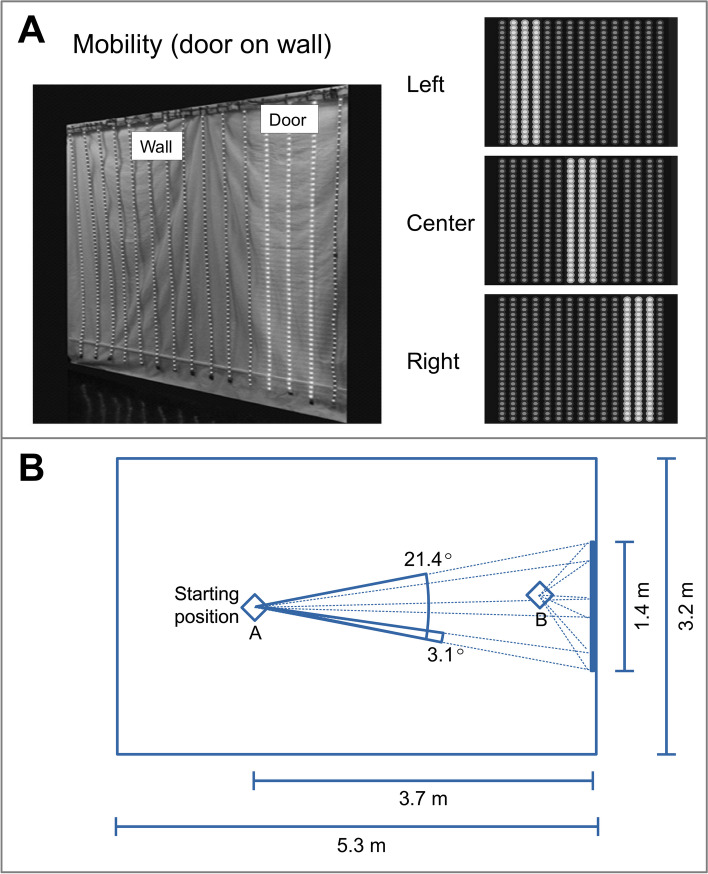
A device consisting of vertical LED strips on a plane resembling a beaded curtain was programmed to produce a rectangular pattern target defining a 'door' of varying luminance that could appear at one of three positions. Mobility performance was evaluated by letting the subject walk from a fixed starting position ~ 4 m away from the device with instructions to touch the door. Success was defined as the subject touching within the 'door' area. Ten runs were performed and the process was repeated for different levels of luminance. Tests were performed monocularly in dark-adapted and dilated eyes. Results from LCA patients with the GUCY2D and CEP290 genotypes and normal subjects were analyzed using logistic regression to estimate the mobility threshold for successful navigation. The relation of thresholds for mobility, FST and visual acuity were quantified using linear regression.
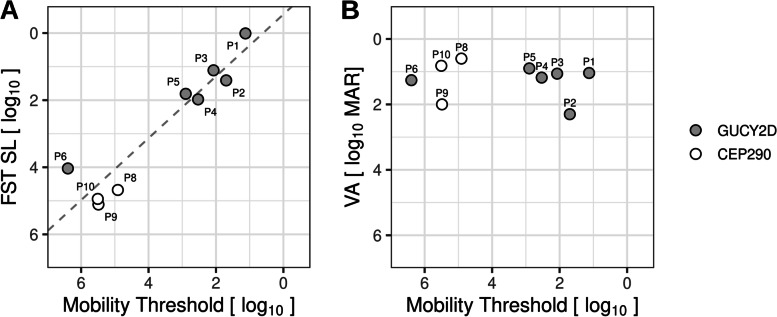
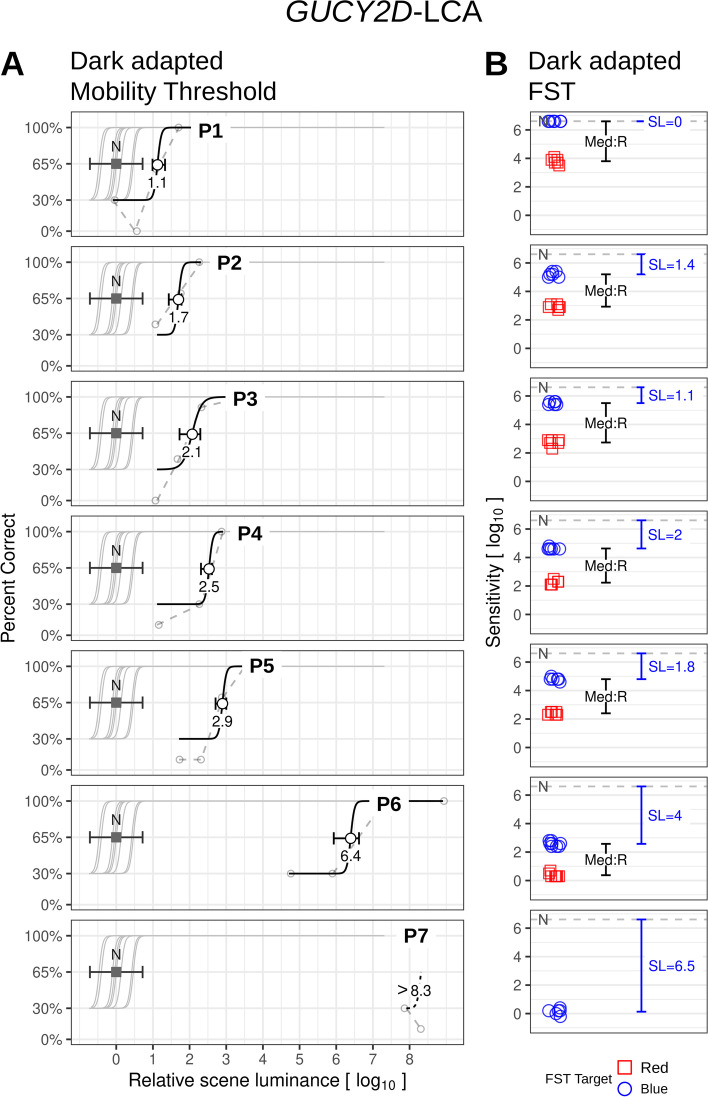
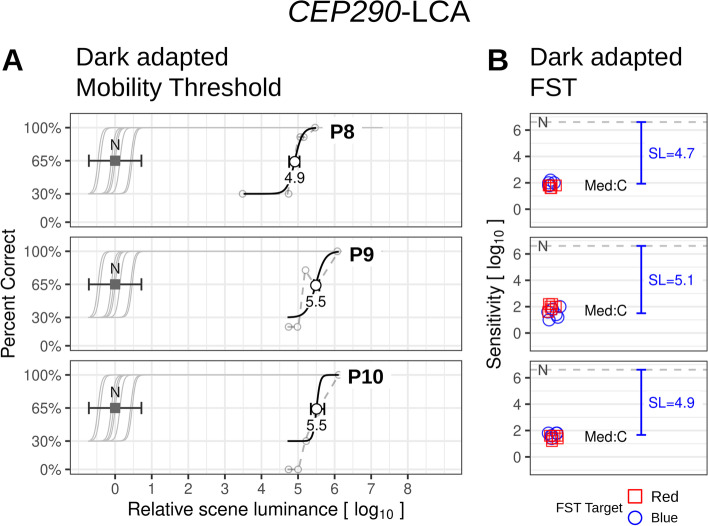
Normal subjects had mobility thresholds near limits of dark-adapted rod vision. GUCY2D-LCA patients had a wide range of mobility thresholds from within 1 log of normal to greater than 8 log abnormal. CEP290-LCA patients had abnormal mobility thresholds that were between 5 and 6 log from normal. Sensitivity loss estimates using FST related linearly to the mobility thresholds which were not correlated with visual acuity.
The mobility task we developed can quantify functional vision in severely disabled patients with LCA. Taken together with other outcome measures of rod and cone photoreceptor-mediated vision, dark-adapted functional vision should provide a more complete understanding of the natural history and effects of treatment in patients with LCA.
遗传性视网膜退行性疾病(IRDs)不同程度地影响日间和夜间视力。在目前的工作中,我们设计了一种方法来量化因莱伯先天性黑矇(LCA)而导致严重儿童失明患者在暗适应条件下的活动能力。将两种不同 LCA 基因型的移动阈值与使用全视野刺激测试(FST)的暗适应视力测量值进行比较,FST 是一种传统的台式棒状视敏度的结果测量方法。
一个由平面上垂直的 LED 条组成的装置类似于珠状窗帘,被编程为产生一个矩形目标图案,定义一个亮度可变的“门”,可以出现在三个位置中的一个位置。通过让受试者从距离装置约 4 米的固定起始位置行走,并指示触摸“门”来评估移动性能。成功定义为受试者触摸到“门”区域内。进行了十次运行,并在不同亮度水平下重复该过程。在暗适应和散瞳眼睛中进行了单眼测试。使用逻辑回归分析来估计成功导航的移动阈值,对具有 GUCY2D 和 CEP290 基因型的 LCA 患者和正常受试者的结果进行分析。使用线性回归来量化移动阈值、FST 和视力之间的关系。
正常受试者的移动阈值接近暗适应棒状视敏度的极限。GUCY2D-LCA 患者的移动阈值范围从正常的 1 对数以内到大于 8 对数异常。CEP290-LCA 患者的移动阈值异常,介于正常的 5 对数到 6 对数之间。使用 FST 估计的灵敏度损失与移动阈值线性相关,而与视力无关。
我们开发的移动任务可以量化 LCA 严重残疾患者的功能性视力。与棒状和锥状光感受器介导的视力的其他结果测量值结合使用,暗适应功能视力应该提供对 LCA 患者自然史和治疗效果的更全面的理解。