Department of Psychiatry, Chung-Ang University Gwangmyeong Hospital, Gyeonggi-do, Korea.
National Center for Disaster and Trauma, National Center for Mental Health, Seoul, Korea.
BMC Public Health. 2022 Jun 14;22(1):1183. doi: 10.1186/s12889-022-13560-8.
The April 2019 wildfires in Gangwon Province, South Korea forced the evacuation of 1500 individuals and cost more than $100 million in damages, making it the worst wildfire disaster in Korean history. The purpose of this paper was to investigate the mental health effects on survivors following the wildfires.
Between April and May 2019, outreach psychological support services were delivered to people impacted by the wildfires. Post-disaster psychological responses using a checklist and the Clinical Global Impression Scale-Severity (CGI-S) were evaluated for 206 wildfires survivors. The CGI-S was administered consequently at 1, 3, and 6 months after baseline measurement.
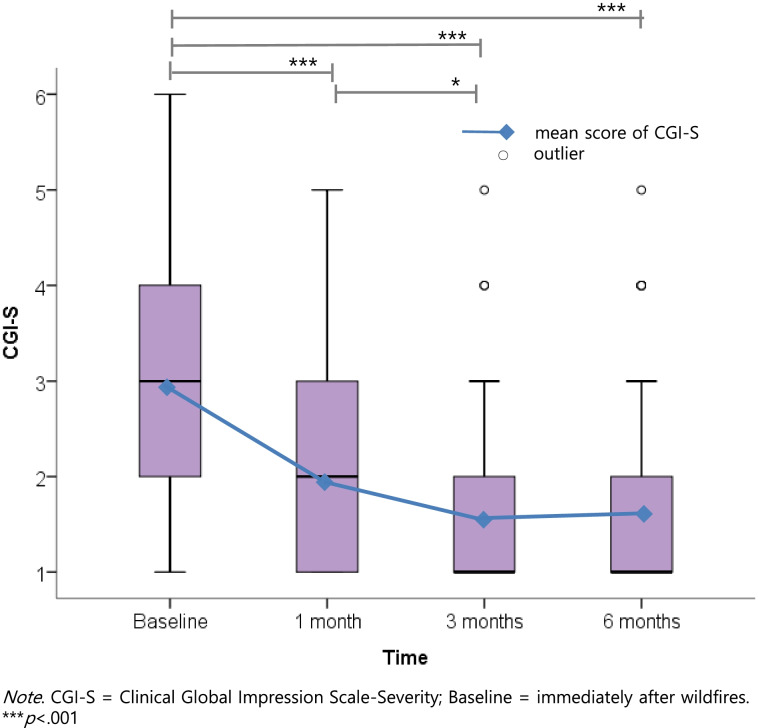
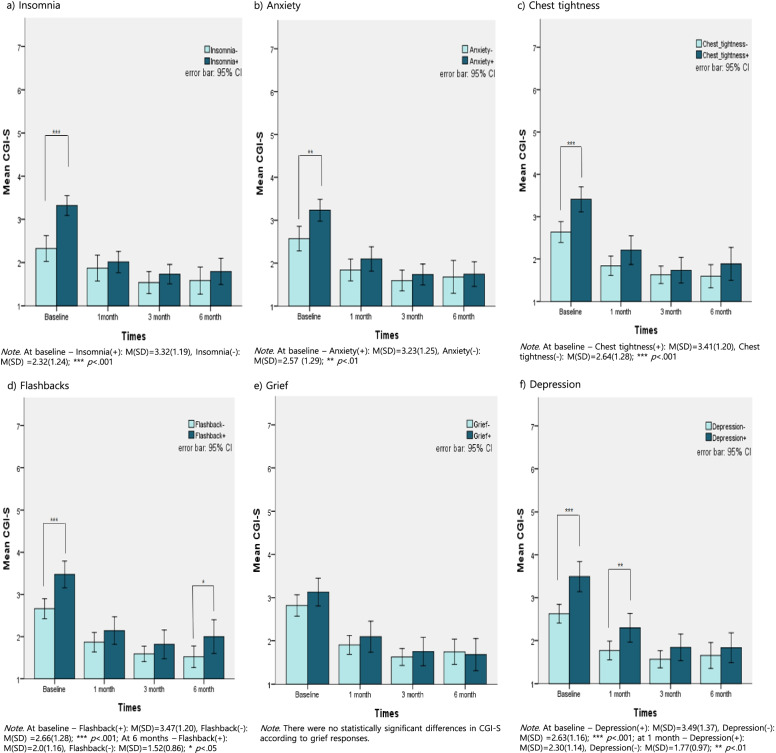
Among four response categories, somatic responses (76.2%) were most frequently observed among the wildfire survivors. Specifically, insomnia (59.2%), anxiety (50%), chest tightness (34%), grief (33%), flashbacks (33%), and depression (32.5%) were reported by over 30% of the participants. The mean CGI-S scores were significantly decreased at 1 month (mean score = 1.94; SE = 0.09) compared to baseline (mean score = 2.94; SE = 0.08) and remained at the decreased level until 6 months (mean score = 1.66; SE = 0.11). However, participants with flashbacks showed significantly higher CGI-S scores compared to those without flashback at 6 months.
Wildfire survivors have various post-disaster responses, especially somatic responses. While most participants' mental health improved over time, a few of them may have experienced prolonged psychological distress after 6 months. Flashbacks were particularly associated with continuing distress. These results suggest that the characteristics of responses should be considered in early phase intervention and in follow-up plans for disaster survivors.
2019 年 4 月韩国江原道发生森林大火,迫使 1500 人撤离,损失超过 1 亿美元,成为韩国历史上最严重的森林火灾灾难。本文旨在调查森林大火对幸存者的心理健康影响。
2019 年 4 月至 5 月期间,向受森林大火影响的人群提供了外展心理支持服务。使用清单和临床总体印象量表严重程度(CGI-S)对 206 名森林大火幸存者进行了灾后心理反应评估。CGI-S 在基线测量后 1、3 和 6 个月进行评估。
在四个反应类别中,躯体反应(76.2%)是火灾幸存者中最常见的。具体来说,失眠(59.2%)、焦虑(50%)、胸闷(34%)、悲伤(33%)、闪回(33%)和抑郁(32.5%)在超过 30%的参与者中报告。与基线相比,1 个月时的 CGI-S 评分明显下降(平均评分=1.94;SE=0.09),与基线相比,6 个月时的 CGI-S 评分仍保持在较低水平(平均评分=1.66;SE=0.11)。然而,有闪回的参与者在 6 个月时的 CGI-S 评分明显高于没有闪回的参与者。
森林大火幸存者有多种灾后反应,特别是躯体反应。虽然大多数参与者的心理健康状况随着时间的推移而改善,但其中一些人在 6 个月后可能会经历持续的心理困扰。闪回与持续的痛苦特别相关。这些结果表明,在早期干预和灾难幸存者的后续计划中,应考虑反应的特征。