Department of Medical & Molecular Genetics.
Department of Medicine, Division of Nephrology, Indiana University School of Medicine, Indianapolis, Indiana, USA.
Curr Opin Nephrol Hypertens. 2022 Jul 1;31(4):320-325. doi: 10.1097/MNH.0000000000000797. Epub 2022 Jun 10.
Chronic kidney disease (CKD) is a progressive disorder that is associated with development of elevated fibroblast growth factor 23 (FGF23) levels and anemia. Here, we review recent literature that extends our current knowledge on the interactions between FGF23 and anemia in CKD and the impact of anemia-targeting therapeutics on FGF23 elevation in CKD.
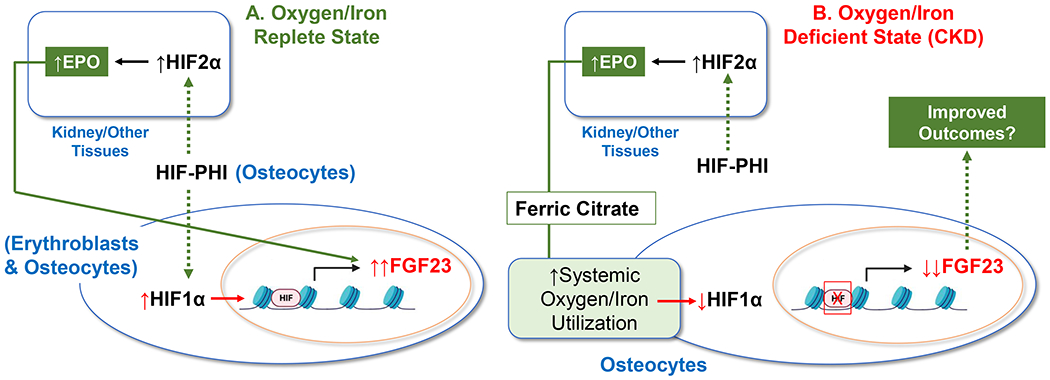
The anemia of CKD is primarily driven by a lack of erythropoietin (EPO) and iron deficiency. In addition to EPO and iron replacement, novel drug classes to treat anemia have been approved or are in clinical development. A recent observational study provides supportive evidence for the hypothesis that FGF23 elevation in CKD mediates adverse effects of iron deficiency on the cardiovascular system in patients with CKD. Preclinical and clinical studies revealed that ferric citrate (FC), and hypoxia-induced factor-prolyl hydroxylase inhibitor (HIF-PHI) treatment may reduce elevated FGF23 levels in CKD, suggesting that correcting anemia in CKD could potentially lower FGF23 levels. However, as we describe, HIF-PHI have context-dependent effects. Moreover, whether a reduction in FGF23 will improve patient outcomes in patients with CKD remains to be determined.
With the emergence of novel therapeutics to treat oxygen and iron utilization deficits in CKD, studies have investigated the impact of these new drugs on FGF23. Several of these drugs, including FC and HIF-PHIs, alleviate iron homeostasis alterations in CKD and are associated with FGF23 reduction. Herein, we review the relationships between oxygen/iron sensing and FGF23 in CKD, recent findings which link FGF23 with cardiac dysfunction, as well as future translational and clinical avenues.
慢性肾脏病(CKD)是一种进行性疾病,其特征是成纤维细胞生长因子 23(FGF23)水平升高和贫血。在此,我们综述了最近的文献,这些文献扩展了我们目前对 CKD 中 FGF23 与贫血之间相互作用的认识,以及贫血靶向治疗对 CKD 中 FGF23 升高的影响。
CKD 的贫血主要是由促红细胞生成素(EPO)和铁缺乏引起的。除了 EPO 和铁的补充外,新型药物类别已被批准或正在临床开发中用于治疗贫血。最近的一项观察性研究为假设提供了支持性证据,即 CKD 中的 FGF23 升高介导了铁缺乏对 CKD 患者心血管系统的不良影响。临床前和临床研究表明,柠檬酸铁(FC)和缺氧诱导因子脯氨酰羟化酶抑制剂(HIF-PHI)治疗可能降低 CKD 中升高的 FGF23 水平,这表明纠正 CKD 中的贫血可能潜在降低 FGF23 水平。然而,正如我们所描述的,HIF-PHI 具有上下文相关的作用。此外,降低 FGF23 是否会改善 CKD 患者的预后仍有待确定。
随着新型治疗药物的出现,用于治疗 CKD 中的氧气和铁利用不足,研究已经调查了这些新药对 FGF23 的影响。这些药物中的几种,包括 FC 和 HIF-PHIs,缓解了 CKD 中的铁稳态改变,并与 FGF23 的降低有关。在此,我们综述了 CKD 中氧气/铁感应与 FGF23 之间的关系、最近将 FGF23 与心脏功能障碍联系起来的发现,以及未来的转化和临床途径。