Universidade Federal de Minas Gerais. Escola de Enfermagem. Departamento de Enfermagem Materno-Infantil e Saúde Pública. Belo Horizonte, MG, Brasil.
Universidade Federal de Minas Gerais. Faculdade de Medicina. Belo Horizonte, MG, Brasil.
Rev Saude Publica. 2022 Jun 13;56:45. doi: 10.11606/s1518-8787.2022056004503. eCollection 2022.
To analyze the number of yellow fever vaccine doses administered before and during the covid-19 pandemic in Brazil.
This is an ecological, time series study based on data from the National Immunization Program. Differences between the median number of yellow fever vaccine doses administered in Brazil and in its regions before (from April/2019 to March/2020) and after (from April/2020 to March/2021) the implementation of social distancing measures in the country were assessed via the Mann-Whitney test. Prais-Winsten regression models were used for time series analyses.
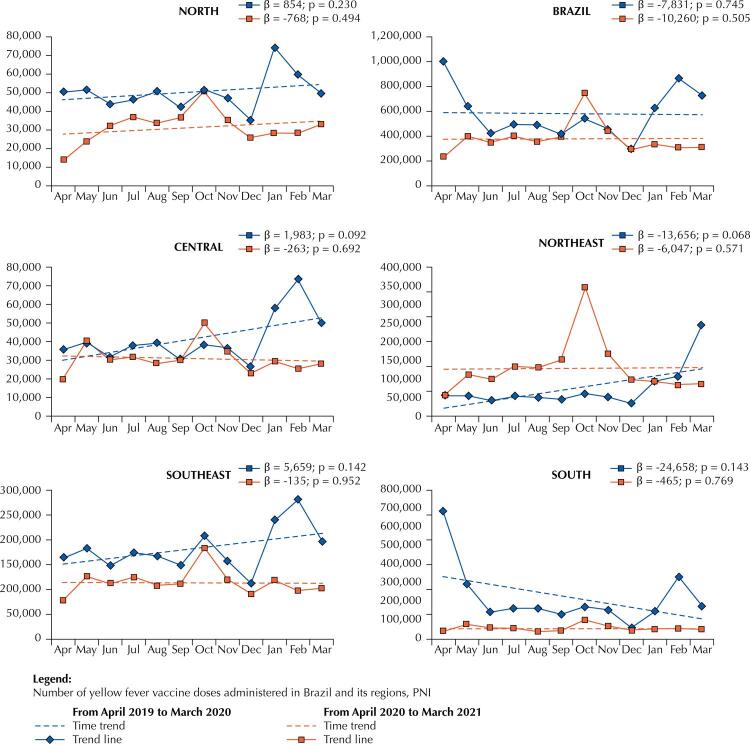
We found a reduction in the median number of yellow fever vaccine doses administered in Brazil and in its regions: North (-34.71%), Midwest (-21.72%), South (-63.50%), and Southeast (-34.42%) (p < 0.05). Series showed stationary behavior in Brazil and in its five regions during the covid-19 pandemic (p > 0.05). Brazilian states also showed stationary trends, except for two states which recorded an increasing trend in the number of administered yellow fever vaccine doses, namely: Alagoas State (before: β = 64, p = 0.081; after: β = 897, p = 0.039), which became a yellow fever vaccine recommendation zone, and Roraima State (before: β = 68, p = 0.724; after: β = 150, p = 0.000), which intensified yellow fever vaccinations due to a yellow fever case confirmation in a Venezuelan State in 2020.
The reduced number of yellow fever vaccine doses administered during the covid-19 pandemic in Brazil may favor the reemergence of urban yellow fever cases in the country.
分析巴西在新冠疫情大流行前后接种黄热病疫苗的剂量。
这是一项基于国家免疫计划数据的生态时间序列研究。采用曼-惠特尼检验比较该国实施社会隔离措施前后(2019 年 4 月至 2020 年 3 月和 2020 年 4 月至 2021 年 3 月)巴西及其地区黄热病疫苗接种中位数的差异。采用 Prais-Winsten 回归模型进行时间序列分析。
我们发现巴西及其地区黄热病疫苗接种中位数均有所减少:北部(-34.71%)、中西部(-21.72%)、南部(-63.50%)和东南部(-34.42%)(p<0.05)。在新冠疫情大流行期间,巴西及其五个地区的系列呈平稳行为(p>0.05)。巴西各州也呈平稳趋势,只有两个州黄热病疫苗接种数量呈上升趋势,分别是:阿拉戈斯州(之前:β=64,p=0.081;之后:β=897,p=0.039),成为黄热病疫苗推荐区,以及罗赖马州(之前:β=68,p=0.724;之后:β=150,p=0.000),由于 2020 年委内瑞拉州确认了一起黄热病病例,该州加强了黄热病疫苗接种。
巴西在新冠疫情大流行期间黄热病疫苗接种数量减少,可能导致该国城市黄热病病例再次出现。