Department of Nutrition and Food Sciences, Institute of Nutrition and Food Sciences, Nutritional Epidemiology, University of Bonn, Friedrich-Hirzebruch-Allee 7, 53115, Bonn, Germany.
Eur J Nutr. 2022 Oct;61(7):3719-3729. doi: 10.1007/s00394-022-02921-z. Epub 2022 Jun 15.
Lifestyle scores which combine single factors such as diet, activity, or sleep duration showed associations with cognitive decline in adults. However, the role of a favourable lifestyle in younger age and the build-up of cognitive reserve is less clear, which is why we investigated longitudinal associations between a lifestyle score in childhood and adolescence and fluid intelligence obtained on average 6 years later.
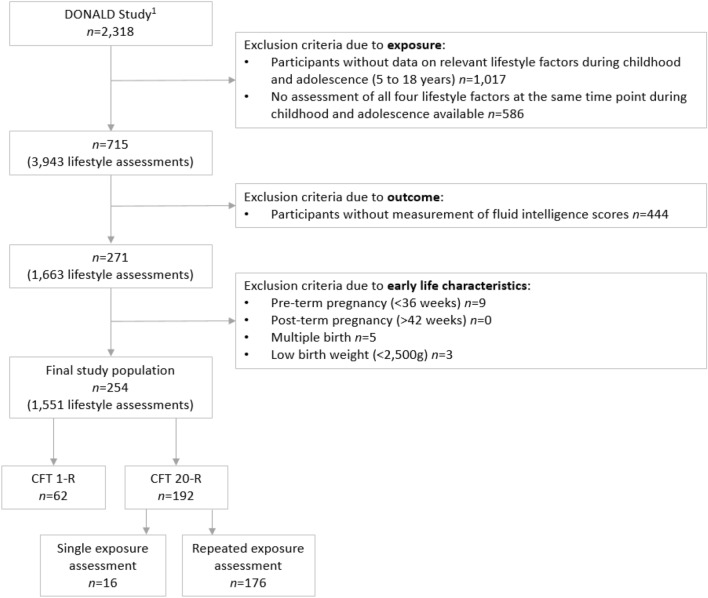
In the DONALD cohort, a lifestyle score of 0 to 4 points including healthy diet and duration of moderate-to-vigorous physical activity, sedentary behaviour and sleep was repeatedly assessed in participants aged 5 and 19 years. Data on fluid intelligence were assessed via a German version of the culture fair intelligence test (CFT), using CFT 1-R in children 8.5 years of age or younger (n = 62) or CFT 20-R in participants older than 8.5 years (n = 192). Multivariable linear regression models were used to investigate prospective associations between the lifestyle score and the fluid intelligence score.
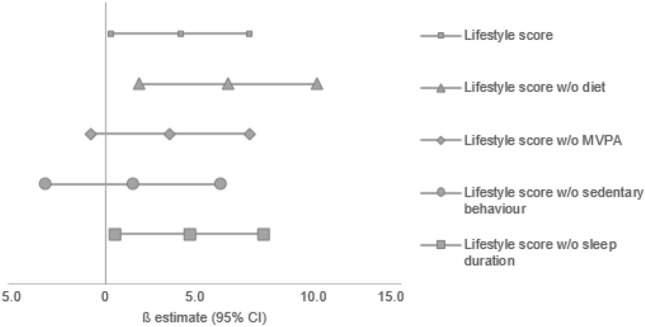
Mean lifestyle score of all participants was 2.2 (0.7-4) points. A one-point increase in the lifestyle score was associated with a higher fluid intelligence score (4.8 points [0.3-7.3], p = 0.0343) for participants completing the CFT 20-R. Furthermore, each additional hour of sedentary behaviour was associated with a lower fluid intelligence score (- 3.0 points [- 5.7 to - 0.3], p = 0.0313). For younger participants (CFT 1-R), no association was found in any analysis (p > 0.05).
A healthy lifestyle was positively associated with fluid intelligence, whereby sedentary behaviour itself seemed to play a prominent role.
将饮食、活动或睡眠持续时间等单一因素结合起来的生活方式评分与成年人的认知能力下降有关。然而,在年轻时采取有利的生活方式和建立认知储备的作用尚不清楚,这就是为什么我们调查了儿童和青少年时期的生活方式评分与 6 年后获得的流体智力之间的纵向关联。
在 DONALD 队列中,参与者在 5 岁和 19 岁时多次评估生活方式评分,评分包括健康饮食和中等至剧烈体力活动的持续时间、久坐行为和睡眠,得分为 0 至 4 分。通过德国文化公平智力测验(CFT)评估流体智力数据,使用 CFT 1-R 评估 8.5 岁以下的儿童(n=62)或 CFT 20-R 评估年龄大于 8.5 岁的参与者(n=192)。使用多变量线性回归模型来研究生活方式评分与流体智力评分之间的前瞻性关联。
所有参与者的平均生活方式评分为 2.2(0.7-4)分。生活方式评分每增加 1 分,完成 CFT 20-R 的参与者的流体智力评分就会更高(4.8 分[0.3-7.3],p=0.0343)。此外,每增加 1 小时的久坐行为,流体智力评分就会更低(-3.0 分[-5.7 至-0.3],p=0.0313)。对于年龄较小的参与者(CFT 1-R),在任何分析中都没有发现关联(p>0.05)。
健康的生活方式与流体智力呈正相关,而久坐行为本身似乎起着重要作用。