Division of Clinical Neurooncology, Department of Neurology, University Hospital Bonn, Venusberg-Campus 1, 53127, Bonn, Germany.
Department of Neurosurgery, University Hospital Bonn, Bonn, Germany.
J Neurooncol. 2022 Aug;159(1):95-101. doi: 10.1007/s11060-022-04046-z. Epub 2022 Jun 15.
The role of obesity in glioblastoma remains unclear, as previous analyses have reported contradicting results. Here, we evaluate the prognostic impact of obesity in two trial populations; CeTeG/NOA-09 (n = 129) for MGMT methylated glioblastoma patients comparing temozolomide (TMZ) to lomustine/TMZ, and GLARIUS (n = 170) for MGMT unmethylated glioblastoma patients comparing TMZ to bevacizumab/irinotecan, both in addition to surgery and radiotherapy.
The impact of obesity (BMI ≥ 30 kg/m) on overall survival (OS) and progression-free survival (PFS) was investigated with Kaplan-Meier analysis and log-rank tests. A multivariable Cox regression analysis was performed including known prognostic factors as covariables.
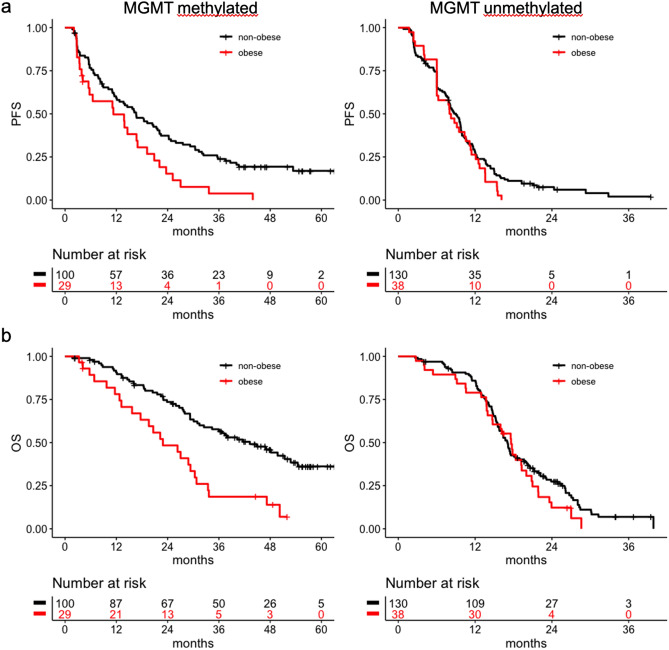
Overall, 22.6% of patients (67 of 297) were obese. Obesity was associated with shorter survival in patients with MGMT methylated glioblastoma (median OS 22.9 (95% CI 17.7-30.8) vs. 43.2 (32.5-54.4) months for obese and non-obese patients respectively, p = 0.001), but not in MGMT unmethylated glioblastoma (median OS 17.1 (15.8-18.9) vs 17.6 (14.7-20.8) months, p = 0.26). The prognostic impact of obesity in MGMT methylated glioblastoma was confirmed in a multivariable Cox regression (adjusted odds ratio: 2.57 (95% CI 1.53-4.31), p < 0.001) adjusted for age, sex, extent of resection, baseline steroids, Karnofsky performance score, and treatment arm.
Obesity was associated with shorter survival in MGMT methylated, but not in MGMT unmethylated glioblastoma patients.
肥胖在胶质母细胞瘤中的作用仍不清楚,因为之前的分析结果相互矛盾。在这里,我们评估了肥胖在两个试验人群中的预后影响;CeTeG/NOA-09(n=129)用于比较替莫唑胺(TMZ)与洛莫司汀/TMZ 治疗甲基化 MGMT 胶质母细胞瘤患者,GLARIUS(n=170)用于比较 TMZ 与贝伐单抗/伊立替康治疗非甲基化 MGMT 胶质母细胞瘤患者,均联合手术和放疗。
采用 Kaplan-Meier 分析和对数秩检验评估肥胖(BMI≥30kg/m2)对总生存期(OS)和无进展生存期(PFS)的影响。采用多变量 Cox 回归分析,将已知的预后因素作为协变量。
总体而言,297 例患者中有 22.6%(67 例)为肥胖患者。肥胖与 MGMT 甲基化胶质母细胞瘤患者的生存时间缩短相关(肥胖患者的中位 OS 为 22.9(95%CI 17.7-30.8)个月,而非肥胖患者为 43.2(32.5-54.4)个月,p=0.001),但在 MGMT 非甲基化胶质母细胞瘤中无此相关性(肥胖患者的中位 OS 为 17.1(15.8-18.9)个月,非肥胖患者为 17.6(14.7-20.8)个月,p=0.26)。多变量 Cox 回归分析(调整后的优势比:2.57(95%CI 1.53-4.31),p<0.001)证实了肥胖在 MGMT 甲基化胶质母细胞瘤中的预后作用,该分析调整了年龄、性别、切除范围、基线类固醇、Karnofsky 表现评分和治疗臂。
肥胖与 MGMT 甲基化胶质母细胞瘤患者的生存时间缩短相关,但与 MGMT 非甲基化胶质母细胞瘤患者的生存时间无关。