Department of Surgery, Washington University in St. Louis, St. Louis, MO 63110, USA.
Division of Urologic Surgery, Washington University in St. Louis, St. Louis, MO 63110, USA.
Sci Transl Med. 2022 Jun 15;14(649):eabg4132. doi: 10.1126/scitranslmed.abg4132.
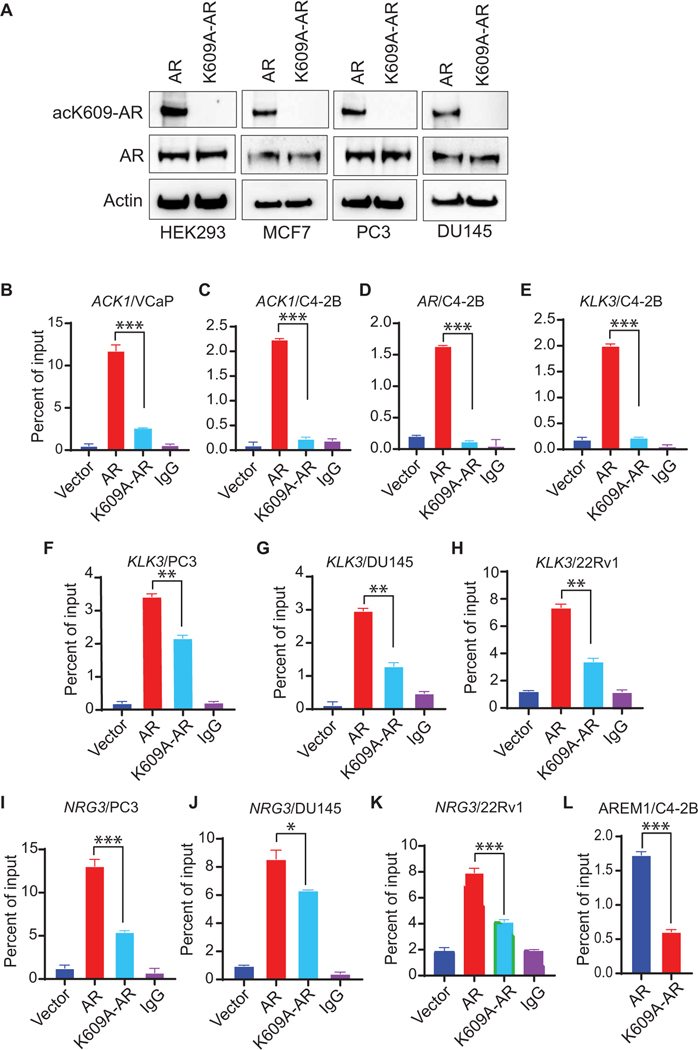
Resistance to second-generation androgen receptor (AR) antagonists such as enzalutamide is an inevitable consequence in patients with castration-resistant prostate cancer (CRPC). There are no effective therapeutic options for this recurrent disease. The expression of truncated AR variant 7 (AR-V7) has been suggested to be one mechanism of resistance; however, its low frequency in patients with CRPC does not explain the almost universal acquisition of resistance. We noted that the ability of AR to translocate to nucleus in an enzalutamide-rich environment opens up the possibility of a posttranslational modification in AR that is refractory to enzalutamide binding. Chemical proteomics in enzalutamide-resistant CRPC cells revealed acetylation at Lys in the zinc finger DNA binding domain of AR (acK609-AR) that not only allowed AR translocation but also galvanized a distinct global transcription program, conferring enzalutamide insensitivity. Mechanistically, acK609-AR was recruited to the and enhancers, up-regulating their transcription. ACK1 kinase-mediated AR Y267 phosphorylation was a prerequisite for AR K609 acetylation, which spawned positive feedback loops at both the transcriptional and posttranslational level that regenerated and sustained high AR and ACK1 expression. Consistent with these findings, oral and subcutaneous treatment with ACK1 small-molecule inhibitor, ()-9b, not only curbed AR Y267 phosphorylation and subsequent K609 acetylation but also compromised enzalutamide-resistant CRPC xenograft tumor growth in mice. Overall, these data uncover chronological modification events in AR that allows prostate cancer to evolve through progressive stages to reach the resilient recurrent CRPC stage, opening up a therapeutic vulnerability.
对第二代雄激素受体 (AR) 拮抗剂(如恩扎卢胺)的耐药性是去势抵抗性前列腺癌 (CRPC) 患者不可避免的后果。对于这种复发性疾病,目前尚无有效的治疗选择。截短的 AR 变体 7 (AR-V7) 的表达被认为是一种耐药机制;然而,其在 CRPC 患者中的低频率并不能解释几乎普遍获得的耐药性。我们注意到,AR 在恩扎卢胺丰富的环境中易位到核中的能力为 AR 的翻译后修饰开辟了可能性,这种修饰对恩扎卢胺结合具有抗性。在恩扎卢胺耐药性 CRPC 细胞中的化学蛋白质组学研究揭示了 AR 的锌指 DNA 结合域中的赖氨酸(acK609-AR)发生乙酰化,这不仅允许 AR 易位,而且还激发了独特的全局转录程序,赋予恩扎卢胺不敏感性。从机制上讲,acK609-AR 被募集到 和 增强子,上调它们的转录。ACK1 激酶介导的 AR Y267 磷酸化是 AR K609 乙酰化的先决条件,这在转录和翻译后水平上产生了正反馈回路,再生并维持了高 AR 和 ACK1 的表达。与这些发现一致,口服和皮下给予 ACK1 小分子抑制剂 ()-9b,不仅抑制了 AR Y267 磷酸化和随后的 K609 乙酰化,而且还损害了小鼠中恩扎卢胺耐药性 CRPC 异种移植肿瘤的生长。总的来说,这些数据揭示了 AR 中的时间修饰事件,使前列腺癌能够通过渐进阶段进化,达到有弹性的复发性 CRPC 阶段,开辟了治疗的脆弱性。