
基因组特征是 SVA 转座子在人类多能干细胞中作为顺式调控元件被内源性激活的基础。
Genomic features underlie the co-option of SVA transposons as cis-regulatory elements in human pluripotent stem cells.
机构信息
Department of Biochemistry and Molecular Biology, Sidney Kimmel Medical College, Thomas Jefferson University, Philadelphia, Pennsylvania, United States of America.
Genetics, Genomics and Cancer Biology PhD Program, Thomas Jefferson University, Philadelphia, Pennsylvania, United States of America.
出版信息
PLoS Genet. 2022 Jun 15;18(6):e1010225. doi: 10.1371/journal.pgen.1010225. eCollection 2022 Jun.
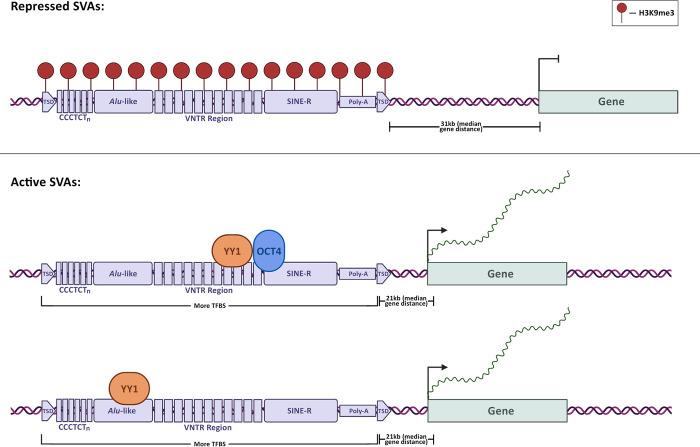
Domestication of transposable elements (TEs) into functional cis-regulatory elements is a widespread phenomenon. However, the mechanisms behind why some TEs are co-opted as functional enhancers while others are not are underappreciated. SINE-VNTR-Alus (SVAs) are the youngest group of transposons in the human genome, where ~3,700 copies are annotated, nearly half of which are human-specific. Many studies indicate that SVAs are among the most frequently co-opted TEs in human gene regulation, but the mechanisms underlying such processes have not yet been thoroughly investigated. Here, we leveraged CRISPR-interference (CRISPRi), computational and functional genomics to elucidate the genomic features that underlie SVA domestication into human stem-cell gene regulation. We found that ~750 SVAs are co-opted as functional cis-regulatory elements in human induced pluripotent stem cells. These SVAs are significantly closer to genes and harbor more transcription factor binding sites than non-co-opted SVAs. We show that a long DNA motif composed of flanking YY1/2 and OCT4 binding sites is enriched in the co-opted SVAs and that these two transcription factors bind consecutively on the TE sequence. We used CRISPRi to epigenetically repress active SVAs in stem cell-like NCCIT cells. Epigenetic perturbation of active SVAs strongly attenuated YY1/OCT4 binding and influenced neighboring gene expression. Ultimately, SVA repression resulted in ~3,000 differentially expressed genes, 131 of which were the nearest gene to an annotated SVA. In summary, we demonstrated that SVAs modulate human gene expression, and uncovered that location and sequence composition contribute to SVA domestication into gene regulatory networks.
转座元件(TEs)驯化成为功能性顺式调控元件是一种广泛存在的现象。然而,为什么有些 TE 被共同选择作为功能性增强子,而有些则没有,其背后的机制尚未得到充分认识。SINE-VNTR-Alus(SVAs)是人类基因组中最年轻的转座子群体,约有 3700 个拷贝被注释,其中近一半是人类特有的。许多研究表明,SVAs 是人类基因调控中最常被共同选择的 TE 之一,但这些过程背后的机制尚未得到彻底研究。在这里,我们利用 CRISPR 干扰(CRISPRi)、计算和功能基因组学来阐明 SVAs 驯化成为人类干细胞基因调控的基因组特征。我们发现,约 750 个 SVAs 被共同选择作为人类诱导多能干细胞中的功能性顺式调控元件。这些 SVA 与基因的距离更近,并且比非共同选择的 SVA 拥有更多的转录因子结合位点。我们表明,由侧翼 YY1/2 和 OCT4 结合位点组成的长 DNA 基序在共同选择的 SVA 中富集,并且这两个转录因子在 TE 序列上连续结合。我们使用 CRISPRi 在干细胞样 NCCIT 细胞中表观遗传抑制活性 SVA。活性 SVA 的表观遗传扰动强烈减弱了 YY1/OCT4 结合,并影响了邻近基因的表达。最终,SVA 抑制导致约 3000 个差异表达基因,其中 131 个是最近的基因注释 SVA。总之,我们证明了 SVAs 调节人类基因表达,并揭示了位置和序列组成有助于 SVA 驯化成为基因调控网络。


 Zotero 插件