International Development Group, RTI International, Washington, District of Columbia, USA.
Center for Global NCDs, RTI International, Research Triangle Park, North Carolina, USA.
BMJ Glob Health. 2022 Jun;7(6). doi: 10.1136/bmjgh-2021-007759.
Despite the high burden of mental disorders among adolescents and the potentially lifelong consequences of these conditions, access to mental health services remains insufficient for adolescents in low-income and middle-income countries. We conducted an economic modelling study to quantify the potential costs and benefits of mental health interventions to prevent or treat anxiety, depression, bipolar disorder, and suicide among adolescents.
We developed a Markov model that followed cohorts of adolescents (ages 10-19) from 36 countries to assess the impact of addressing anxiety, depression, bipolar disorder, and suicide during adolescence on health and non-health outcomes through their lives. We estimated the costs of interventions using an ingredients-based approach and modelled impacts on education and employment and the resulting economic, morbidity, and mortality benefits.
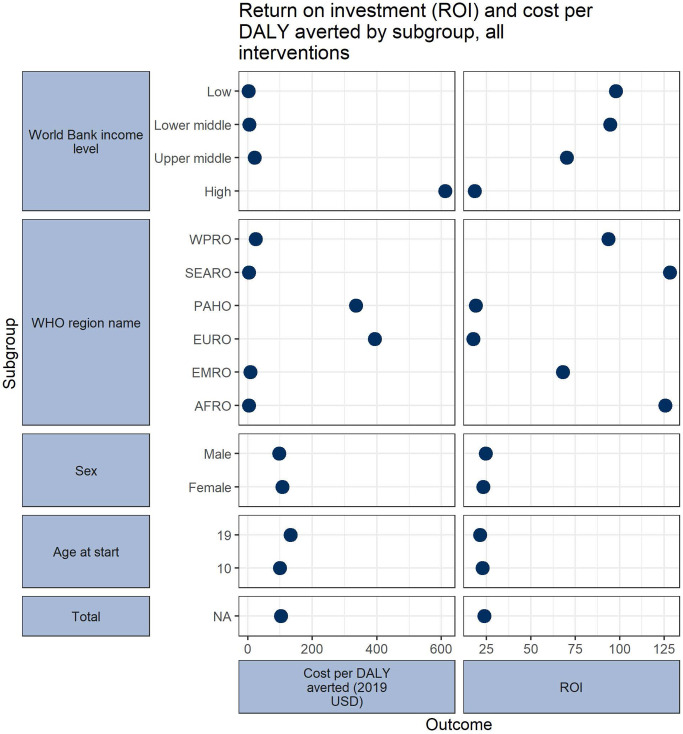
Implementing the selected interventions offers a return on investment of 23.6 and a cost of $102.9 per disability adjusted life year (DALY) averted over 80 years. The high return on investment and low cost per DALY averted is observed across regions and country income levels, with the highest return on investment arising from treating mild depression with group-based cognitive behavioural therapy, prevention of suicide attempts among high-risk adolescents, and universal prevention of combined anxiety and depression in low-income and lower-middle income countries.
The high return on investment and low cost per DALY averted suggests the importance and value of addressing mental disorders among adolescents worldwide. Intervening to prevent and treat these mental disorders even only during adolescence can have lifelong health and economic benefits.
尽管青少年的精神障碍负担沉重,这些疾病可能会带来终身影响,但在中低收入国家,青少年获得精神卫生服务的机会仍然不足。我们进行了一项经济建模研究,以量化预防或治疗青少年焦虑、抑郁、双相情感障碍和自杀的精神卫生干预措施的潜在成本和收益。
我们开发了一个马尔可夫模型,对来自 36 个国家的青少年队列进行了跟踪,以评估在青少年时期解决焦虑、抑郁、双相情感障碍和自杀问题对健康和非健康结果的影响,这些影响贯穿其一生。我们采用基于成分的方法来估计干预措施的成本,并对教育和就业的影响以及由此产生的经济、发病率和死亡率收益进行建模。
实施选定的干预措施可带来 23.6 的投资回报率,每避免一个残疾调整生命年(DALY)的成本为 102.9 美元,在 80 年内有效。在不同地区和国家收入水平下,都观察到了高投资回报率和低每 DALY 避免成本,其中最高的投资回报率来自于群体认知行为疗法治疗轻度抑郁、预防高危青少年自杀企图以及在低收入和中低收入国家普遍预防合并焦虑和抑郁。
高投资回报率和低每 DALY 避免成本表明,解决全世界青少年精神障碍问题的重要性和价值。即使仅在青少年时期进行干预以预防和治疗这些精神障碍,也能带来终身的健康和经济效益。