• 文献检索
  • 文档翻译
  • 深度研究
  • 学术资讯
  • Suppr Zotero 插件Zotero 插件
  • 邀请有礼
  • 套餐&价格
  • 历史记录
应用&插件
Suppr Zotero 插件Zotero 插件浏览器插件Mac 客户端Windows 客户端微信小程序
定价
高级版会员购买积分包购买API积分包
服务
文献检索文档翻译深度研究API 文档MCP 服务
关于我们
关于 Suppr公司介绍联系我们用户协议隐私条款
关注我们

Suppr 超能文献

核心技术专利:CN118964589B侵权必究
粤ICP备2023148730 号-1Suppr @ 2026

文献检索

告别复杂PubMed语法,用中文像聊天一样搜索,搜遍4000万医学文献。AI智能推荐,让科研检索更轻松。

立即免费搜索

文件翻译

保留排版,准确专业,支持PDF/Word/PPT等文件格式,支持 12+语言互译。

免费翻译文档

深度研究

AI帮你快速写综述,25分钟生成高质量综述,智能提取关键信息,辅助科研写作。

立即免费体验

以学校为基础的干预措施促进青少年健康:世界卫生组织西太平洋区域低收入和中等收入国家的系统评价。

School-based interventions to promote adolescent health: A systematic review in low- and middle-income countries of WHO Western Pacific Region.

机构信息

National Center for Women and Children's Health, Chinese Center for Disease Control and Prevention, Beijing, China.

Reproductive, Maternal, Newborn, Child and Adolescent Health, Division of Noncommunicable Diseases and Health Through Life-Course, World Health Organization, Regional Office for the Western Pacific, Manila, Philippines.

出版信息

PLoS One. 2020 Mar 5;15(3):e0230046. doi: 10.1371/journal.pone.0230046. eCollection 2020.

DOI:10.1371/journal.pone.0230046
PMID:32134985
原文链接:https://pmc.ncbi.nlm.nih.gov/articles/PMC7058297/
Abstract

BACKGROUND

In the World Health Organization Western Pacific Region (WHO WPRO), most adolescents enroll in secondary school. Safe, healthy and nurturing school environments are critical for adolescent health and development. Yet, there were no systematic reviews found on the efficacy of school-based interventions among adolescents living in low and middle income countries (LMIC) in the Region. There is an urgent need to identify effective school-based interventions and facilitating factors for successful implementation in adolescent health in WPRO.

METHODS

For this systematic review, we used five electronic databases to search for school-based interventions to promote adolescent health published from January 1995 to March 2019. We searched RCT and non-RCT studies among adolescents between 10 to 19 years old, done in LMIC of WHO WPRO, and targeted health and behaviour, school environment and academic outcomes. Quality of studies, risk of bias and treatment effects were analyzed. Effective interventions and implementation approaches were summarized for consideration in scale-up.

RESULTS

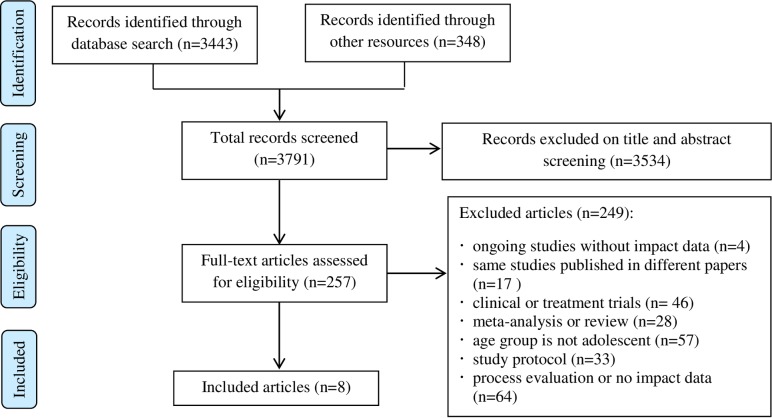
Despite a broad key term search strategy, we identified only eight publications (with 18,774 participants). Most of the studies used knowledge, attitudes and behaviours as outcome measures. A few also included changes in the school policy and physical environment as outcome measures while only one used BMI, waist circumference and quality of life as their outcome measures. The topics in these studies included: AIDS, sexual and reproductive health, de-worming, nutrition, obesity, tobacco use, and suicide. Some interventions were reported to be successful in improving knowledge, attitudes and behaviours, but their impact and scale were limited. The interventions used by the different studies varied from those that addressed a single action area (e.g. developing personal skills) or a combination of action areas in health promotion, e.g. developing a health policy, creating a supportive environment and developing personal skills. No intervention study was found on other important issues such as screening, counseling and developing safe and nurturing school environments.

CONCLUSIONS

Only eight school-based health interventions were conducted in the Region. This study found that school-based interventions were effective in changing knowledge, attitudes, behaviors, healthy policies and environment. Moreover, it was clarified that policy support, involving multiple stakeholders, incorporating existing curriculum, student participation as crucial factors for successful implementation.

摘要

背景

在世界卫生组织西太平洋区域(世卫组织西太区),大多数青少年都在中学就读。安全、健康和有益的学校环境对青少年的健康和发展至关重要。然而,在该区域的中低收入国家(LMIC),尚未发现针对青少年的基于学校的干预措施的系统评价。因此,迫切需要确定有效的基于学校的干预措施,并确定在西太区青少年健康中成功实施的促进因素。

方法

为了进行这项系统评价,我们使用了五个电子数据库,检索了 1995 年 1 月至 2019 年 3 月间在西太区的 LMIC 中开展的、以促进青少年健康为目的的基于学校的干预措施。我们检索了针对 10 至 19 岁青少年的 RCT 和非 RCT 研究,研究地点为世卫组织西太区,研究内容为健康和行为、学校环境和学业成绩。我们对研究质量、偏倚风险和治疗效果进行了分析,并对有效的干预措施和实施方法进行了总结,以便在扩大规模时考虑采用。

结果

尽管我们采用了广泛的关键词搜索策略,但仅确定了 8 篇文献(涉及 18774 名参与者)。大多数研究使用知识、态度和行为作为结果测量指标。少数研究还包括学校政策和物理环境的变化作为结果测量指标,而仅有 1 项研究使用 BMI、腰围和生活质量作为结果测量指标。这些研究的主题包括艾滋病、性健康和生殖健康、驱虫、营养、肥胖、烟草使用和自杀。一些干预措施被报道在提高知识、态度和行为方面是成功的,但它们的影响和规模有限。不同研究中采用的干预措施各不相同,有的干预措施针对单一行动领域(例如,培养个人技能),有的干预措施则涉及健康促进中的多个行动领域,例如制定健康政策、营造支持性环境和培养个人技能。没有发现关于其他重要问题的干预研究,如筛查、咨询和营造安全有益的学校环境。

结论

在该区域仅开展了八项基于学校的健康干预措施。本研究发现,基于学校的干预措施在改变知识、态度、行为、健康政策和环境方面是有效的。此外,研究还明确了政策支持、涉及多个利益相关者、纳入现有课程以及学生参与是成功实施的关键因素。
https://cdn.ncbi.nlm.nih.gov/pmc/blobs/ec39/7058297/26e443d0ee27/pone.0230046.g001.jpg

相似文献

1
School-based interventions to promote adolescent health: A systematic review in low- and middle-income countries of WHO Western Pacific Region.以学校为基础的干预措施促进青少年健康:世界卫生组织西太平洋区域低收入和中等收入国家的系统评价。
PLoS One. 2020 Mar 5;15(3):e0230046. doi: 10.1371/journal.pone.0230046. eCollection 2020.
2
Strategies for enhancing the implementation of school-based policies or practices targeting risk factors for chronic disease.加强针对慢性病风险因素的校本政策或实践实施的策略。
Cochrane Database Syst Rev. 2017 Nov 29;11(11):CD011677. doi: 10.1002/14651858.CD011677.pub2.
3
Folic acid supplementation and malaria susceptibility and severity among people taking antifolate antimalarial drugs in endemic areas.在流行地区,服用抗叶酸抗疟药物的人群中,叶酸补充剂与疟疾易感性和严重程度的关系。
Cochrane Database Syst Rev. 2022 Feb 1;2(2022):CD014217. doi: 10.1002/14651858.CD014217.
4
Strategies for enhancing the implementation of school-based policies or practices targeting diet, physical activity, obesity, tobacco or alcohol use.加强实施针对饮食、体育活动、肥胖、烟草或酒精使用的校本政策或做法的策略。
Cochrane Database Syst Rev. 2024 Dec 12;12(12):CD011677. doi: 10.1002/14651858.CD011677.pub4.
5
Recovery schools for improving behavioral and academic outcomes among students in recovery from substance use disorders: a systematic review.改善物质使用障碍康复期学生行为和学业成果的康复学校:一项系统综述
Campbell Syst Rev. 2018 Oct 4;14(1):1-86. doi: 10.4073/csr.2018.9. eCollection 2018.
6
Evidence and Gap Map of Whole-School Interventions Promoting Mental Health and Preventing Risk Behaviours in Adolescence: Programme Component Mapping Within the Health-Promoting Schools Framework: An evidence and gap map.促进青少年心理健康和预防风险行为的全学校干预措施的证据与差距图:健康促进学校框架内的计划组成部分映射:一份证据与差距图。
Campbell Syst Rev. 2025 Mar 10;21(1):e70024. doi: 10.1002/cl2.70024. eCollection 2025 Mar.
7
School-based interventions for reducing disciplinary school exclusion: a systematic review.基于学校的减少校内纪律性开除的干预措施:一项系统综述
Campbell Syst Rev. 2018 Jan 9;14(1):i-216. doi: 10.4073/csr.2018.1. eCollection 2018.
8
The future of Cochrane Neonatal.考克兰新生儿协作网的未来。
Early Hum Dev. 2020 Nov;150:105191. doi: 10.1016/j.earlhumdev.2020.105191. Epub 2020 Sep 12.
9
The effectiveness of web-based programs on the reduction of childhood obesity in school-aged children: A systematic review.基于网络的项目对学龄儿童肥胖症减轻的有效性:一项系统评价。
JBI Libr Syst Rev. 2012;10(42 Suppl):1-14. doi: 10.11124/jbisrir-2012-248.
10
Strategies to improve the implementation of workplace-based policies or practices targeting tobacco, alcohol, diet, physical activity and obesity.改善针对烟草、酒精、饮食、身体活动和肥胖的工作场所政策或措施实施情况的策略。
Cochrane Database Syst Rev. 2018 Nov 14;11(11):CD012439. doi: 10.1002/14651858.CD012439.pub2.

引用本文的文献

1
Bullying and Cyberbullying Are Associated with Inappropriate Use of the Internet, Cell Phones, and Video Games in Children and Adolescents.欺凌和网络欺凌与儿童和青少年不恰当地使用互联网、手机及电子游戏有关。
Eur J Investig Health Psychol Educ. 2025 May 15;15(5):82. doi: 10.3390/ejihpe15050082.
2
Perceptions regarding cardiovascular health and preparedness for digital health education among adolescents in an urban community of Nepal: A qualitative study.尼泊尔一个城市社区青少年对心血管健康的认知及数字健康教育准备情况:一项定性研究
Digit Health. 2025 Feb 18;11:20552076251321068. doi: 10.1177/20552076251321068. eCollection 2025 Jan-Dec.
3

本文引用的文献

1
Implementation and effectiveness of adolescent life skills programs in low- and middle-income countries: A critical review and meta-analysis.青少年生活技能项目在中低收入国家的实施和效果:批判性评价和荟萃分析。
Behav Res Ther. 2020 Jul;130:103402. doi: 10.1016/j.brat.2019.04.010. Epub 2019 Apr 26.
2
Progress in adolescent health and wellbeing: tracking 12 headline indicators for 195 countries and territories, 1990-2016.青少年健康与福祉进展:1990-2016 年对 195 个国家和地区的 12 项主要指标进行跟踪。
Lancet. 2019 Mar 16;393(10176):1101-1118. doi: 10.1016/S0140-6736(18)32427-9. Epub 2019 Mar 12.
3
Improving adolescent health: an evidence-based call to action.
Interrelation Between BMI, Dietary Habits, Self-Rated Health, and Body Image Perception Among Korean Adolescents: The Korea Youth Risk Behavior Web-Based Survey (2022).
韩国青少年的体重指数、饮食习惯、自我评估健康状况与身体意象认知之间的相互关系:韩国青少年风险行为网络调查(2022年)
Nutrients. 2025 Jan 11;17(2):253. doi: 10.3390/nu17020253.
4
The effect of participatory action research on HPV primary preventive measures among in-school adolescents in Benue State, Nigeria.参与行动研究对尼日利亚贝努埃州在校青少年 HPV 一级预防措施的影响。
BMC Public Health. 2024 Nov 1;24(1):3033. doi: 10.1186/s12889-024-20536-3.
5
School-based healthy eating interventions for adolescents aged 10-19 years: an umbrella review.以学校为基础的 10-19 岁青少年健康饮食干预措施:伞式综述。
Int J Behav Nutr Phys Act. 2024 Oct 14;21(1):117. doi: 10.1186/s12966-024-01668-6.
6
Meta-analysis of the effectiveness of educational programs about HIV prevention on knowledge, attitude, and behavior among adolescents.关于预防艾滋病教育项目对青少年知识、态度和行为影响的荟萃分析。
Narra J. 2024 Aug;4(2):e870. doi: 10.52225/narra.v4i2.870. Epub 2024 Jul 22.
7
A Provider-Focused Intervention to Increase Universal HIV Testing among Adolescents in School-Based Health Centers.以提供者为中心的干预措施,以增加学校卫生中心青少年的普遍艾滋病毒检测。
AIDS Behav. 2024 Nov;28(11):3596-3604. doi: 10.1007/s10461-024-04444-6. Epub 2024 Jul 24.
8
Any better? A follow-up content analysis of adolescent sexual and reproductive health inclusion in Global Financing Facility country planning documents.有改善吗?对全球融资机制国家规划文件中包含的青少年性健康和生殖健康内容的后续分析。
Glob Health Action. 2024 Dec 31;17(1):2315644. doi: 10.1080/16549716.2024.2315644. Epub 2024 Jun 19.
9
Adolescents' perspectives and experiences of accessing general practitioner services: A systematic review.青少年获取全科医生服务的观点和经历:一项系统综述。
J Child Health Care. 2024 Apr 17:13674935241239837. doi: 10.1177/13674935241239837.
10
Multi-country case study on school health policy and its implementation in relation to COVID-19 control in Micronesia Small Islands Developing States.关于密克罗尼西亚小岛屿发展中国家学校卫生政策及其在新冠疫情防控方面实施情况的多国案例研究。
Trop Med Health. 2024 Mar 29;52(1):27. doi: 10.1186/s41182-024-00590-8.
改善青少年健康:基于证据的行动呼吁。
Lancet. 2019 Mar 16;393(10176):1073-1075. doi: 10.1016/S0140-6736(18)32996-9. Epub 2019 Mar 12.
4
Adolescent Health Interventions: Conclusions, Evidence Gaps, and Research Priorities.青少年健康干预措施:结论、证据差距及研究重点
J Adolesc Health. 2016 Oct;59(4S):S88-S92. doi: 10.1016/j.jadohealth.2016.05.006.
5
What is known about school-based interventions for health promotion and their impact in developing countries? A scoping review of the literature.关于以学校为基础的健康促进干预措施及其在发展中国家的影响,我们了解多少?文献综述。
Health Educ Res. 2016 Oct;31(5):587-602. doi: 10.1093/her/cyw040. Epub 2016 Aug 10.
6
Our future: a Lancet commission on adolescent health and wellbeing.我们的未来:《柳叶刀》青少年健康与福祉委员会
Lancet. 2016 Jun 11;387(10036):2423-78. doi: 10.1016/S0140-6736(16)00579-1. Epub 2016 May 9.
7
School-Based Interventions Going Beyond Health Education to Promote Adolescent Health: Systematic Review of Reviews.基于学校的干预措施超越健康教育,促进青少年健康:系统评价综述。
J Adolesc Health. 2016 Apr;58(4):382-396. doi: 10.1016/j.jadohealth.2015.12.017.
8
Effect of Internet-based Intervention on Obesity among Adolescents in Kuala Lumpur: A School-based Cluster Randomised Trial.基于互联网的干预对吉隆坡青少年肥胖的影响:一项基于学校的整群随机试验。
Malays J Med Sci. 2015 Jul-Aug;22(4):47-56.
9
Outcome of a school-based intervention to promote life-skills among young people in Cambodia.柬埔寨学校生活技能干预项目的成果。
Asian J Psychiatr. 2014 Jun;9:78-84. doi: 10.1016/j.ajp.2014.01.011. Epub 2014 Feb 12.
10
The WHO Health Promoting School framework for improving the health and well-being of students and their academic achievement.世界卫生组织促进健康学校框架,旨在改善学生的健康和福祉以及他们的学业成绩。
Cochrane Database Syst Rev. 2014 Apr 16;2014(4):CD008958. doi: 10.1002/14651858.CD008958.pub2.