School of Chemistry, University of Nottingham, University Park, Nottingham, NG7 2RD, UK.
Department of Chemistry, Biochemistry and Pharmaceutical Sciences, University of Bern, Freiestrasse 3, 3012, Bern, Switzerland.
Chembiochem. 2022 Aug 3;23(15):e202200335. doi: 10.1002/cbic.202200335. Epub 2022 Jul 1.
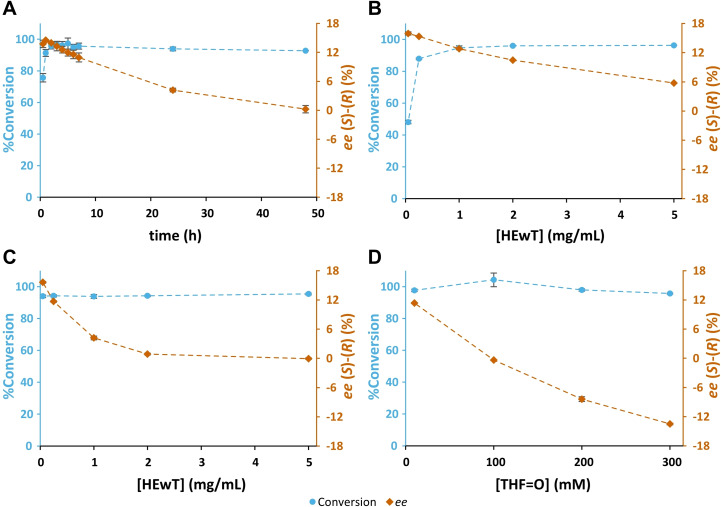
Enzymatic enantiopreference is one of the key advantages of biocatalysis. While exploring the synthesis of small cyclic (chiral amines) such as 3-aminotetrahydrofuran (THF-amine), using the (S)-selective transaminase from Halomonas elongata (HEwT), inversion of the enantiopreference was observed at increasing substrate loadings. In addition, the enantiopreference could be altered by variation of the ionic strength, or of the co-solvent content in the reaction mixture. For example, using otherwise identical reaction conditions, the presence of 2 M sodium chloride gave (R)-THF-amine (14 % ee), while the addition of 2.2 M isopropyl alcohol gave the (S)-enantiomer in 30 % ee. While the underlying cause is not currently understood, it appears likely that subtle changes in the structure of the enzyme cause the shift in enantiopreference and are worth exploring further.
酶的对映体选择性是生物催化的关键优势之一。在探索使用嗜盐 elongata 菌(HEwT)来源的(S)选择性转氨酶合成小环(手性胺),如 3-氨基四氢呋喃(THF-胺)时,在增加底物负载时观察到对映体选择性的反转。此外,通过改变离子强度或反应混合物中的共溶剂含量,也可以改变对映体选择性。例如,在其他条件相同的情况下,存在 2 M 氯化钠时得到(R)-THF-胺(14%ee),而添加 2.2 M 异丙醇时则以 30%ee 得到(S)对映体。虽然目前尚不清楚其根本原因,但似乎是酶结构的细微变化导致对映体选择性发生转变,值得进一步探索。