Parasitic and Insect Disease Laboratory, Bacterial Disease Division, Department of Animal and Plant Health Research, Animal and Plant Quarantine Agency, Gimcheon, 39660, Republic of Korea.
Division of Vectors and Parasitic Diseases, Korea Disease Control and Prevention Agency, 187 Osongsaengmyeong 2-ro, Heungdeok-gu, Cheongju, Chungbuk, 28159, Republic of Korea.
Sci Rep. 2022 Jun 15;12(1):10010. doi: 10.1038/s41598-022-13535-0.
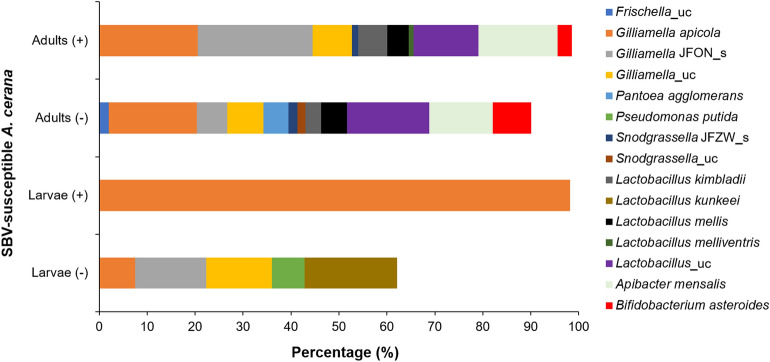
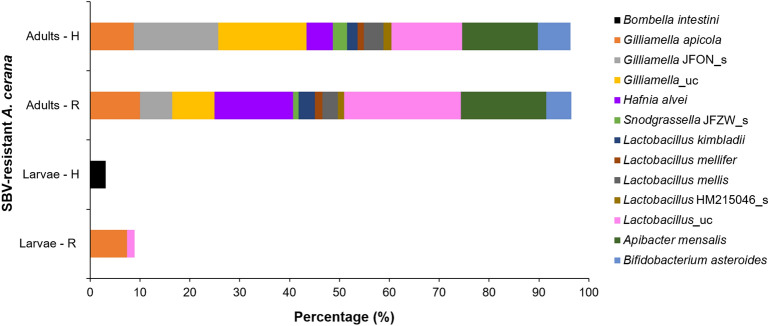
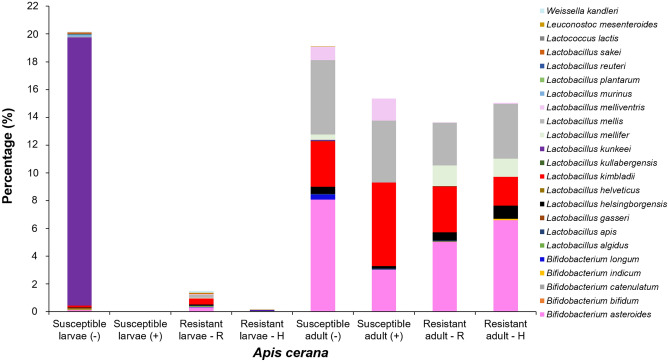
Honey bees are important pollinators for the conservation of the ecosystem and agricultural products and provide a variety of products important for human use, such as honey, pollen, and royal jelly. Sacbrood disease (SD) is a devastating viral disease in Apis cerana; an effective preventive measure for SD is urgently needed. In this study, the relationship between the gut microbiome of honey bees and SD was investigated by pyrosequencing. Results revealed that sacbrood virus (SBV)-resistant A. cerana strains harbour a unique acetic acid bacterium, Bombella intestini, and the lactic acid bacteria (LAB) Lactobacillus (unclassified)_uc, Bifidobacterium longum, B. catenulatum, Lactococcus lactis, and Leuconostoc mesenteroides in larvae and Hafnia alvei, B. indicum, and the LAB L. mellifer and Lactobacillus HM215046_s in adult bees. Changes in the gut microbiome due to SBV infection resulted in loss of bacteria that could affect host nutrients and inhibit honey bee pathogens, such as Gilliamella JFON_s, Gilliamella_uc, Pseudomonas putida, and L. kunkeei in A. cerana larvae and Frischella_uc, Pantoea agglomerans, Snodgrassella_uc, and B. asteroides in adult bees. These findings provide important information for the selection of probiotics for A. cerana larvae and adults to prevent pathogenic infections and keep honey bees healthy.
蜜蜂是生态系统和农产品保护的重要传粉媒介,为人类提供了各种重要的产品,如蜂蜜、花粉和蜂王浆。囊状幼虫病(SD)是一种严重的蜜蜂病毒病;急需有效的预防措施。本研究通过焦磷酸测序技术研究了蜜蜂肠道微生物组与 SD 的关系。结果表明,囊状幼虫病毒(SBV)抗性中华蜜蜂(A. cerana)菌株在幼虫中含有一种独特的醋酸菌,即Bombella intestini,以及乳酸菌(LAB)乳杆菌(未分类)_uc、双歧杆菌(B. longum)、B. catenulatum、乳球菌(Lactococcus lactis)和肠膜明串珠菌(Leuconostoc mesenteroides),在成年蜜蜂中则含有Hafnia alvei、B. indicum 和 LAB 乳杆菌 L. mellifer 和 Lactobacillus HM215046_s。由于 SBV 感染导致肠道微生物组发生变化,失去了可能影响宿主营养并抑制蜜蜂病原体(如 Gilliamella JFON_s、Gilliamella_uc、假单胞菌和 L. kunkeei 在中华蜜蜂幼虫中)的细菌,以及在成年蜜蜂中失去了 Frischella_uc、聚团肠杆菌、Snodgrassella_uc 和 B. asteroides 等细菌。这些发现为中华蜜蜂幼虫和成虫选择益生菌以预防病原感染和保持蜜蜂健康提供了重要信息。