Department of Psychiatry, Tsyr-Huey Mental Hospital, Kaohsiung Jen-Ais Home, Taiwan.
Department of Emergency Medicine, E-Da Hospital, Kaohsiung City, Taiwan.
Sci Rep. 2022 Jun 15;12(1):9958. doi: 10.1038/s41598-022-14220-y.
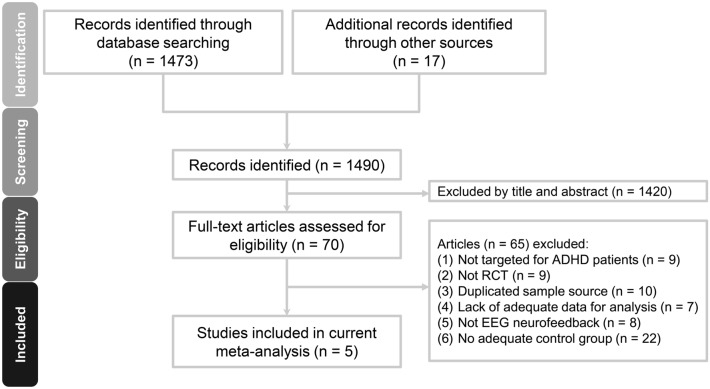
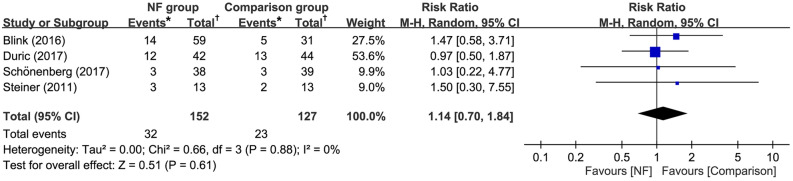
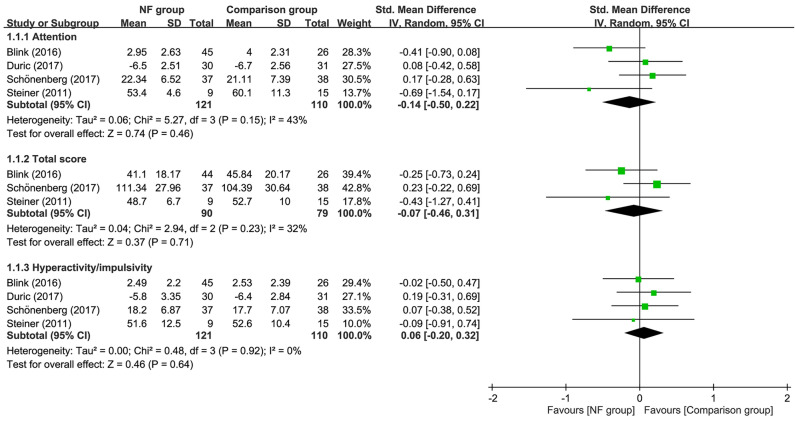
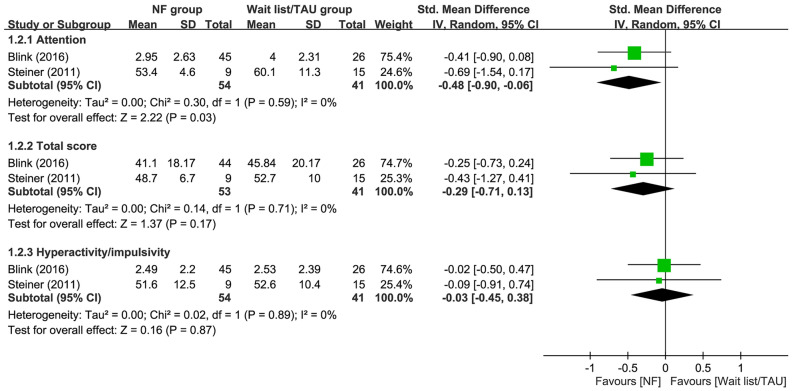
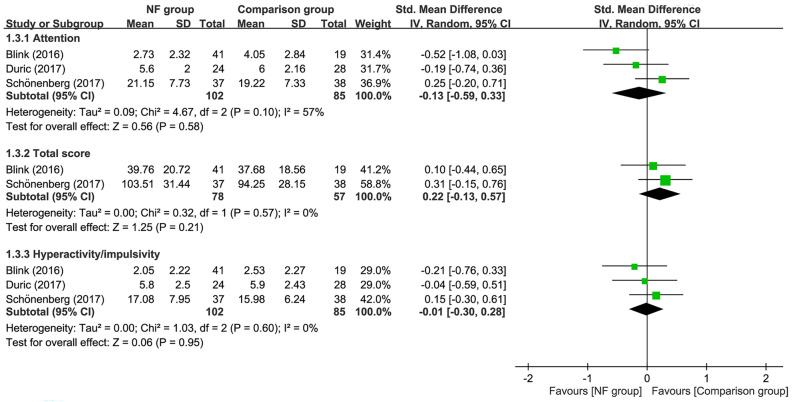
Self-reported effectiveness of electroencephalogram-based neurofeedback (EEG-NF) against the core symptoms of attention-deficit hyperactivity disorder (ADHD) in adolescents/adults remains unclear. We searched PubMed, Embase, ClinicalKey, Cochrane CENTRAL, ScienceDirect, Web of Science, and ClinicalTrials.gov from inception to August 2021 for randomized clinical trials (RCTs) of EEG-NF with self-reported ADHD symptom ratings. Comparators included participants on waitlist/treatment as usual (TAU) or receiving other interventions. Of the 279 participants (mean age = 23.48; range: 6-60) in five eligible RCTs, 183 received EEG-NF treatment. Forest plot demonstrated no difference in inattention (SMD = -0.11, 95% CI -0.39-0.18, p = 0.46), total score (SMD = -0.08, 95% CI -0.36-0.2, p = 0.56), and hyperactivity/impulsivity (SMD = 0.01, 95% CI -0.23-0.25, p = 0.91) between EEG-NF and comparison groups. Nevertheless, compared with waitlist/TAU, EEG-NF showed better improvement in inattention (SMD = -0.48, 95% CI -0.9--0.06, p = 0.03) but not hyperactivity/impulsivity (SMD = -0.03, 95% CI -0.45-0.38, p = 0.87). Follow-up 6-12 months demonstrated no difference in inattention (SMD = -0.01, 95% CI -0.41-0.38, p = 0.94), total score (SMD = 0.22, 95% CI -0.08-0.52, p = 0.15), and hyperactivity/impulsivity (SMD = -0.01, 95% CI -0.27-0.26, p = 0.96) between the two groups. Dropout rate also showed no difference (RR = 1.05, 95% CI 0.82-1.33, p = 0.72). Our results support EEG-NF for improving inattention in adolescents/young adults, although its effectiveness against hyperactivity/impulsivity remains inconclusive.
自我报告的基于脑电图的神经反馈(EEG-NF)对青少年/成年人注意缺陷多动障碍(ADHD)核心症状的疗效仍不清楚。我们从 2021 年 8 月开始在 PubMed、Embase、ClinicalKey、Cochrane CENTRAL、ScienceDirect、Web of Science 和 ClinicalTrials.gov 上搜索了针对 ADHD 症状自评的 EEG-NF 的随机临床试验(RCT)。对照组包括候补组/常规治疗(TAU)或接受其他干预的参与者。在五项合格 RCT 中的 279 名参与者(平均年龄 23.48 岁;范围:6-60 岁)中,183 名接受了 EEG-NF 治疗。森林图显示,在注意力不集中(SMD = -0.11,95%CI -0.39-0.18,p = 0.46)、总分(SMD = -0.08,95%CI -0.36-0.2,p = 0.56)和多动/冲动(SMD = 0.01,95%CI -0.23-0.25,p = 0.91)方面,EEG-NF 与对照组之间没有差异。然而,与候补组/TAU 相比,EEG-NF 在注意力不集中方面显示出更好的改善(SMD = -0.48,95%CI -0.9--0.06,p = 0.03),但在多动/冲动方面没有改善(SMD = -0.03,95%CI -0.45-0.38,p = 0.87)。6-12 个月的随访显示,在注意力不集中(SMD = -0.01,95%CI -0.41-0.38,p = 0.94)、总分(SMD = 0.22,95%CI -0.08-0.52,p = 0.15)和多动/冲动(SMD = -0.01,95%CI -0.27-0.26,p = 0.96)方面,两组之间没有差异。脱落率也没有差异(RR = 1.05,95%CI 0.82-1.33,p = 0.72)。我们的结果支持 EEG-NF 改善青少年/年轻人的注意力不集中,但对多动/冲动的疗效仍不确定。