Chair of General Practice I and Interprofessional Care, Institute of General Practice and Primary Care, Faculty of Health, Witten/Herdecke University, Alfred-Herrhausen-Str. 50, 58448, Witten, Germany.
Chair of General Practice II and Patient-Centeredness in Primary Care, Institute of General Practice and Primary Care, Faculty of Health, Witten/Herdecke University, Alfred-Herrhausen-Str. 50, 58448, Witten, Germany.
BMC Neurol. 2022 Jun 15;22(1):220. doi: 10.1186/s12883-022-02743-w.
Upper limb (UL) paresis is one of the most common stroke consequences and significantly restricts patients in everyday life. Instruments objectively measuring direct arm use in stroke patients are lacking, but might be helpful to understand patients' impairment. Aiming to examine whether accelerometry is a suitable objective measure for everyday UL use in stroke patients, we conducted a systematic review on the association between accelerometer-derived measurements and clinical scales.
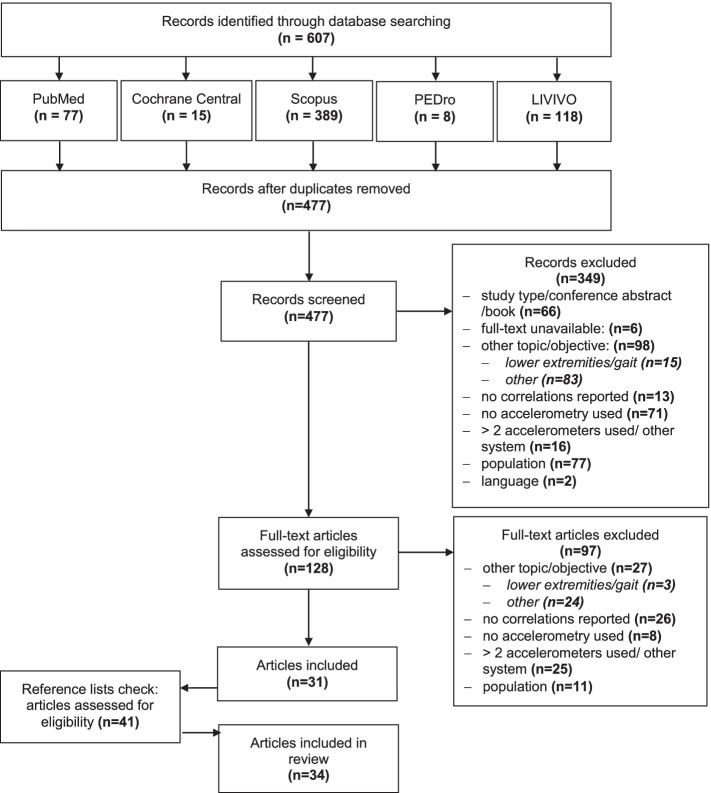
Articles were systematically searched in PubMed, Scopus, Cochrane Library, PeDro and LIVIVO through December 12, 2021, screened for inclusion by AH, and subsequently independently screened by CK and MK. Disagreements were discussed until consensus. We included English and German peer-reviewed articles dealing with the validity of accelerometers as a measurement of UL use in stroke patients and eligible systematic reviews. Studies exclusively using accelerometry as an outcome parameter, book contributions, conference abstracts and case studies were excluded. Data extraction was conducted by AH and confirmed by CK focussing on study type, objective, accelerometer device, sample size, stroke status, assessments conducted, measurement method, wearing time and key results. We analysed all eligible articles regarding the correlation between accelerometry and other clinical assessments and the validity in accordance with the type of accelerometer.
Excluding duplicates, the initial search yielded 477 records. In the 34 eligible studies accelerometers was used with a predominance of tri-axial accelerometery (n = 12) and only few with two-axial application (n = 4). Regarding measures to examine association to accelerometer data different clinical scales were applied depending on the setting, the degree of impairment and/or the status of stroke. Cut-off values to determine correlations varied largely; most significant correlations are reported for the MAL [Range 0.31- 0.84] and the ARAT [Range 0.15-0.79].
Accelerometers can provide reliable data about daily arm use frequency but do not supply information about the movements´ quality and restrictions on everyday activities of stroke patients. Depending on the context, it is advisable to use both, accelerometry and other clinical measures. According to the literature there is currently no accelerometer device most suitable to measure UL activity. High correlations indicate that multi-dimensional accelerometers should be preferred.
上肢(UL)瘫痪是中风最常见的后果之一,严重限制了患者的日常生活。目前缺乏客观测量中风患者直接手臂使用的仪器,但可能有助于了解患者的损伤情况。本研究旨在探讨加速度计是否可作为中风患者日常生活中 UL 使用的客观测量指标,因此我们系统地回顾了加速度计测量值与临床量表之间的相关性。
我们于 2021 年 12 月 12 日之前在 PubMed、Scopus、Cochrane 图书馆、PeDro 和 LIVIVO 上进行了系统检索,AH 对文章进行了筛选,随后 CK 和 MK 对文章进行了独立筛选。对存在分歧的文章,我们进行了讨论并达成共识。我们纳入了探讨加速度计作为中风患者 UL 使用测量指标的有效性的英文和德文同行评议文章,以及合格的系统评价。我们排除了仅使用加速度计作为结果参数、书籍贡献、会议摘要和案例研究的文章。AH 对研究类型、目的、加速度计设备、样本量、中风状态、进行的评估、测量方法、佩戴时间和关键结果进行了数据提取,CK 对数据提取进行了确认。我们根据加速度计的类型,分析了所有合格文章中关于加速度计与其他临床评估之间的相关性和有效性。
排除重复文献后,初始搜索得到 477 条记录。在 34 项合格研究中,使用了三轴加速度计(n=12),而使用双轴加速度计的研究较少(n=4)。关于与加速度计数据相关的测量,不同的临床量表根据设置、损伤程度和/或中风状态而有所不同。确定相关性的截止值差异很大;报道的相关性最大的是 MAL [范围 0.31-0.84]和 ARAT [范围 0.15-0.79]。
加速度计可以提供有关日常手臂使用频率的可靠数据,但无法提供中风患者日常生活中手臂运动质量和活动受限的相关信息。根据具体情况,建议同时使用加速度计和其他临床测量方法。根据文献,目前尚无最适合测量 UL 活动的加速度计设备。高相关性表明应优先使用多维加速度计。