Institute of Medical Sciences, University of Toronto, Toronto, M5S1A8, Canada.
Donnelly Centre for Cellular and Biomolecular Research, University of Toronto, 160 College Street, Room 1006, Toronto, ON, M5S3E1, Canada.
J Neuroinflammation. 2022 Jun 15;19(1):146. doi: 10.1186/s12974-022-02487-x.
Neonatal stroke is a devastating insult that can lead to life-long impairments. In response to hypoxic-ischaemic injury, there is loss of neurons and glia as well as a neuroinflammatory response mediated by resident immune cells, including microglia and astrocytes, which can exacerbate damage. Administration of the antidiabetic drug metformin has been shown to improve functional outcomes in preclinical models of brain injury and the cellular basis for metformin-mediated recovery is unknown. Given metformin's demonstrated anti-inflammatory properties, we investigated its role in regulating the microglia activation and used a microglia ablation strategy to investigate the microglia-mediated outcomes in a mouse model of neonatal stroke.
Hypoxia-ischaemia (H-I) was performed on post-natal day 8. Metformin was administered for one week, starting one day after injury. Immunohistochemistry was used to examine the spatiotemporal response of microglia and astrocytes after hypoxia-ischaemia, with or without metformin treatment. To evaluate the effects of microglia depletion after hypoxia-ischaemia, we delivered Plexxikon 5622 for 1 or 2 weeks post-injury. The regional pattern of microglia and astrocyte depletion was assessed through immunohistochemistry. Motor behaviour was assessed with the righting reflex, hindlimb suspension, grip strength and cylinder tests.
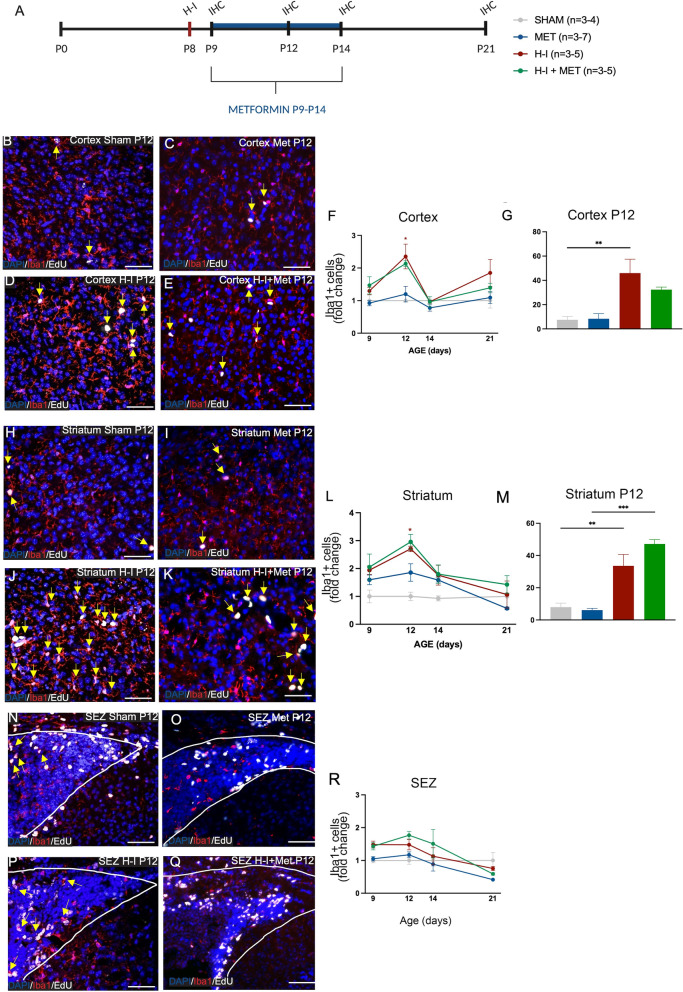
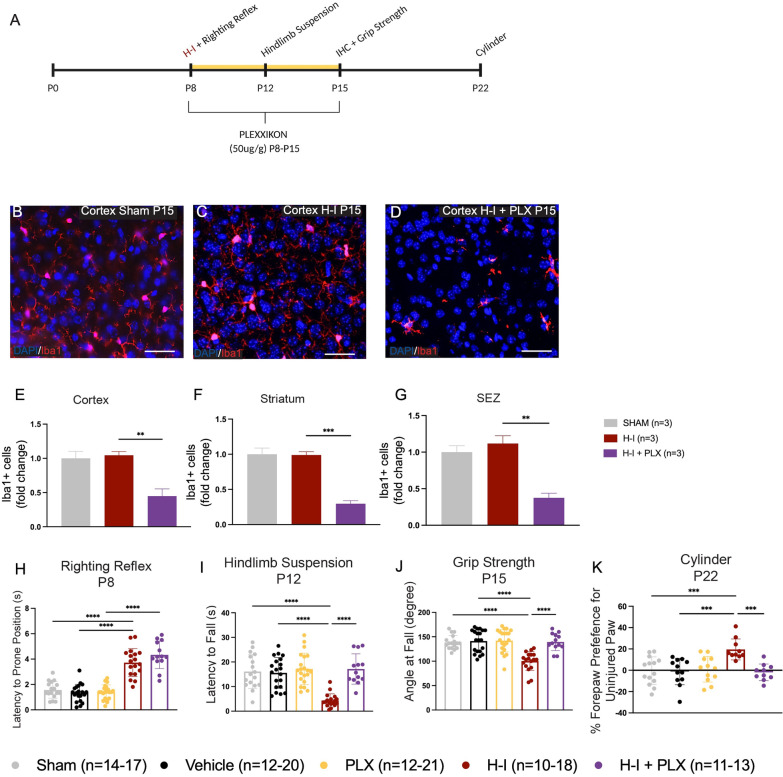
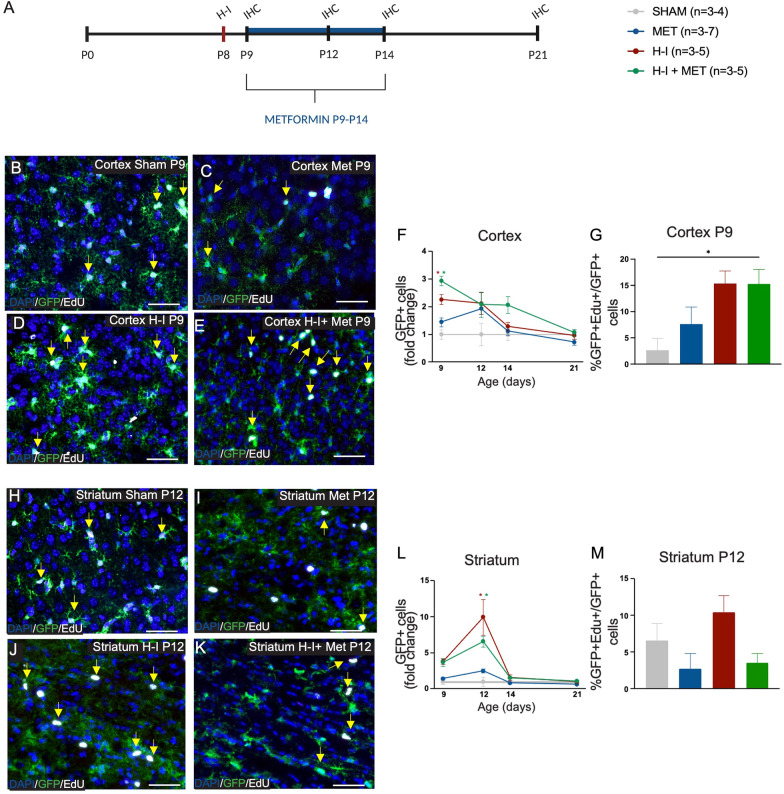
Herein, we revealed a spatiotemporally regulated response of microglia and astrocytes after hypoxia-ischaemia. Metformin treatment after hypoxia-ischaemia had no effect on microglia number and proliferation, but significantly reduced microglia activation in all regions examined, concomitant with improved behavioural outcomes in injured mice. Plexxikon 5622 treatment successfully ablated microglia, resulting in a > 90% depletion in microglia in the neonatal brain. Microglia rapidly repopulated upon treatment cessation of Plexxikon. Most interesting, microglia ablation was sufficient to reduce functional deficits after hypoxia-ischaemia, mimicking the effects of 1 week of metformin treatment post-injury.
These results highlight the importance of regulating the neuroinflammatory response after neonatal stroke to promote recovery.
新生儿中风是一种毁灭性的损伤,可导致终身损伤。在缺氧缺血性损伤的反应中,神经元和神经胶质细胞丧失,以及由常驻免疫细胞(包括小胶质细胞和星形胶质细胞)介导的神经炎症反应会加剧损伤。已表明抗糖尿病药物二甲双胍可改善脑损伤的临床前模型中的功能结局,并且二甲双胍介导的恢复的细胞基础尚不清楚。鉴于二甲双胍表现出的抗炎特性,我们研究了其在调节小胶质细胞激活中的作用,并使用小胶质细胞消融策略在新生鼠中风模型中研究了小胶质细胞介导的结局。
在出生后第 8 天进行缺氧缺血(H-I)。在损伤后一天开始,用二甲双胍治疗一周。使用免疫组织化学检查缺氧缺血后小胶质细胞和星形胶质细胞的时空反应,有或没有二甲双胍治疗。为了评估缺氧缺血后小胶质细胞耗竭的影响,我们在损伤后 1 或 2 周给予 Plexxikon 5622。通过免疫组织化学评估小胶质细胞和星形胶质细胞耗竭的区域模式。运动行为通过翻正反射、后肢悬垂、握力和圆筒试验进行评估。
在此,我们揭示了缺氧缺血后小胶质细胞和星形胶质细胞的时空调节反应。缺氧缺血后用二甲双胍治疗对小胶质细胞数量和增殖没有影响,但显著降低了所有检查区域的小胶质细胞激活,同时改善了受伤小鼠的行为结局。Plexxikon 5622 治疗成功地消融了小胶质细胞,导致新生脑中的小胶质细胞耗竭超过 90%。Plexxikon 治疗停止后小胶质细胞迅速重新填充。最有趣的是,小胶质细胞消融足以减少缺氧缺血后的功能缺陷,模拟了损伤后 1 周用二甲双胍治疗的效果。
这些结果强调了调节新生儿中风后神经炎症反应以促进恢复的重要性。