Department of Plant Pathology, University of California at Davis, Davis, California, USA.
United States Department of Agriculture, Agricultural Research Service, Salinas, California, USA.
Environ Microbiol. 2022 Oct;24(10):4570-4586. doi: 10.1111/1462-2920.16101. Epub 2022 Jun 20.
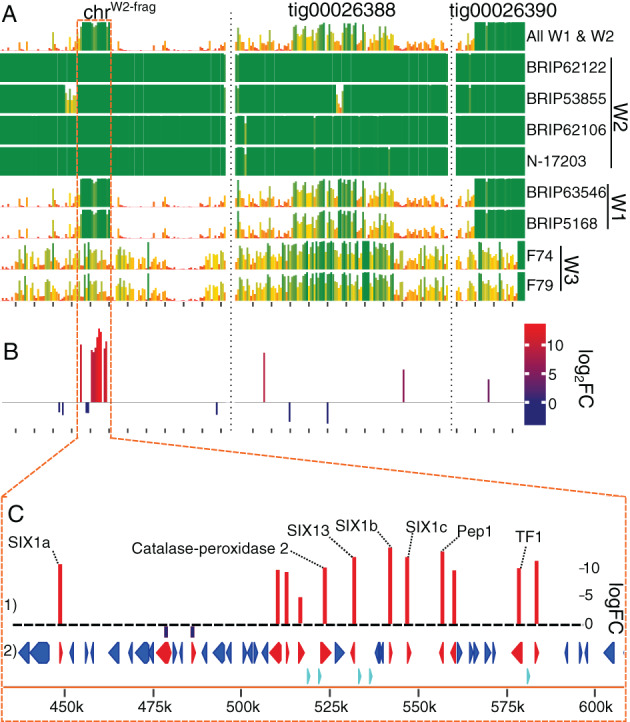
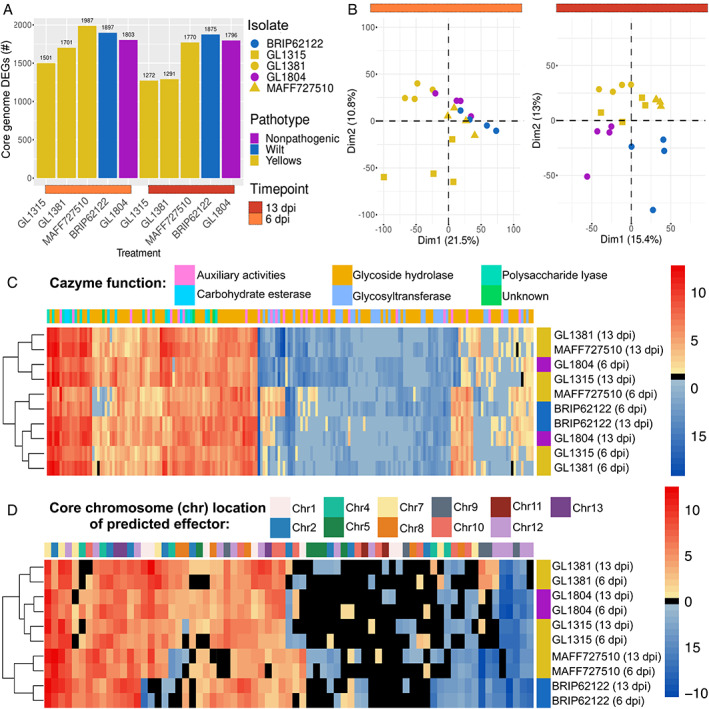
Convergent evolution of phytopathogenicity is poorly described, especially among multiple strains of a single microbial species. We investigated this phenomenon with genetically diverse isolates of Fusarium oxysporum f. sp. fragariae (Fof) that cause one of two syndromes: chlorosis and wilting (the 'yellows-fragariae' pathotype), or only wilting (the 'wilt-fragariae' pathotype). We challenged strawberry (Fragaria × ananassa) plants to root infection by five fungal isolates: three yellows-fragariae, one wilt-fragariae and one that is not pathogenic to strawberry. All Fof isolates had chromosome-level assemblies; three were newly generated. The two pathotypes triggered distinct host responses, especially among phytohormone-associated genes; yellows-fragariae isolates strongly induced jasmonic acid-associated genes, whereas the wilt-fragariae isolate primarily induced ethylene biosynthesis and signalling. The differentially expressed genes on fungal accessory chromosomes were almost entirely distinct between pathotypes. We identified an ~150 kbp 'pathogenicity island' that was horizontally transferred between wilt-fragariae strains. This predicted pathogenicity island was enriched with differentially expressed genes whose predicted functions were related to plant infection, and only one of these genes was also upregulated in planta by yellows-fragariae isolates. These results support the conclusion that wilt- and yellows-fragariae cause physiologically distinct syndromes by the expression of discrete repertoires of genes on accessory chromosomes.
植物病原性的趋同进化描述得很少,特别是在单一微生物物种的多个菌株中。我们用具有遗传多样性的草莓镰孢菌(Fusarium oxysporum f. sp. fragariae,简称 Fof)分离株研究了这一现象,这些分离株引起两种综合征之一:黄化和萎蔫(“黄化-草莓”病原型),或仅萎蔫(“萎蔫-草莓”病原型)。我们用五个真菌分离株对草莓(Fragaria ×ananassa)植株进行根感染挑战:三个黄化-草莓,一个萎蔫-草莓,一个对草莓没有致病性。所有 Fof 分离株都有染色体水平的组装;其中三个是新生成的。两种病原型引发了明显不同的宿主反应,特别是在植物激素相关基因中;黄化-草莓分离株强烈诱导茉莉酸相关基因,而萎蔫-草莓分离株主要诱导乙烯生物合成和信号转导。不同病原型真菌附加染色体上的差异表达基因几乎完全不同。我们鉴定了一个约 150kbp 的“致病性岛”,它在萎蔫-草莓菌株之间发生了水平转移。这个预测的致病性岛富含差异表达基因,其预测功能与植物感染有关,而这些基因中只有一个在黄化-草莓分离株中也在植物中上调。这些结果支持这样的结论:萎蔫-和黄化-草莓通过在附加染色体上表达离散的基因库引起生理上明显不同的综合征。