Kalia Vrinda, Niedzwiecki Megan M, Bradner Joshua M, Lau Fion K, Anderson Faith L, Bucher Meghan L, Manz Katherine E, Schlotter Alexa Puri, Fuentes Zoe Coates, Pennell Kurt D, Picard Martin, Walker Douglas I, Hu William T, Jones Dean P, Miller Gary W
Department of Environmental Health Sciences, Mailman School of Public Health, Columbia University, New York, NY, 10032 USA.
Department of Environmental Medicine and Public Health, Icahn School of Medicine at Mount Sinai, New York, NY, 10029 USA.
PNAS Nexus. 2022 May 3;1(2):pgac050. doi: 10.1093/pnasnexus/pgac050. eCollection 2022 May.
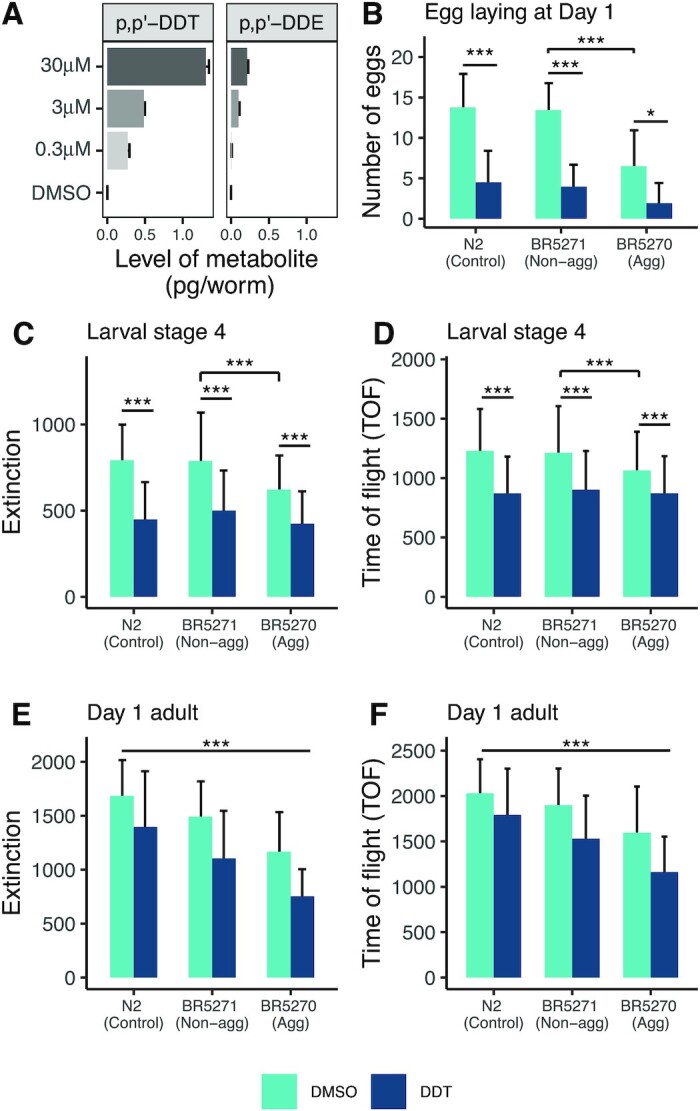
Exposure to the pesticide dichlorodiphenyltrichloroethane (DDT) has been associated with increased risk of Alzheimer's disease (AD), a disease also associated with hyperphosphorylated tau (p-tau) protein aggregation. We investigated whether exposure to DDT can exacerbate tau protein toxicity in using a transgenic strain that expresses human tau protein prone to aggregation by measuring changes in size, swim behavior, respiration, lifespan, learning, and metabolism. In addition, we examined the association between cerebrospinal fluid (CSF) p-tau protein-as a marker of postmortem tau burden-and global metabolism in both a human population study and in , using the same p-tau transgenic strain. From the human population study, plasma and CSF-derived metabolic features associated with p-tau levels were related to drug, amino acid, fatty acid, and mitochondrial metabolism pathways. A total of five metabolites overlapped between plasma and , and four between CSF and . DDT exacerbated the inhibitory effect of p-tau protein on growth and basal respiration. In the presence of p-tau protein, DDT induced more curling and was associated with reduced levels of amino acids but increased levels of uric acid and adenosylselenohomocysteine. Our findings in indicate that DDT exposure and p-tau aggregation both inhibit mitochondrial function and DDT exposure can exacerbate the mitochondrial inhibitory effects of p-tau aggregation. Further, biological pathways associated with exposure to DDT and p-tau protein appear to be conserved between species.
接触杀虫剂二氯二苯三氯乙烷(DDT)与患阿尔茨海默病(AD)风险增加有关,AD也是一种与tau蛋白过度磷酸化(p-tau)聚集相关的疾病。我们通过测量体型、游泳行为、呼吸、寿命、学习和新陈代谢的变化,利用一种表达易于聚集的人类tau蛋白的转基因品系,研究了接触DDT是否会加剧tau蛋白在 中的毒性。此外,我们在一项人群研究以及在 中,使用相同的p-tau转基因品系,研究了脑脊液(CSF)中p-tau蛋白(作为死后tau负荷的标志物)与整体代谢之间的关联。在人群研究中,与p-tau水平相关的血浆和脑脊液衍生的代谢特征与药物、氨基酸、脂肪酸和线粒体代谢途径有关。血浆和 之间共有五种代谢物重叠,脑脊液和 之间有四种。DDT加剧了p-tau蛋白对生长和基础呼吸的抑制作用。在存在p-tau蛋白的情况下,DDT诱导更多卷曲,并与氨基酸水平降低但尿酸和腺苷硒代同型半胱氨酸水平升高有关。我们在 中的研究结果表明,接触DDT和p-tau聚集均会抑制线粒体功能,并且接触DDT会加剧p-tau聚集对线粒体的抑制作用。此外,与接触DDT和p-tau蛋白相关的生物学途径在物种之间似乎是保守的。