Department of Pediatrics, Division of Infectious Diseases, University of California San Diego, La Jolla, California, USA.
Division of Infectious Diseases, Rady Children's Hospital, San Diego, California, USA.
J Leukoc Biol. 2022 Nov;112(5):1273-1284. doi: 10.1002/JLB.4MR0422-636R. Epub 2022 Jun 16.
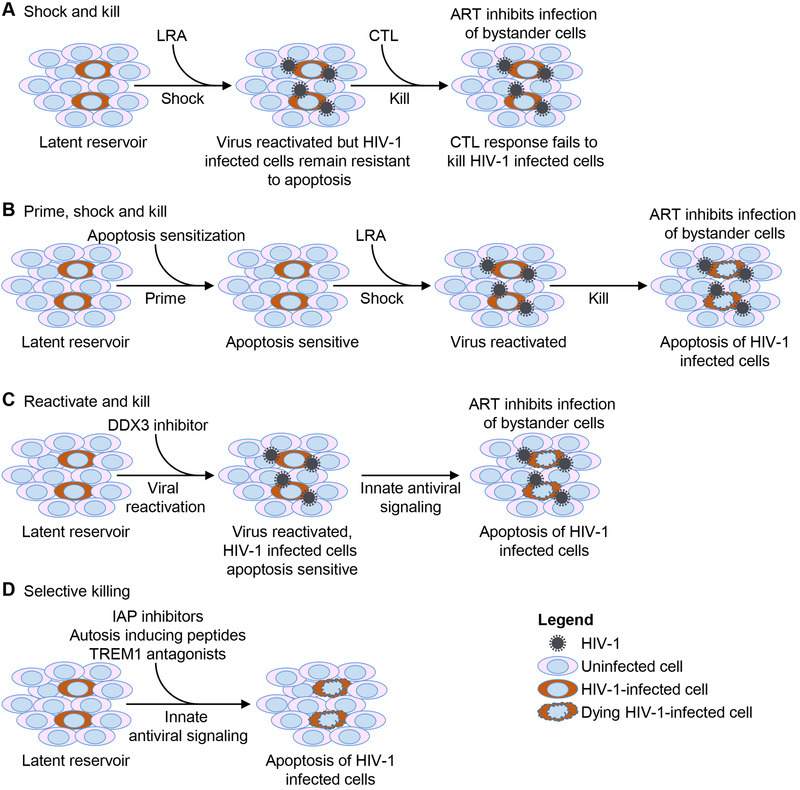
Although combination antiretroviral therapy (ART) has led to significant HIV-1 suppression and improvement in immune function, persistent viral reservoirs remain that are refractory to intensified ART. ART poses many challenges such as adherence to drug regimens, the emergence of resistant virus, and cumulative toxicity resulting from long-term therapy. Moreover, latent HIV-1 reservoir cells can be stochastically activated to produce viral particles despite effective ART and contribute to the rapid viral rebound that typically occurs within 2 weeks of ART interruption; thus, lifelong ART is required for continued viral suppression. Several strategies have been proposed to address the HIV-1 reservoir such as reactivation of HIV-1 transcription using latency reactivating agents with a combination of ART, host immune clearance and HIV-1-cytotoxicity to purge the infected cells-a "shock and kill" strategy. However, these approaches do not take into account the multiple transcriptional and translational blocks that contribute to HIV-1 latency or the complex heterogeneity of the HIV-1 reservoir, and clinical trials have thus far failed to produce the desired results. Here, we describe alternative strategies being pursued that are designed to kill selectively HIV-1-infected cells while sparing uninfected cells in the absence of enhanced humoral or adaptive immune responses.
尽管联合抗逆转录病毒疗法(ART)已显著抑制了 HIV-1 并改善了免疫功能,但仍存在对强化 ART 有抗性的持续性病毒储存库。ART 带来了许多挑战,如药物方案的依从性、耐药病毒的出现以及长期治疗带来的累积毒性。此外,尽管进行了有效的 ART,潜伏的 HIV-1 储存库细胞仍可能随机被激活产生病毒颗粒,并导致 ART 中断后通常在 2 周内迅速发生病毒反弹;因此,需要终身接受 ART 以持续抑制病毒。已经提出了几种策略来解决 HIV-1 储存库的问题,例如使用潜伏再激活剂与 ART 联合激活 HIV-1 转录,宿主免疫清除和 HIV-1 细胞毒性以清除受感染的细胞——一种“震撼和杀伤”策略。然而,这些方法没有考虑到导致 HIV-1 潜伏的多个转录和翻译阻断,以及 HIV-1 储存库的复杂异质性,因此临床试验迄今为止未能取得预期的结果。在这里,我们描述了正在探索的替代策略,旨在在没有增强的体液或适应性免疫反应的情况下,选择性地杀死 HIV-1 感染的细胞,而不伤害未感染的细胞。