Foshan Hospital of Traditional Chinese Medicine, Foshan, 528000, Guangdong Province, China.
Shenzhen Traditional Chinese Medicine Hospital, Shenzhen, 518000, Guangdong Province, China.
Chin J Traumatol. 2022 Nov;25(6):325-330. doi: 10.1016/j.cjtee.2022.06.001. Epub 2022 Jun 9.
Antibiotic-loaded bone cement (ALBC) was usually used to prevent periprosthetic joint infection (PJI) in primary total knee arthroplasty (PTKA), but whether to use ALBC or plain bone cement in PTKA remains unclear. We aimed to compare the occurrence rate of PJI using two different cements, and to investigate the efficacy of different antibiotic types and doses administered in preventing surgical site infection (SSI) with ALBC.
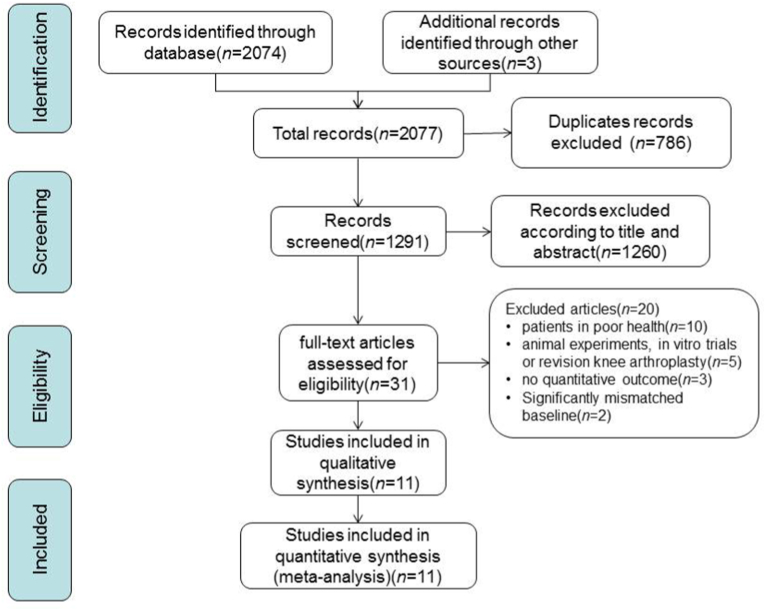
The availability of ALBC for preventing PJI was evaluated by using a systematic review and meta-analysis referring to the Preferred Reporting Items for Systematic Reviews and Meta-Analyses guidelines. Existing articles until December 2021 involving PTKA patients with both ALBC and plain bone cement cohorts were scanned by searching "total knee arthroplasty", "antibiotic-loaded cement", "antibiotic prophylaxis", "antibiotic-impregnated cement" and "antibiotic-laden cement" in the database of PubMed/MEDLINE, Embase, Web of Science and the Cochrane Library. Subgroup analysis included the effectiveness of different antibiotic types and doses in preventing SSI with ALBC. The modified Jadad scale was employed to score the qualities of included articles.
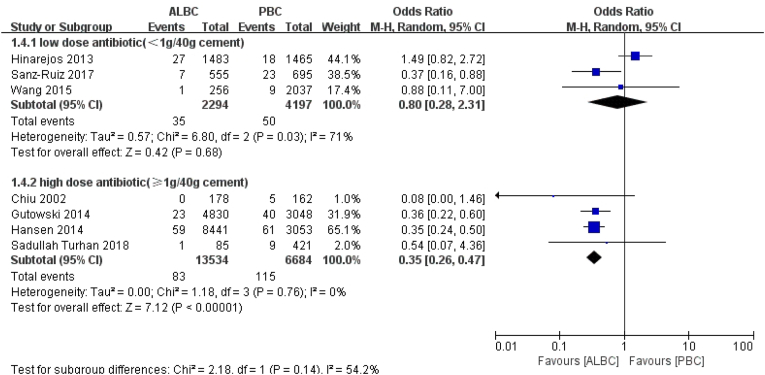
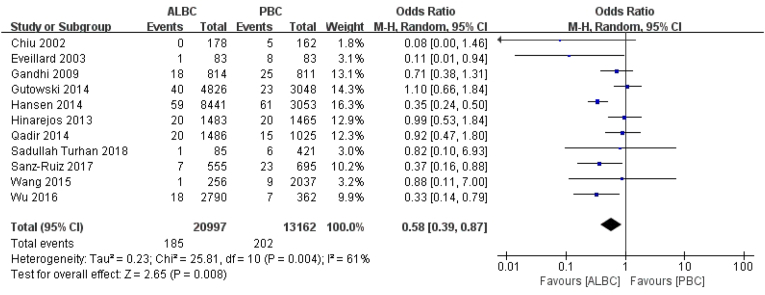
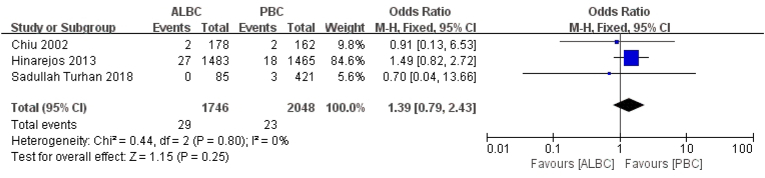
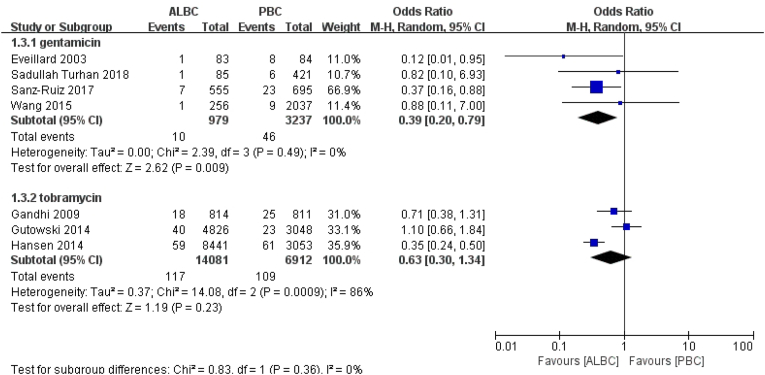
Eleven quantitative studies were enrolled, including 34,159 knees undergoing PTKA. The meta-analysis results demonstrated that the use of prophylactic ALBC could significantly reduce the prevalence of deep incisional SSI after PTKA, whereas there was no significant reduction in the rate of superficial incisional SSI. Moreover, gentamicin-loaded cement was effective in preventing deep incisional SSI, and the use of high-dose ALBC significantly reduced the rate of deep incisional SSI after PTKA. Besides, no significant adverse reactions and complications were stated during the use of ALBC in PTKA.
The preventive application of ALBC during PTKA could reduce the rates of deep PJI. Furthermore, bone cement containing gentamicin and high-dose ALBC could even better prevent deep infection after PTKA. However, the existing related articles are mostly single-center and retrospective studies, and further high-quality ones are needed for confirmation.
抗生素骨水泥(ALBC)通常用于预防初次全膝关节置换术(PTKA)中的假体周围关节感染(PJI),但在 PTKA 中使用 ALBC 还是普通骨水泥仍不清楚。我们旨在比较两种不同骨水泥使用后 PJI 的发生率,并探讨 ALBC 中不同抗生素类型和剂量预防手术部位感染(SSI)的效果。
我们参考系统评价和荟萃分析的首选报告项目,通过系统评价和荟萃分析评估 ALBC 预防 PJI 的效果。通过在 PubMed/MEDLINE、Embase、Web of Science 和 Cochrane 图书馆中搜索“全膝关节置换术”、“抗生素负载水泥”、“抗生素预防”、“抗生素浸渍水泥”和“抗生素负载水泥”,扫描了截至 2021 年 12 月涉及使用 ALBC 和普通骨水泥队列的 PTKA 患者的现有文章。亚组分析包括不同类型和剂量的抗生素在预防 ALBC 引起的 SSI 中的效果。采用改良 Jadad 量表对纳入文章的质量进行评分。
共纳入 11 项定量研究,包括 34159 例接受 PTKA 的膝关节。荟萃分析结果表明,预防性使用 ALBC 可显著降低 PTKA 后深部切口 SSI 的发生率,但对浅部切口 SSI 的发生率无显著降低。此外,庆大霉素负载水泥在预防深部切口 SSI 方面有效,且高剂量 ALBC 的使用可显著降低 PTKA 后深部切口 SSI 的发生率。此外,在 PTKA 中使用 ALBC 未报告明显的不良反应和并发症。
在 PTKA 中预防性应用 ALBC 可降低深部 PJI 的发生率。此外,含庆大霉素的骨水泥和高剂量 ALBC 甚至可以更好地预防 PTKA 后的深部感染。然而,现有的相关文章大多是单中心和回顾性研究,需要进一步的高质量研究来证实。