Papageorgi Ioulia, Saunders Jo, Himonides Evangelos, Welch Graham F
School of Humanities and Social Sciences, University of Nicosia, Nicosia, Cyprus.
Department of Culture, Communication and Media, University College London (UCL) Institute of Education, London, United Kingdom.
Front Psychol. 2022 Jun 2;13:823229. doi: 10.3389/fpsyg.2022.823229. eCollection 2022.
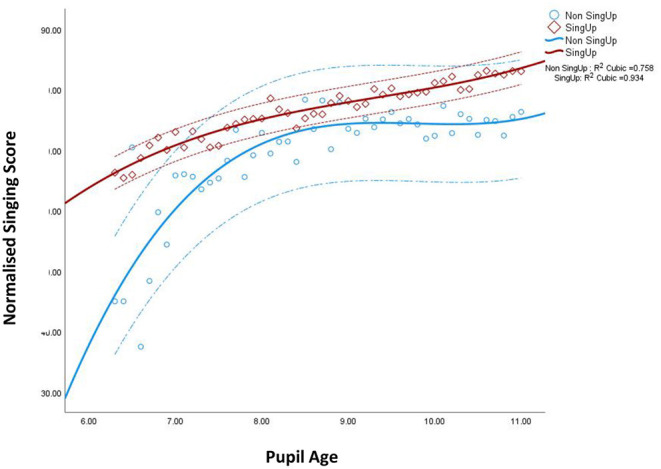
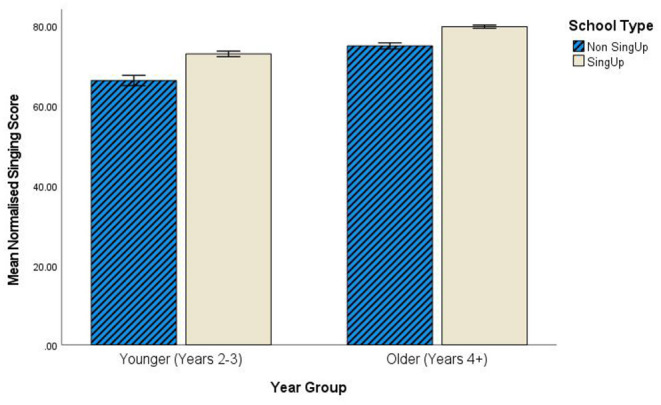
A range of studies suggest that singing activities with young children can have a beneficial impact on other aspects of their development. However, there is little research examining the relationship between young children's singing and their developing social identity. In the current study, data were captured of young children's singing and social identity as part of a larger-scale, longitudinal evaluation of the nationwide programme in England. Participants were 720 children aged 5-8 years old. The assessment of young children's singing ability employed an established measure and was undertaken individually. With adult support, the children were also asked to complete a simple questionnaire that focused on selected aspects of their social identity, both in general terms and also related to singing. Key themes embraced their attitudes to singing (at home, in school and in informal settings), singer identity (emotional engagement with singing and self-concept), and perceptions of self (self-efficacy, self-esteem, social integration). Comparative data were collected from young children of a similar age outside the programme. Findings suggested that the programme had a positive impact on children's singing ability, both overall and including the youngest children. The data analyses suggest that children could be identified as either "pupils with positive singing identity" or "pupils with less positive, or still developing singing identity." Overall, pupils with a more positive singer identity-irrespective of -related experience-tended to report more positive attitudes toward singing at school and other settings, had higher perceived levels of self-esteem and social integration, as well as more positive evaluations of their singing ability. Furthermore, the research suggests that successful participation in high-quality singing activities is likely to have a positive impact on young children's singing ability and, by implication, such positive singing development will also be associated with aspects of self that are related to contexualised singer identity and their sense of social inclusion.
一系列研究表明,与幼儿开展唱歌活动对他们发展的其他方面可能会产生有益影响。然而,很少有研究探讨幼儿唱歌与他们正在形成的社会身份之间的关系。在当前这项研究中,作为对英格兰全国性项目的一项大规模纵向评估的一部分,收集了幼儿唱歌和社会身份的数据。参与者是720名5至8岁的儿童。对幼儿唱歌能力的评估采用了一种既定的测量方法,并且是单独进行的。在成人的协助下,孩子们还被要求完成一份简单的问卷,该问卷聚焦于他们社会身份的选定方面,包括总体情况以及与唱歌相关的方面。关键主题包括他们对唱歌的态度(在家、在学校和在非正式场合)、歌手身份(对唱歌的情感投入和自我概念)以及自我认知(自我效能感、自尊、社会融合)。从该项目之外的同龄幼儿那里收集了对比数据。研究结果表明,该项目对孩子们的唱歌能力产生了积极影响,无论是总体上还是对最小的孩子来说都是如此。数据分析表明,孩子们可以被归类为“具有积极唱歌身份的学生”或“唱歌身份不太积极或仍在发展中的学生”。总体而言,具有更积极歌手身份的学生——无论与唱歌相关的经历如何——往往对在学校和其他场合唱歌表现出更积极的态度,有更高的自尊和社会融合感,以及对自己唱歌能力的更积极评价。此外,研究表明,成功参与高质量的唱歌活动可能会对幼儿的唱歌能力产生积极影响,而且,这种积极的唱歌发展也可能与与情境化歌手身份及社会包容感相关的自我方面有关。