Min Hye-Young, Kim Hyewon, Lee Ho Jin, Yoon Na-Young, Kim Yeon-Kye, Lee Ho-Young
College of Pharmacy and Research Institute of Pharmaceutical Sciences, Seoul National University, Seoul 08826, Republic of Korea.
Division of Food Safety and Processing Research, National Institute of Fisheries Science, Busan 46083, Republic of Korea.
Evid Based Complement Alternat Med. 2022 Jun 10;2022:6160010. doi: 10.1155/2022/6160010. eCollection 2022.
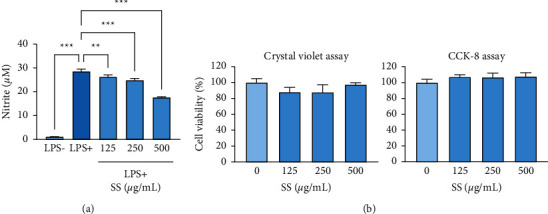
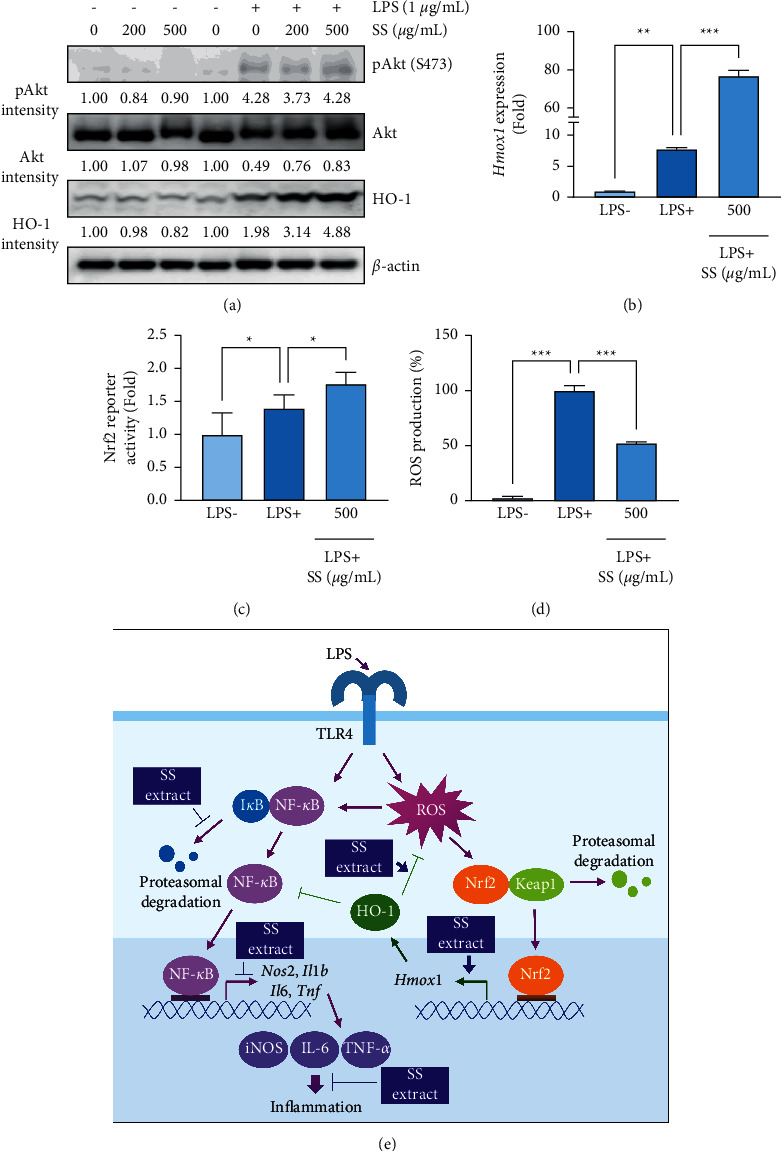
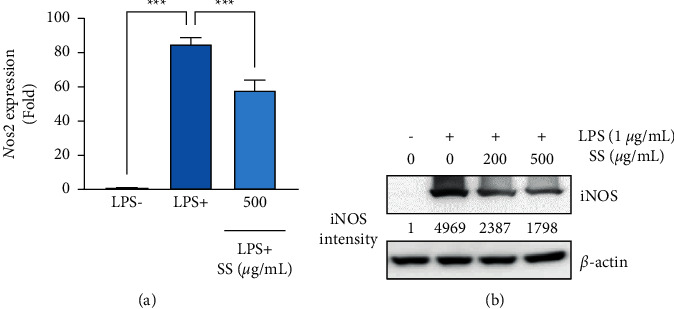
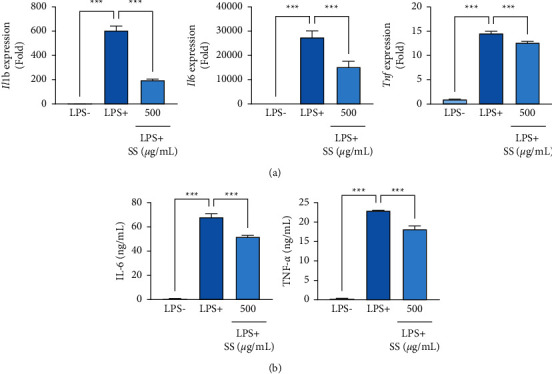
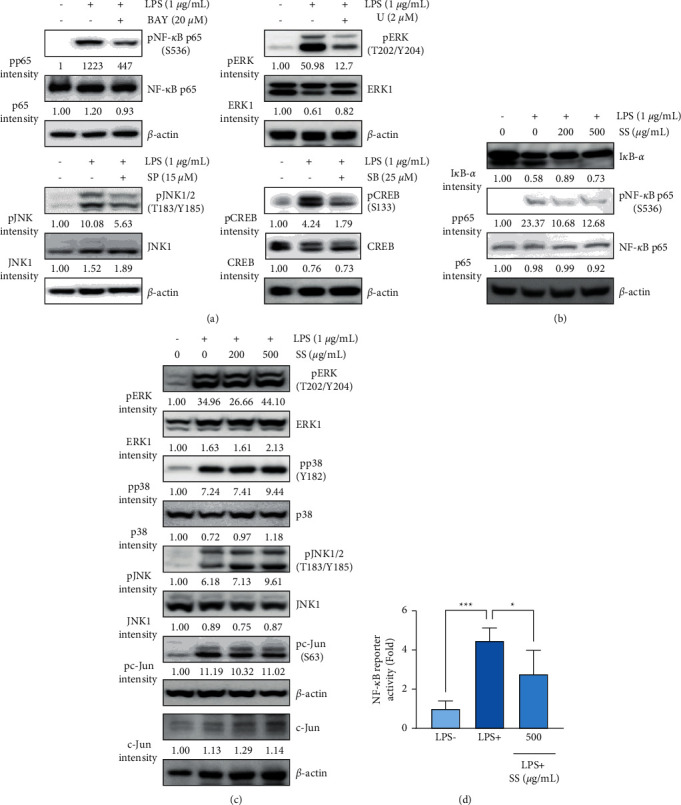
(SS) is an edible brown seaweed widely consumed in Korea and considered a functional food source. Previous studies have reported various biological activities of SS extracts, including antioxidant and hepatoprotective properties. In the present study, we examined the anti-inflammatory effects of the SS extract and assessed the underlying mechanism of action. The SS extract significantly inhibited lipopolysaccharide (LPS)-induced nitric oxide (NO) production in a dose-dependent manner (% of NO production at 500 g/mL: 60.1 ± 0.9%), with no obvious toxicity. Furthermore, the SS extract inhibited mRNA and protein expression levels of inducible NO synthase, as well as LPS-induced expression and production of proinflammatory cytokines such as IL-1, IL-6, or TNF- (IL-6 production (ng/mL) : LPS-: 0.7 ± 0.3; LPS+: 68.1 ± 2.8; LPS + SS extract: 51.9 ± 1.2; TNF- production (ng/mL) : LPS-: 0.3 ± 0.1; LPS+: 23.0 ± 0.1; LPS + SS extract: 18.2 ± 10.8). Mechanistically, the SS extract attenuated LPS-induced activation of the nuclear factor kappa-light-chain-enhancer of activated B cells (nuclear factor-kappa B, NF-B) signaling pathway such as phosphorylation of NF-B p65 and degradation of IB-, thereby blocking LPS-induced activation of NF-B transcriptional activity. The SS extract also enhanced LPS-induced heme oxygenase-1 expression and attenuated LPS-induced cellular reactive oxygen species production (% of ROS production at 500 g/mL: 52.2 ± 1.3%). Collectively, these findings suggest that the SS extract elicits anti-inflammatory effects in mouse macrophage cells.
裙带菜是一种可食用的褐藻,在韩国被广泛食用,并被视为一种功能性食物来源。先前的研究报道了裙带菜提取物的多种生物活性,包括抗氧化和肝脏保护特性。在本研究中,我们检测了裙带菜提取物的抗炎作用,并评估了其潜在的作用机制。裙带菜提取物以剂量依赖性方式显著抑制脂多糖(LPS)诱导的一氧化氮(NO)生成(500μg/mL时NO生成的百分比:60.1±0.9%),且无明显毒性。此外,裙带菜提取物抑制诱导型NO合酶的mRNA和蛋白质表达水平,以及LPS诱导的促炎细胞因子如白细胞介素-1(IL-1)、白细胞介素-6(IL-6)或肿瘤坏死因子-α(TNF-α)的表达和生成(IL-6生成量(ng/mL):LPS-:0.7±0.3;LPS+:68.1±2.8;LPS+裙带菜提取物:51.9±1.2;TNF-α生成量(ng/mL):LPS-:0.3±0.1;LPS+:23.0±0.1;LPS+裙带菜提取物:18.2±10.8)。从机制上讲,裙带菜提取物减弱了LPS诱导的活化B细胞核因子κ轻链增强子(核因子-κB,NF-κB)信号通路的激活,如NF-κB p65的磷酸化和IκB-α的降解,从而阻断LPS诱导的NF-κB转录活性的激活。裙带菜提取物还增强了LPS诱导的血红素加氧酶-1表达,并减弱了LPS诱导的细胞活性氧生成(500μg/mL时ROS生成的百分比:52.2±1.3%)。总的来说,这些发现表明裙带菜提取物在小鼠巨噬细胞中具有抗炎作用。