Koh Don Thong Siang, Tan Marcus Wei Ping, Zhan Xia, Li Zongxian, Tay Kae Sian, Tan Shi Ming, Yeo Nicholas Eng Meng, Rikhraj Singh Inderjeet
Department of Orthopaedic Surgery, Singapore General Hospital, Singapore.
Foot Ankle Orthop. 2022 Jun 12;7(2):24730114221103263. doi: 10.1177/24730114221103263. eCollection 2022 Apr.
Osteochondral lesions of the talus (OLTs) are a common condition found in patients with chronic ankle pain after previous ankle sprains. Surgical management is indicated after conservative management has failed.
HYPOTHESIS/PURPOSE: This study evaluates the influence of body mass index (BMI) on the early clinical outcomes of arthroscopic debridement and microfracture of OLTs.
A total of 252 patients with symptomatic OLTs who failed conservative management underwent arthroscopic debridement and microfracture of OLTs over the affected ankle between 2007 and 2017. Patients from this cohort were divided into 2 groups based on BMI: the normal BMI group (NB Group) (BMI 18.5-25.0) and overweight and obese BMI group (OB Group) (BMI ≥25). Visual analogue scale (VAS), American Orthopaedic Foot & Ankle Society (AOFAS) hindfoot score, and the physical and mental component summaries of the 36-Item Short-Form Health Survey (PCS and MCS, respectively) were prospectively collected from the cohort during their standard postoperative outpatient follow-up.
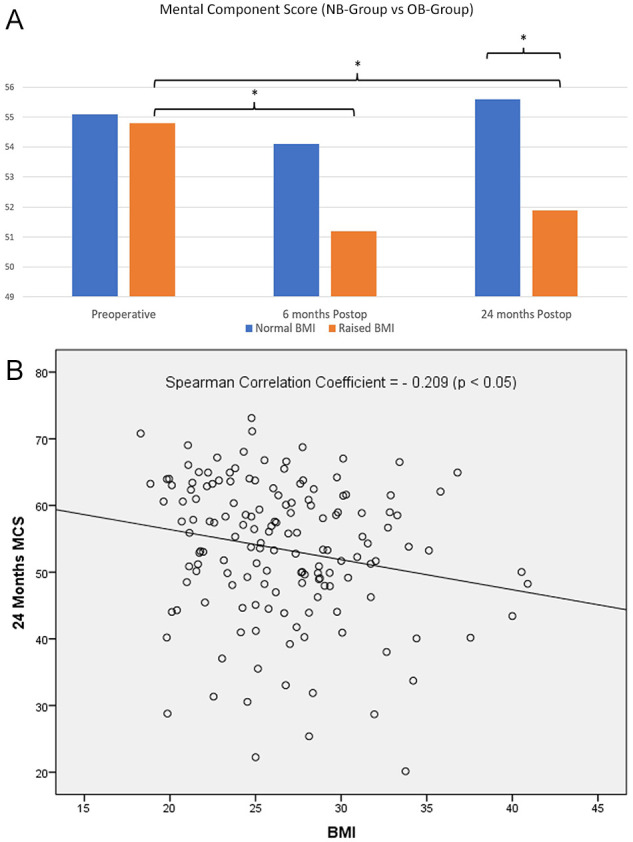
The NB Group (n=105) and OB Group (n=147) were well matched demographically. The operative duration was significantly shorter for the NB Group compared to the OB Group. Patients from both groups had significant improvements in VAS, AOFAS, and PCS scores postoperatively at 6 and 24 months after surgery ( < .05). Between both groups, patients had comparable VAS, AOFAS, and PCS scores at preoperation, 6 months postoperation, and 24 months postoperation ( > .05). However, MCS in the OB Group was lower at 24 months postoperatively compared with the NB Group ( < .05). The OB Group reported better satisfaction scores (82.4% vs 72.6%, < .05), and a greater proportion had their expectations met (88.2% vs 77.9%, < .05).
A BMI ≥25 was not associated with worse postoperative pain and functional outcomes, but rather was found to be associated with greater satisfaction and fulfillment. However, patients with BMI ≥25 required longer procedure duration and had poorer MCS scores at 24 months after surgery. Level III, retrospective cohort study.
距骨骨软骨损伤(OLTs)是既往踝关节扭伤后慢性踝关节疼痛患者中常见的病症。保守治疗失败后需进行手术治疗。
假设/目的:本研究评估体重指数(BMI)对OLTs关节镜下清创和微骨折早期临床疗效的影响。
2007年至2017年期间,共有252例保守治疗失败的有症状OLTs患者接受了患侧踝关节OLTs的关节镜下清创和微骨折治疗。该队列中的患者根据BMI分为两组:正常BMI组(NB组)(BMI 18.5 - 25.0)以及超重和肥胖BMI组(OB组)(BMI≥25)。在标准术后门诊随访期间,前瞻性收集该队列患者的视觉模拟量表(VAS)、美国矫形足踝协会(AOFAS)后足评分以及36项简短健康调查的身体和心理成分总结(分别为PCS和MCS)。
NB组(n = 105)和OB组(n = 147)在人口统计学上匹配良好。与OB组相比,NB组的手术时间明显更短。两组患者术后6个月及24个月时VAS、AOFAS和PCS评分均有显著改善(P <.05)。两组之间,患者术前、术后6个月及术后24个月的VAS、AOFAS 和PCS评分相当(P >.05 )。然而,术后24个月时,OB组的MCS低于NB组(P <.0 )。OB组报告的满意度评分更高( 82.4% 对72.6%,P <.05 ),并且达到预期的比例更大( 88.2% 对77.9%,P <.0 )。
结论BMI≥25与术后疼痛和功能结局较差无关,反而发现其与更高的满意度和满足感相关。然而,BMI≥25的患者手术时间更长且术后24个月时MCS评分较差。三级,回顾性队列研究。