EmitBio Inc., 4222 Emperor Blvd, Suite 470, Durham, NC 27703, United States.
EmitBio Inc., 4222 Emperor Blvd, Suite 470, Durham, NC 27703, United States.
J Dent. 2022 Aug;123:104203. doi: 10.1016/j.jdent.2022.104203. Epub 2022 Jun 17.
Using a battery of preclinical tests to support development of a light-based treatment for COVID-19, establish a range of 425 nm light doses that are non-hazardous to the tissues of the oral cavity and assess whether a 425 nm light dose in this non-hazardous range can inactivate SARS-CoV-2 in artificial saliva.
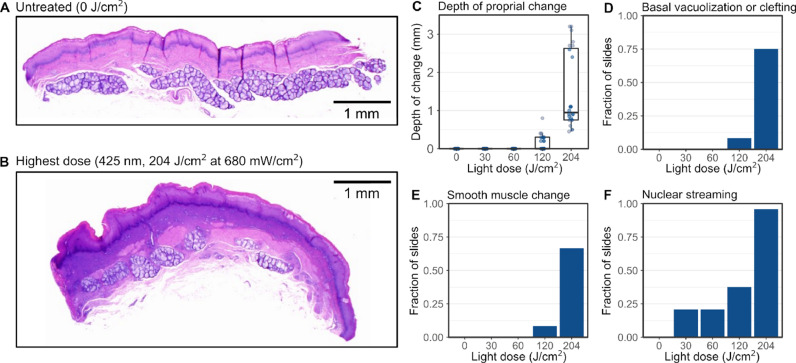
The potential hazards to oral tissues associated with a range of acute 425 nm light doses were assessed using a battery of four preclinical tests: (1) cytotoxicity, using well-differentiated human large airway and buccal epithelial models; (2) toxicity to commensal oral bacteria, using a panel of model organisms; (3) light-induced histopathological changes, using ex vivo porcine esophageal tissue, and (4) thermal damage, by dosing the oropharynx of intact porcine head specimens. Then, 425 nm light doses established as non-hazardous using these tests were evaluated for their potential to inactivate SARS-CoV-2 in artificial saliva.
A dose range was established at which 425 nm light is not cytotoxic in well-differentiated human large airway or buccal epithelial models, is not cytotoxic to a panel of commensal oral bacteria, does not induce histopathological damage in ex vivo porcine esophageal tissue, and does not induce thermal damage to the oropharynx of intact porcine head specimens. Using these tests, no hazards were observed for 425 nm light doses less than 63 J/cm delivered at irradiance less than 200 mW/cm. A non-hazardous 425 nm light dose in this range (30 J/cm at 50 mW/cm) was shown to inactivate SARS-CoV-2 in vitro in artificial saliva.
Preclinical hazard assessments and SARS-CoV-2 inactivation efficacy testing were combined to guide the development of a 425 nm light-based treatment for COVID-19.
The process used here to evaluate the potential hazards associated with 425 nm acute light dosing of the oral cavity to treat COVID-19 can be extended to other wavelengths, anatomical targets, and therapeutic applications to accelerate the development of novel photomedicine treatments.
使用一系列临床前测试来支持开发针对 COVID-19 的基于光的治疗方法,确定一系列对口腔组织无危害的 425nm 光剂量,并评估该无害范围内的 425nm 光剂量是否能使人工唾液中的 SARS-CoV-2 失活。
使用一系列四种临床前测试评估一系列急性 425nm 光剂量对口腔组织的潜在危害:(1)细胞毒性,使用分化良好的人大型气道和颊上皮模型;(2)对共生口腔细菌的毒性,使用模型生物组;(3)光诱导的组织病理学变化,使用离体猪食管组织,以及(4)热损伤,通过对完整猪头部标本的口咽部位进行剂量给药。然后,使用这些测试确定对口腔组织无害的 425nm 光剂量,评估其在人工唾液中灭活 SARS-CoV-2 的潜力。
建立了一个剂量范围,在此范围内,425nm 光在分化良好的人大型气道或颊上皮模型中没有细胞毒性,对共生口腔细菌模型组没有细胞毒性,在离体猪食管组织中不会引起组织病理学损伤,在完整猪头部标本的口咽部位不会引起热损伤。使用这些测试,在小于 200mW/cm 的辐照度下,小于 63J/cm 的 425nm 光剂量不会观察到任何危害。在此范围内(50mW/cm 时为 30J/cm)的无害 425nm 光剂量在人工唾液中显示出能使 SARS-CoV-2 失活。
临床前危害评估和 SARS-CoV-2 失活功效测试相结合,指导开发针对 COVID-19 的基于 425nm 光的治疗方法。
此处用于评估治疗 COVID-19 时口腔 425nm 急性光剂量的潜在危害的过程可以扩展到其他波长、解剖靶标和治疗应用,以加速新型光医学治疗方法的开发。