Institute of Virology and Immunology (IVI), Bern and Mittelhäusern, Switzerland.
Department of Infectious Diseases and Pathobiology, Vetsuisse Faculty, University of Bern, Bern, Switzerland.
Sci Rep. 2022 Jun 20;12(1):10340. doi: 10.1038/s41598-022-13777-y.
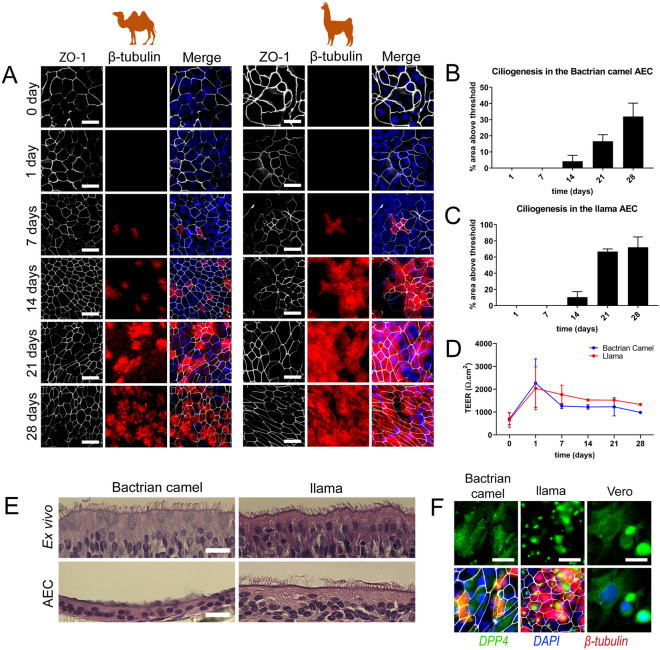
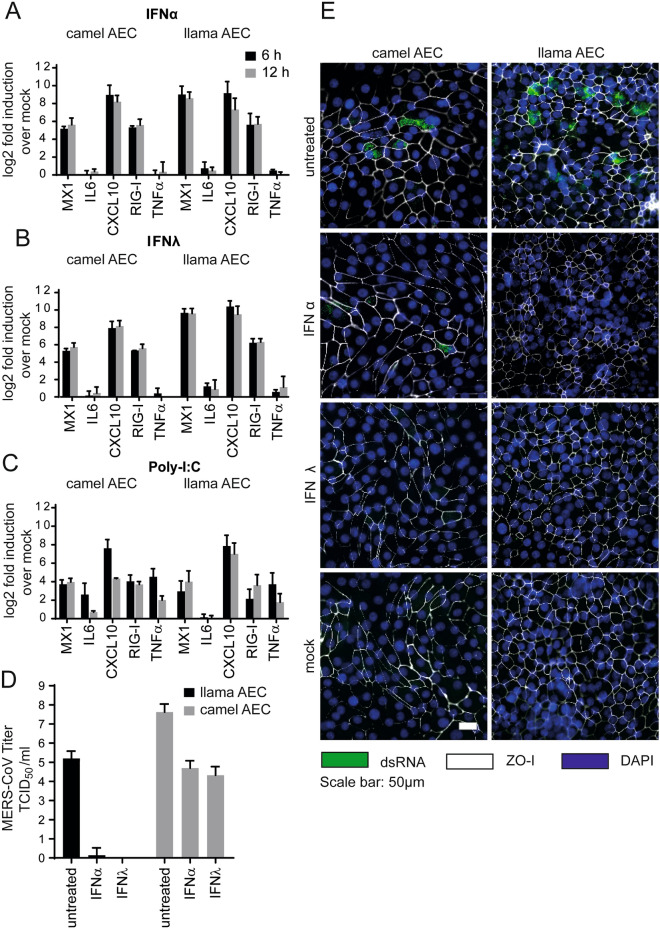
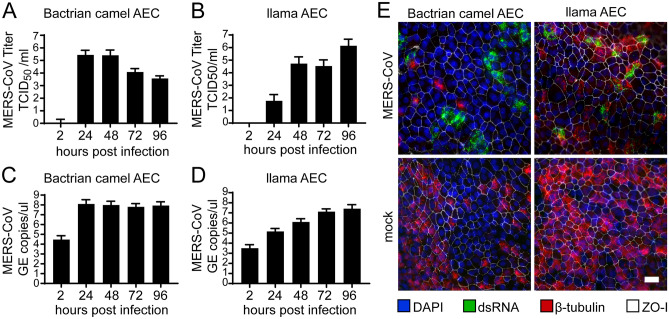
In 2012, Middle East respiratory syndrome coronavirus (MERS-CoV) emerged in Saudi Arabia and was mostly associated with severe respiratory illness in humans. Dromedary camels are the zoonotic reservoir for MERS-CoV. To investigate the biology of MERS-CoV in camelids, we developed a well-differentiated airway epithelial cell (AEC) culture model for Llama glama and Camelus bactrianus. Histological characterization revealed progressive epithelial cellular differentiation with well-resemblance to autologous ex vivo tissues. We demonstrate that MERS-CoV displays a divergent cell tropism and replication kinetics profile in both AEC models. Furthermore, we observed that in the camelid AEC models MERS-CoV replication can be inhibited by both type I and III interferons (IFNs). In conclusion, we successfully established camelid AEC cultures that recapitulate the in vivo airway epithelium and reflect MERS-CoV infection in vivo. In combination with human AEC cultures, this system allows detailed characterization of the molecular basis of MERS-CoV cross-species transmission in respiratory epithelium.
2012 年,中东呼吸综合征冠状病毒(MERS-CoV)在沙特阿拉伯出现,主要与人类严重的呼吸道疾病有关。单峰驼是 MERS-CoV 的动物宿主。为了研究 MERS-CoV 在骆驼科动物中的生物学特性,我们建立了一个分化良好的骆驼气道上皮细胞(AEC)培养模型,用于羊驼和双峰驼。组织学特征显示出渐进的上皮细胞分化,与自体离体组织非常相似。我们证明,MERS-CoV 在这两种 AEC 模型中表现出不同的细胞嗜性和复制动力学特征。此外,我们观察到在骆驼科动物的 AEC 模型中,I 型和 III 型干扰素(IFNs)都可以抑制 MERS-CoV 的复制。总之,我们成功地建立了骆驼科动物 AEC 培养物,这些培养物重现了体内气道上皮,并反映了 MERS-CoV 的体内感染。结合人 AEC 培养物,该系统允许对 MERS-CoV 在呼吸道上皮中的跨种传播的分子基础进行详细表征。