• 文献检索
  • 文档翻译
  • 深度研究
  • 学术资讯
  • Suppr Zotero 插件Zotero 插件
  • 邀请有礼
  • 套餐&价格
  • 历史记录
应用&插件
Suppr Zotero 插件Zotero 插件浏览器插件Mac 客户端Windows 客户端微信小程序
定价
高级版会员购买积分包购买API积分包
服务
文献检索文档翻译深度研究API 文档MCP 服务
关于我们
关于 Suppr公司介绍联系我们用户协议隐私条款
关注我们

Suppr 超能文献

核心技术专利:CN118964589B侵权必究
粤ICP备2023148730 号-1Suppr @ 2026

文献检索

告别复杂PubMed语法,用中文像聊天一样搜索,搜遍4000万医学文献。AI智能推荐,让科研检索更轻松。

立即免费搜索

文件翻译

保留排版,准确专业,支持PDF/Word/PPT等文件格式,支持 12+语言互译。

免费翻译文档

深度研究

AI帮你快速写综述,25分钟生成高质量综述,智能提取关键信息,辅助科研写作。

立即免费体验

深度学习神经网络和灵长类动物大脑中的面部身份编码。

Face identity coding in the deep neural network and primate brain.

机构信息

Lane Department of Computer Science and Electrical Engineering, West Virginia University, Morgantown, WV, 26506, USA.

Department of Neurosurgery, West Virginia University, Morgantown, WV, 26506, USA.

出版信息

Commun Biol. 2022 Jun 20;5(1):611. doi: 10.1038/s42003-022-03557-9.

DOI:10.1038/s42003-022-03557-9
PMID:35725902
原文链接:https://pmc.ncbi.nlm.nih.gov/articles/PMC9209415/
Abstract

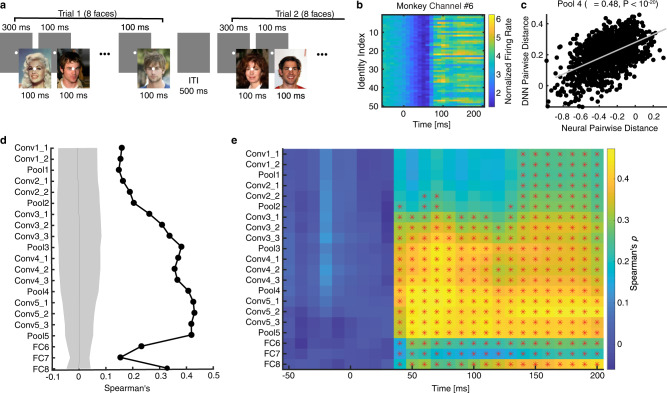
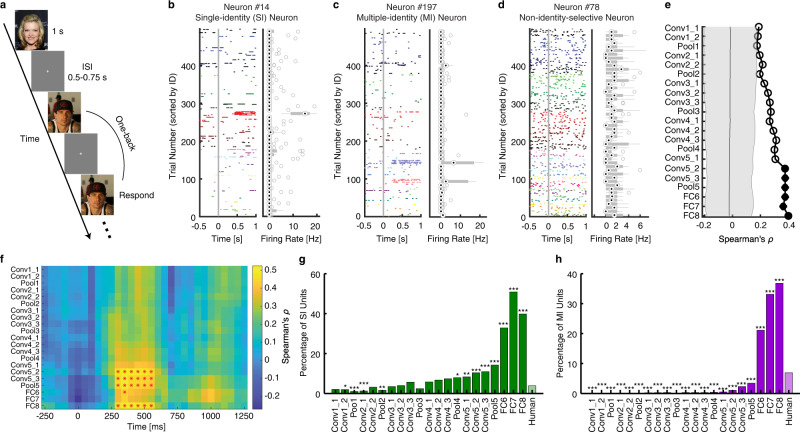
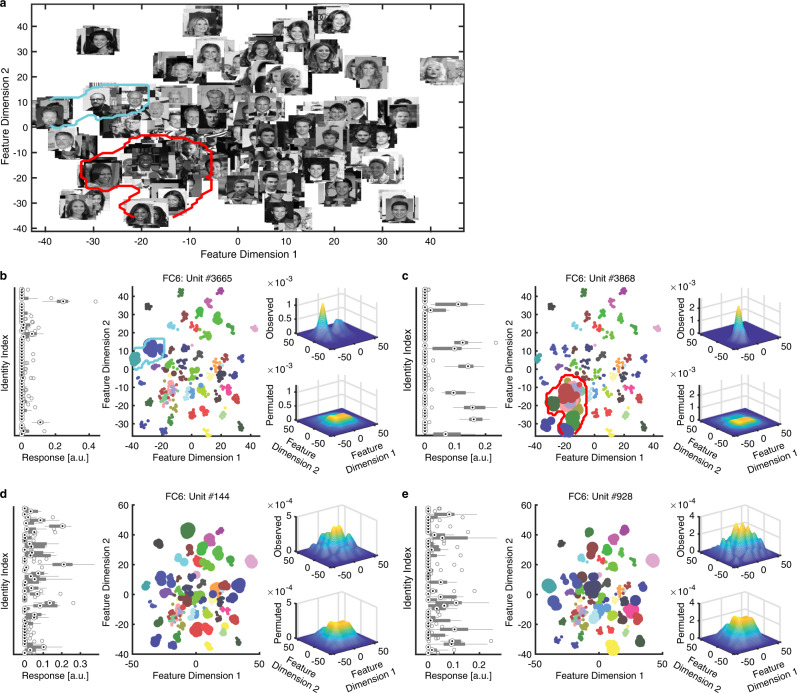
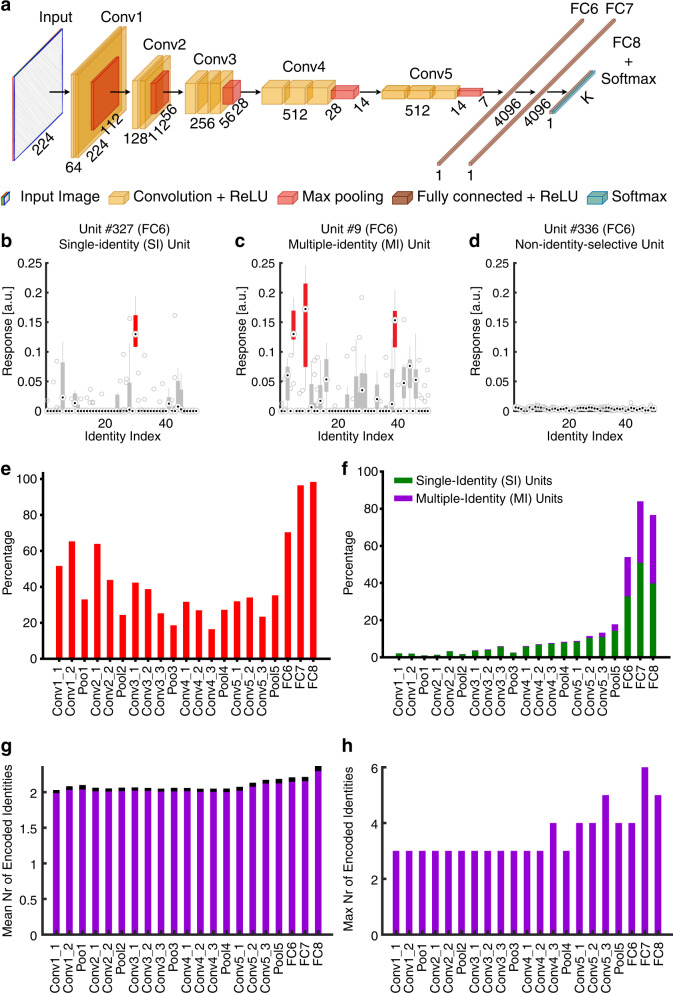
A central challenge in face perception research is to understand how neurons encode face identities. This challenge has not been met largely due to the lack of simultaneous access to the entire face processing neural network and the lack of a comprehensive multifaceted model capable of characterizing a large number of facial features. Here, we addressed this challenge by conducting in silico experiments using a pre-trained face recognition deep neural network (DNN) with a diverse array of stimuli. We identified a subset of DNN units selective to face identities, and these identity-selective units demonstrated generalized discriminability to novel faces. Visualization and manipulation of the network revealed the importance of identity-selective units in face recognition. Importantly, using our monkey and human single-neuron recordings, we directly compared the response of artificial units with real primate neurons to the same stimuli and found that artificial units shared a similar representation of facial features as primate neurons. We also observed a region-based feature coding mechanism in DNN units as in human neurons. Together, by directly linking between artificial and primate neural systems, our results shed light on how the primate brain performs face recognition tasks.

摘要

面部识别研究的一个核心挑战是理解神经元如何对人脸身份进行编码。由于缺乏对整个面部处理神经网络的同步访问,以及缺乏能够描述大量面部特征的全面多方面模型,这一挑战尚未得到解决。在这里,我们通过使用具有各种刺激的预先训练的人脸识别深度神经网络(DNN)进行计算机实验来解决这一挑战。我们确定了一组对人脸身份具有选择性的 DNN 单元,这些身份选择性单元对新面孔表现出普遍的可辨别性。对网络的可视化和操作揭示了身份选择性单元在人脸识别中的重要性。重要的是,使用我们的猴子和人类单细胞记录,我们直接比较了人工单元与真实灵长类神经元对相同刺激的反应,发现人工单元与灵长类神经元对面部特征的表示相似。我们还在 DNN 单元中观察到了基于区域的特征编码机制,就像人类神经元一样。总的来说,通过在人工和灵长类神经之间直接建立联系,我们的结果揭示了灵长类大脑如何执行面部识别任务。
https://cdn.ncbi.nlm.nih.gov/pmc/blobs/adaf/9209415/28d2ef16f12d/42003_2022_3557_Fig8_HTML.jpg
https://cdn.ncbi.nlm.nih.gov/pmc/blobs/adaf/9209415/99cf64f00c82/42003_2022_3557_Fig1_HTML.jpg
https://cdn.ncbi.nlm.nih.gov/pmc/blobs/adaf/9209415/0fc0abfacecc/42003_2022_3557_Fig2_HTML.jpg
https://cdn.ncbi.nlm.nih.gov/pmc/blobs/adaf/9209415/69bc83722675/42003_2022_3557_Fig3_HTML.jpg
https://cdn.ncbi.nlm.nih.gov/pmc/blobs/adaf/9209415/f600acc780d0/42003_2022_3557_Fig4_HTML.jpg
https://cdn.ncbi.nlm.nih.gov/pmc/blobs/adaf/9209415/ef4d0e793b26/42003_2022_3557_Fig5_HTML.jpg
https://cdn.ncbi.nlm.nih.gov/pmc/blobs/adaf/9209415/4efae941f010/42003_2022_3557_Fig6_HTML.jpg
https://cdn.ncbi.nlm.nih.gov/pmc/blobs/adaf/9209415/f10cec8a59a8/42003_2022_3557_Fig7_HTML.jpg
https://cdn.ncbi.nlm.nih.gov/pmc/blobs/adaf/9209415/28d2ef16f12d/42003_2022_3557_Fig8_HTML.jpg
https://cdn.ncbi.nlm.nih.gov/pmc/blobs/adaf/9209415/99cf64f00c82/42003_2022_3557_Fig1_HTML.jpg
https://cdn.ncbi.nlm.nih.gov/pmc/blobs/adaf/9209415/0fc0abfacecc/42003_2022_3557_Fig2_HTML.jpg
https://cdn.ncbi.nlm.nih.gov/pmc/blobs/adaf/9209415/69bc83722675/42003_2022_3557_Fig3_HTML.jpg
https://cdn.ncbi.nlm.nih.gov/pmc/blobs/adaf/9209415/f600acc780d0/42003_2022_3557_Fig4_HTML.jpg
https://cdn.ncbi.nlm.nih.gov/pmc/blobs/adaf/9209415/ef4d0e793b26/42003_2022_3557_Fig5_HTML.jpg
https://cdn.ncbi.nlm.nih.gov/pmc/blobs/adaf/9209415/4efae941f010/42003_2022_3557_Fig6_HTML.jpg
https://cdn.ncbi.nlm.nih.gov/pmc/blobs/adaf/9209415/f10cec8a59a8/42003_2022_3557_Fig7_HTML.jpg
https://cdn.ncbi.nlm.nih.gov/pmc/blobs/adaf/9209415/28d2ef16f12d/42003_2022_3557_Fig8_HTML.jpg

相似文献

1
Face identity coding in the deep neural network and primate brain.深度学习神经网络和灵长类动物大脑中的面部身份编码。
Commun Biol. 2022 Jun 20;5(1):611. doi: 10.1038/s42003-022-03557-9.
2
Explaining face representation in the primate brain using different computational models.用不同的计算模型解释灵长类动物大脑中的面部表示。
Curr Biol. 2021 Jul 12;31(13):2785-2795.e4. doi: 10.1016/j.cub.2021.04.014. Epub 2021 May 4.
3
Equivalent processing of facial expression and identity by macaque visual system and task-optimized neural network.恒河猴视觉系统和任务优化神经网络对面部表情和身份的等价处理。
Neuroimage. 2023 Jun;273:120067. doi: 10.1016/j.neuroimage.2023.120067. Epub 2023 Mar 28.
4
Intracranial Electroencephalography and Deep Neural Networks Reveal Shared Substrates for Representations of Face Identity and Expressions.颅内脑电图和深度神经网络揭示了面部身份和表情表示的共享基础。
J Neurosci. 2023 Jun 7;43(23):4291-4303. doi: 10.1523/JNEUROSCI.1277-22.2023. Epub 2023 May 4.
5
Face detection in untrained deep neural networks.未训练的深度神经网络中的人脸检测。
Nat Commun. 2021 Dec 16;12(1):7328. doi: 10.1038/s41467-021-27606-9.
6
Social Trait Information in Deep Convolutional Neural Networks Trained for Face Identification.深度卷积神经网络在人脸识别训练中所获取的社交特质信息。
Cogn Sci. 2019 Jun;43(6):e12729. doi: 10.1111/cogs.12729.
7
Comparison of neuronal responses in primate inferior-temporal cortex and feed-forward deep neural network model with regard to information processing of faces.灵长类动物下颞叶皮质与前馈深度神经网络模型在面部信息处理方面的神经元反应比较。
J Comput Neurosci. 2021 Aug;49(3):251-257. doi: 10.1007/s10827-021-00778-5. Epub 2021 Feb 17.
8
The visually guided development of facial representations in the primate ventral visual pathway: A computer modeling study.灵长类动物腹侧视觉通路中面部表达的视觉引导发育:一项计算机建模研究。
Psychol Rev. 2016 Nov;123(6):696-739. doi: 10.1037/rev0000042.
9
The neural representation of the gender of faces in the primate visual system: A computer modeling study.灵长类视觉系统中面孔性别特征的神经表示:计算机建模研究。
Psychol Rev. 2017 Mar;124(2):154-167. doi: 10.1037/rev0000049. Epub 2017 Jan 9.
10
FFA and OFA Encode Distinct Types of Face Identity Information.FFA 和 OFA 编码不同类型的面孔身份信息。
J Neurosci. 2021 Mar 3;41(9):1952-1969. doi: 10.1523/JNEUROSCI.1449-20.2020. Epub 2021 Jan 15.

引用本文的文献

1
A neural computational framework for face processing in the human temporal lobe.人类颞叶中用于面部处理的神经计算框架。
Curr Biol. 2025 Apr 21;35(8):1765-1778.e6. doi: 10.1016/j.cub.2025.02.063. Epub 2025 Mar 20.
2
Can micro-expressions be used as a biomarker for autism spectrum disorder?微表情能否用作自闭症谱系障碍的生物标志物?
Front Neuroinform. 2024 Oct 3;18:1435091. doi: 10.3389/fninf.2024.1435091. eCollection 2024.
3
Decoding dynamic visual scenes across the brain hierarchy.在大脑层级中解码动态视觉场景。

本文引用的文献

1
A neuronal social trait space for first impressions in the human amygdala and hippocampus.人类杏仁核和海马体中用于第一印象的神经元社会特征空间。
Mol Psychiatry. 2022 Aug;27(8):3501-3509. doi: 10.1038/s41380-022-01583-x. Epub 2022 Jun 8.
2
Brain-like functional specialization emerges spontaneously in deep neural networks.类脑功能特化在深度神经网络中自发出现。
Sci Adv. 2022 Mar 18;8(11):eabl8913. doi: 10.1126/sciadv.abl8913. Epub 2022 Mar 16.
3
Face detection in untrained deep neural networks.未训练的深度神经网络中的人脸检测。
PLoS Comput Biol. 2024 Aug 2;20(8):e1012297. doi: 10.1371/journal.pcbi.1012297. eCollection 2024 Aug.
4
Encoding of Visual Objects in the Human Medial Temporal Lobe.人类内侧颞叶中的视觉对象编码。
J Neurosci. 2024 Apr 17;44(16):e2135232024. doi: 10.1523/JNEUROSCI.2135-23.2024.
5
A critical period for developing face recognition.面部识别发展的关键时期。
Patterns (N Y). 2023 Dec 26;5(2):100895. doi: 10.1016/j.patter.2023.100895. eCollection 2024 Feb 9.
6
Deep social neuroscience: the promise and peril of using artificial neural networks to study the social brain.深度社会神经科学:使用人工神经网络研究社会大脑的前景与风险。
Soc Cogn Affect Neurosci. 2024 Feb 21;19(1). doi: 10.1093/scan/nsae014.
7
Neural mechanisms of face familiarity and learning in the human amygdala and hippocampus.人类杏仁核和海马体中面孔熟悉度和学习的神经机制。
Cell Rep. 2024 Jan 23;43(1):113520. doi: 10.1016/j.celrep.2023.113520. Epub 2023 Dec 26.
8
Using multi-task experiments to test principles of hippocampal function.运用多任务实验检验海马体功能原理。
Hippocampus. 2023 May;33(5):646-657. doi: 10.1002/hipo.23540. Epub 2023 Apr 12.
Nat Commun. 2021 Dec 16;12(1):7328. doi: 10.1038/s41467-021-27606-9.
4
Encoding of facial features by single neurons in the human amygdala and hippocampus.人类杏仁核和海马体中单神经元对面部特征的编码。
Commun Biol. 2021 Dec 14;4(1):1394. doi: 10.1038/s42003-021-02917-1.
5
Explaining face representation in the primate brain using different computational models.用不同的计算模型解释灵长类动物大脑中的面部表示。
Curr Biol. 2021 Jul 12;31(13):2785-2795.e4. doi: 10.1016/j.cub.2021.04.014. Epub 2021 May 4.
6
No Pattern Separation in the Human Hippocampus.人类海马体中不存在模式分离。
Trends Cogn Sci. 2020 Dec;24(12):994-1007. doi: 10.1016/j.tics.2020.09.012. Epub 2020 Nov 5.
7
Fast Recurrent Processing via Ventrolateral Prefrontal Cortex Is Needed by the Primate Ventral Stream for Robust Core Visual Object Recognition.腹外侧前额叶皮层的快速重复处理是灵长类动物腹侧流进行稳健核心视觉物体识别所必需的。
Neuron. 2021 Jan 6;109(1):164-176.e5. doi: 10.1016/j.neuron.2020.09.035. Epub 2020 Oct 19.
8
The Face of Image Reconstruction: Progress, Pitfalls, Prospects.《图像重建之面貌:进展、陷阱、前景》。
Trends Cogn Sci. 2020 Sep;24(9):747-759. doi: 10.1016/j.tics.2020.06.006. Epub 2020 Jul 13.
9
A map of object space in primate inferotemporal cortex.灵长类动物下颞叶皮层的客体空间图谱。
Nature. 2020 Jul;583(7814):103-108. doi: 10.1038/s41586-020-2350-5. Epub 2020 Jun 3.
10
Efficient inverse graphics in biological face processing.生物面部处理中的高效反向图形。
Sci Adv. 2020 Mar 4;6(10):eaax5979. doi: 10.1126/sciadv.aax5979. eCollection 2020 Mar.