Merck Center for Catalysis at Princeton University, Washington Road, Princeton, NJ 08544, USA.
Angew Chem Int Ed Engl. 2022 Aug 26;61(35):e202207150. doi: 10.1002/anie.202207150. Epub 2022 Jul 19.
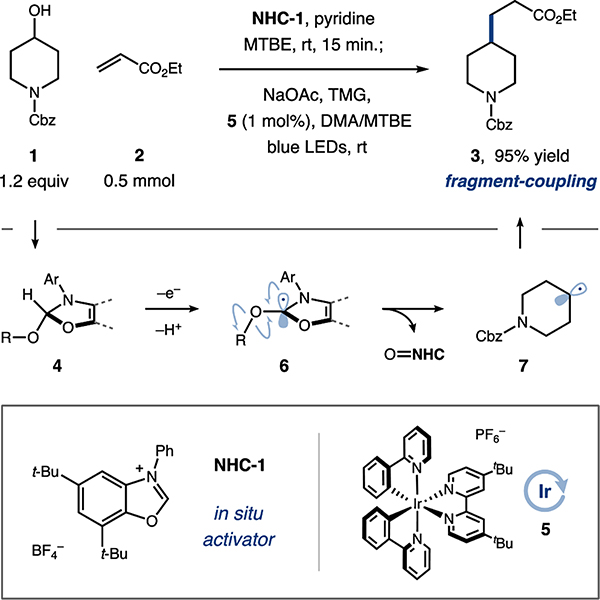
The rapid exploration of sp -enriched chemical space is facilitated by fragment-coupling technologies that utilize simple and abundant alkyl precursors, among which alcohols are a highly desirable, commercially accessible, and synthetically versatile class of substrate. Herein, we describe an operationally convenient, N-heterocyclic carbene (NHC)-mediated deoxygenative Giese-type addition of alcohol-derived alkyl radicals to electron-deficient alkenes under mild photocatalytic conditions. The fragment coupling accommodates a broad range of primary, secondary, and tertiary alcohol partners, as well as structurally varied Michael acceptors containing traditionally reactive sites, such as electrophilic or oxidizable moieties. We demonstrate the late-stage diversification of densely functionalized molecular architectures, including drugs and biomolecules, and we further telescope our protocol with metallaphotoredox cross-coupling for step-economic access to sp -rich complexity.
富电子化学空间的快速探索得益于片段偶联技术,该技术利用简单且丰富的烷基前体,其中醇是一类非常理想的、商业上可获得的、具有综合多功能性的底物。在此,我们描述了一种操作方便的、氮杂环卡宾(NHC)介导的醇衍生的烷基自由基在温和的光催化条件下对缺电子烯烃的去氧 Giese 型加成反应。片段偶联可以容纳广泛的伯、仲和叔醇伙伴,以及结构多样的迈克尔受体,其中含有传统上反应性的位点,如亲电或可氧化的部分。我们展示了高度官能化分子结构的后期多样化,包括药物和生物分子,并且我们进一步用金属光氧化还原交叉偶联来扩展我们的方案,以实现经济有效的 sp 丰富复杂性。